
Rotor Hat Offset
The axial distance positioning a rotor's friction ring relative to the hub mounting face.
- It centers the disc within the caliper
- Wrong offset can cause contact
- Hub cleanliness changes installed runout
Brake fitment is not merely whether a part bolts on. Rotor diameter and offset must center the friction ring in the caliper; thickness must suit piston and pad travel; brackets set radial position; backing plates and abutments control pad movement; hoses must flex without pulling or rubbing.
Vehicle year and model can still contain axle, wheel, brake-package, production-date, drivetrain, payload, electronic-parking, or performance-option splits. A near match can change clearance, balance, heat capacity, sensor operation, parking retention, or hydraulic volume. Fitment therefore needs VIN and build data, measured removed parts, current catalog notes, exact procedures, and controlled verification—not appearance alone.
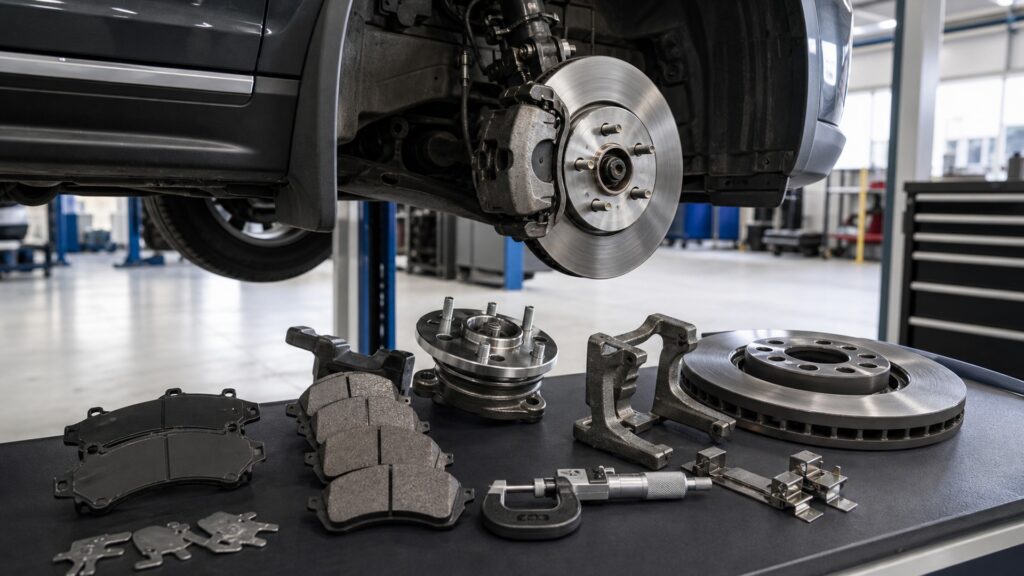
Correct fitment preserves the designed relationship among hydraulic displacement, clamp location, friction area, thermal mass, wheel travel, sensors, and parking mechanisms.
Tip: Do not grind brackets, omit clips, stretch hoses, retract electronic parking actuators without procedure, or substitute friction shapes to make a near-match fit. Those changes can defeat safety margins invisibly.
These dimensions and interfaces explain why catalog fitment must be more precise than visual similarity.
The axial distance positioning a rotor's friction ring relative to the hub mounting face.
The fixed mount locating a sliding caliper and pad assembly at the designed rotor radius.
The shaped steel support carrying friction material and transmitting caliper force through guides and abutments.
The total hydraulic piston area converting line pressure into wheel-end actuation force and fluid displacement.
The specified path allowing a flexible brake hose to follow steering and suspension without tension, twist, abrasion, or tire contact.
A build identifier distinguishing brake package, axle, wheel, suspension, parking, payload, or production equipment within one model.
Tip: Keep the old part for comparison until the new system passes static, leak, clearance, warning, parking, and controlled-road checks.
The rotor must seat flat on the hub, rotate inside the caliper, place its friction faces between pads, and maintain clearance to brackets and shields. Diameter also determines the radius where pad force creates torque.
A disc that mounts can still be axially or radially wrong.
The bracket establishes caliper position; pad ears slide on defined lands; clips manage noise and movement. Rust scale, wrong hardware, thick coatings, damaged guides, or a similar-looking backing plate can bind application or release.
Pad freedom is engineered clearance, not looseness or force-fitting.
Caliper piston count and diameter influence fluid movement and clamp force. Hose threads, seats, banjo thickness, sealing washers, clocking, and bracket position must retain pressure while allowing full suspension and steering travel.
A leak-free garage check is incomplete if movement later stretches the hose.
A smaller or thinner near-fit rotor may shed mass and heat capacity; a different vane, material, or friction sweep can alter cooling and wear. Wheel clearance, dust shields, and airflow must suit the complete assembly.
Thermal fitment matters during repeated stops, not only while parked.
Wear sensors, wheel-speed wiring, electronic parking actuators, drum-in-hat shoes, integrated levers, and brake-control modules may require distinct connectors, procedures, service modes, adjustments, or calibrations.
Mechanical installation can be wrong even when the warning lamp has not yet appeared.
A correct part maintains geometry and interfaces through steering, suspension, pressure, temperature, wear, electronic monitoring, and parking operation.
VIN, build date, option codes, catalog notes, removed-part measurements, markings, and service information all converge on the same rotor, pad, caliper, hose, sensor, and parking configuration.
After installation, the assembly turns freely, clears through full movement, holds pressure without leakage, releases correctly, reports no relevant faults, retains parking function, and passes controlled bedding and stopping checks.
Conflicting dimensions, forced bolts, grinding, omitted hardware, stretched hoses, connector adapters, wrong friction sweep, piston mismatch, wheel contact, uncertain option codes, or unapproved substitutions require correction before use.
Online year-make-model claims, matching photos, shared bolt spacing, or a part that physically enters the space cannot establish balance, thermal duty, sensor compatibility, hydraulic integrity, or legal suitability.
Fitment myths reward bolt alignment and visual similarity while ignoring travel, pressure, heat, control, and wear states.
Bolt spacing checks only one interface. Rotor offset, thickness and diameter, bracket height, piston area, pad sweep, hose routing, sensor provisions, wheel clearance, parking hardware, and thermal rating can still be wrong.
Manufacturers can vary brakes by engine, axle, wheel, payload, performance package, drivetrain, build date, market, or parking system. Decode the exact built vehicle and confirm catalog notes and physical dimensions.
Rotor diameter sets friction radius; thickness and mass support piston position and thermal capacity. An undersized disc can leave pad overhang, change torque, overextend pistons, or overheat despite static clearance.
Thread engagement alone does not verify seat type, length, volume, banjo geometry, clocking, bracket location, pressure rating, or movement. The hose must seal and remain unstressed through full steering and suspension travel.
Tip: Prove the component in every operating dimension it must occupy, not only in the static position where the installer first sees it.
These answers cover VIN lookup, measuring old parts, axle pairs, rotor size, wheel clearance, and verification after installation.
VIN data may not expose every production split, axle, wheel, or optional package. Catalog footnotes can require build date, option label, rotor measurement, caliper casting, pad shape, or dealer build information.
Friction components are commonly serviced across an axle to preserve comparable material and condition, following manufacturer procedure. Calipers, hoses, sensors, and hardware require diagnosis; replacement policy and bedding remain vehicle-specific.
Wheel diameter can narrow possibilities but does not prove rotor, caliper, offset, or package. Different brakes may fit one wheel, and aftermarket wheels change clearance. Use build data, markings, dimensions, and catalog notes.
Record rotor outside diameter, thickness, overall height or offset, hub bore, bolt pattern, pad outline, caliper casting, piston diameter where specified, hose ends, sensor connectors, parking design, and relevant option codes.
Verify fastener torque, wheel torque, free rotation, hose and wire clearance, fluid level, leak-free pressure, pedal reserve, parking operation, warning lamps, actuator calibration, then perform cautious stops and bedding by approved procedure.
Brake-component fitment matters because the part must preserve designed force, friction radius, piston travel, thermal mass, hose movement, wheel clearance, sensing, parking retention, and front-rear control—not merely attach.
Use exact vehicle identity, option codes, catalog notes, removed-part measurements, current procedures, and complete post-installation checks. Any forced adaptation or unresolved mismatch blocks the repair, even if the assembly looks normal while stationary.
Related explainers connect fitment geometry to the brake operating chain, replacement-part application workflow, and the safety consequences that make near-matches unacceptable.
Trace how each fitted dimension participates in command, pressure, friction torque, heat, ABS, and parking retention.
Follow diagnosis, exact application lookup, installation, and functional verification across replacement parts.
Understand the safety and performance consequences of braking as a complete system rather than a collection of wear items.
Choose a retailer
Prices checked regularly. We may earn a commission at no cost to you.