
Field of View
The physical scene visible through a camera and lens at its installed position.
- Width: defines lateral coverage
- Depth: changes target size
- Obstruction: removes visible areas
Video surveillance matters because security events are often ambiguous. A door alarm says a contact changed; a loss report says an item is missing; a safety incident leaves conflicting accounts. Properly designed video can show the relevant person, object, action, direction, and time, helping operators assess an event and investigators reconstruct what occurred.
That value depends on a complete imaging and evidence path. Field of view, target size, lens, mounting angle, illumination, dynamic range, frame rate, exposure, compression, network, storage, time synchronization, search metadata, retention, and export integrity all affect usability. Monitoring and response determine whether live information changes an outcome. Access restrictions, privacy masks, purpose limits, and deletion govern whether collecting the footage is proportionate and defensible.
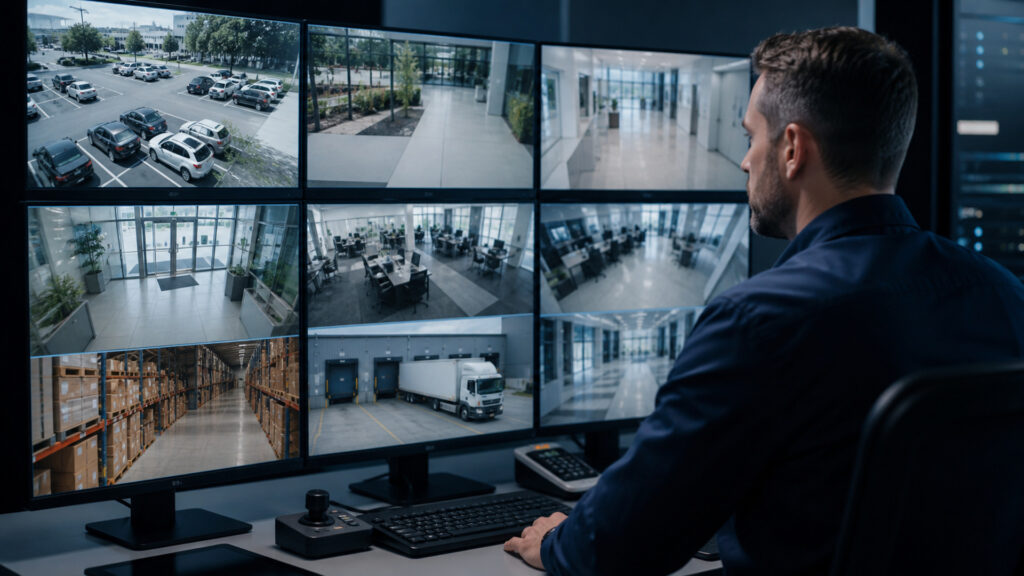
Follow objective, scene, optics, light, encoding, transport, recording, event search, operator assessment, export, privacy, health, and response.
Tip: For each camera, name the event and target, required detail, lighting extremes, obstruction risk, recording mode, retention, search method, viewer, response, export procedure, privacy boundary, and failure alert.
These terms describe scene geometry, imaging performance, recording, event assessment, and evidentiary controls.
The physical scene visible through a camera and lens at its installed position.
The number of image pixels representing a person, object, plate, or feature at a chosen distance.
A camera's ability to preserve useful detail across bright and dark portions of one scene.
A method for encoding image sequences to reduce transport and storage demand.
The period recorded video remains available before deletion or overwrite.
Human or controlled automated assessment of imagery associated with an alarm or reported event.
Tip: Specify whether the objective is detection, observation, recognition, or identification at a particular location and condition; a wide overview and a detailed identification view are different camera jobs.
Entrances, transaction points, aisles, perimeters, vehicle lanes, cash areas, and critical equipment require different target detail and context. Placement controls angle, occlusion, backlighting, tampering, and privacy.
Surveillance matters only when the scene contains the evidence needed for the intended decision.
Lens, sensor, focus, exposure, shutter, infrared, illumination, dynamic range, frame rate, bit rate, and codec convert reflected light into compressed frames. Motion and low light increase encoding difficulty.
Resolution is one input; usable detail emerges from photons, geometry, motion control, and encoding together.
Recorders or cloud services index video by camera and synchronized time. Continuous, scheduled, event-triggered, or hybrid recording changes coverage and storage. Metadata can accelerate search but may miss or misclassify events.
A camera that streamed live but failed to retain searchable footage cannot support a later investigation.
Operators combine imagery with access, intrusion, intercom, sensor, and business context, then follow response rules. Analytics prioritize attention; they do not establish intent or legal conclusions.
Video changes outcomes when timely assessment reaches a capable responder with authority and usable location information.
Viewer roles, audit logs, encryption, privacy masks, export formats, hashes or signatures, custody records, retention, legal holds, and deletion protect both evidentiary value and affected people.
Trust depends on showing what was recorded, who accessed it, how it was handled, and why collection and retention were justified.
Imagery supports detection, assessment, investigation, and evidence only within the scene and operating process.
It supplies timely visual context, deters selected behavior, supports alarm verification, reconstructs events, and preserves reviewable evidence.
Health monitoring exposes recording failures.
They cannot see outside the scene, infer every intention, guarantee identification, physically delay entry, or ensure someone responds.
Privacy costs can exceed value when purpose is vague.
These claims overstate resolution, analytics, retention, and the preventive power of cameras.
Higher pixel count can add detail, but lens quality, target size, light, exposure, motion blur, focus, compression, mounting angle, weather, and storage still govern usability. More pixels across an overly wide scene may remain insufficient.
Visible cameras may deter selected actors, while covert or ignored cameras may not. Prevention also requires barriers, access policy, detection, monitoring, intervention, consequences, and environmental design. Recorded footage often supports assessment after activity begins.
Analytics can prioritize motion, objects, crossings, or patterns but produce missed detections and nuisance events under changing light, weather, crowds, occlusion, and unusual behavior. Human review and measured performance remain necessary.
Footage can have wrong time, missing frames, undocumented exports, excessive compression, lost metadata, broad access, or broken custody. Evidentiary trust requires system health, controlled collection, integrity, documented handling, and appropriate interpretation.
Tip: Review surveillance as an evidence chain: objective, scene, light, target detail, recording, synchronized time, search, assessment, export, custody, retention, privacy, and response.
These questions explain retention, resolution, lighting, analytics, health, and exports.
Set retention from security purpose, incident discovery time, legal obligations, privacy, storage risk, insurer requirements, and investigation needs. Longer is not automatically better; preserve incident holds separately and delete routine footage predictably.
Determine required target detail at the critical distance, then account for lens, field of view, light, motion, angle, compression, and display. A purpose-specific scene test is more reliable than a megapixel number.
Continuous recording reduces dependence on event detection but uses more storage and bandwidth. Motion recording can extend retention yet miss subtle or poorly classified activity. Hybrid policies should preserve pre-event context and be tested.
Monitor camera heartbeat, stream status, storage writes, retention, clock, focus, obstruction, tamper, image quality, network, and recorder health. Add periodic visual review and retrieval tests rather than relying only on device connectivity.
Preserve relevant native footage, timestamps, camera identity, metadata, player or documented format, export logs, integrity information, incident context, access restrictions, and custody history. Create convenient viewing copies without replacing the controlled original.
Video surveillance matters when it captures the right target and context, retains usable footage, lets operators verify events, and preserves trustworthy evidence. Camera count and resolution alone cannot produce those results.
Effective surveillance connects scene engineering, light, encoding, storage, search, response, privacy, health monitoring, and custody. Its purpose is reduced uncertainty and supported action—not universal identification or automatic prevention.
These explainers place video inside physical response and compare the cloud, local, wired, and wireless recording paths that affect evidence availability.
See how barriers, access, intrusion, video, alarms, monitoring, response, and evidence operate together.
Understand identities, credentials, readers, controllers, locks, schedules, logs, and revocation.
Compare recording location, bandwidth, retention, administration, security, failure behavior, and cost.
Choose a retailer
Prices checked regularly. We may earn a commission at no cost to you.