
Floor Liner
A formed removable barrier shaped to cover part of a vehicle footwell.
- Raised edges can contain liquid
- Rigid shape affects pedal clearance
- Fit is vehicle-position specific
Floor protection matters because shoes introduce abrasive grit, moisture, road salt, mud, oils, and debris exactly where repeated foot movement grinds them into carpet. A suitable mat or liner intercepts that load, contains it long enough for removal, and provides a replaceable wear surface that is easier to clean than the molded cabin floor.
The driver's position makes protection a safety component as well as a cleaning product. An incompatible, unsecured, curled, or stacked mat can enter the accelerator or brake path. Effective protection matches the footwell, engages every intended retainer, stays flat through temperature cycles, preserves full pedal travel and return, and is removed for emptying, washing, and complete drying.
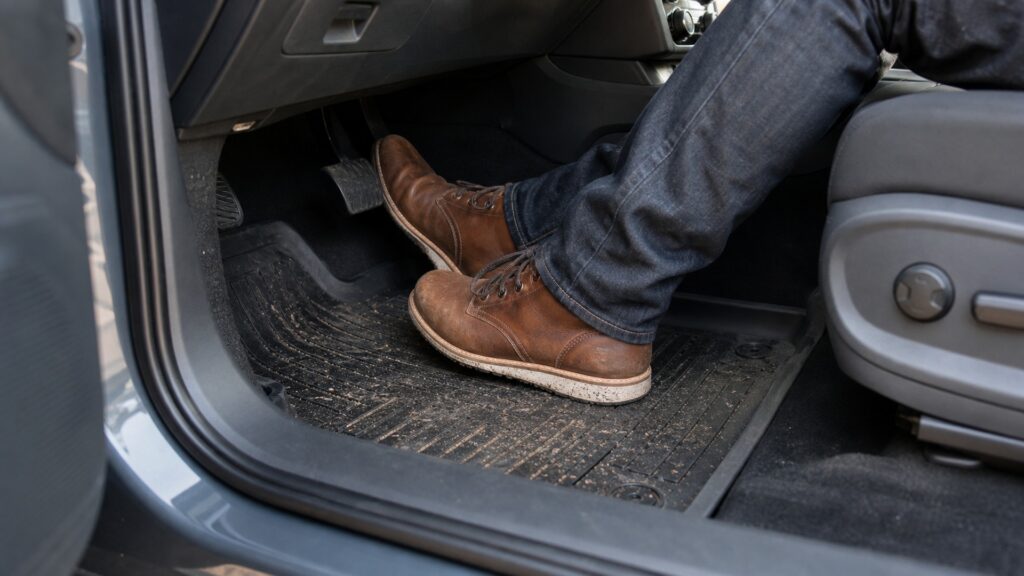
Floor protection succeeds by receiving particles and liquid, limiting their movement, staying outside control paths, and releasing the collected material during maintenance.
Tip: After installing the driver's mat, press each pedal fully through its path with the vehicle secured and off, then confirm the mat cannot shift forward, bunch, or delay pedal return.
These terms connect cleanliness performance with the geometry that keeps a driver-side product safe.
A formed removable barrier shaped to cover part of a vehicle footwell.
A textile-faced removable layer intended to receive dry soil and modest moisture.
A vehicle or mat feature designed to locate and resist movement of the floor covering.
The free space required for complete pedal movement and unrestricted return.
The capacity to hold tracked or spilled liquid until the liner can be removed.
Liquid movement through fibers or along material interfaces beyond the original wet area.
Tip: Never solve poor fit with stacking, trimming around a pedal casually, or improvising retainers; replace the product with one documented for the footwell.
Hard particles cut and crush fibers under shoes, while water carries dissolved salt and soil into backing and seams. Repeated wetting can create odor, staining, and hidden dampness; aggressive cleaning later can leave residues or over-wet underlying material.
The removable barrier preserves the original floor by taking both the abrasion and the cleaning cycle.
Ridges elevate shoes above collected liquid, channels guide runoff away from contact zones, and raised edges delay escape into carpet. Textile pile captures fine dry particles but can hold moisture; elastomer surfaces release liquid more readily during washing.
A deep-looking pattern is useful only if it contains the actual load without distorting the foot position.
Friction backing resists small motion, molded contour resists rotation, and factory-compatible anchors oppose forward migration. None is sufficient when the mat is on top of another layer, the retainer is broken, or the product is assigned to the wrong vehicle or side.
Retention must be positive enough to preserve pedal clearance after repeated entry, braking, and temperature change.
NHTSA investigations and recalls document accelerator entrapment involving incompatible or unsecured mats. A front edge can ride under or over a pedal, while thickness can reduce space. Braking and accelerator return must remain unobstructed through the full range.
A clean carpet is never worth introducing uncertainty into accelerator or brake operation.
Vacuuming removes particles before they abrade during scrubbing. Washing chemistry should suit the material, and both mat and carpet need complete drying. Reinstallation ends with anchor engagement, pedal testing, and a visual check beneath the pedals.
Maintenance is complete only after the product returns to the correct position and cannot enter the controls.
Floor protection can preserve carpet and simplify cleaning only when it remains contained outside every pedal path.
A well-fitted barrier receives abrasion, captures soil, contains manageable liquid, and can be removed for more controlled cleaning.
Regular lifting exposes hidden moisture, failed retainers, floor corrosion risks, or contamination before damage spreads unseen.
An incompatible, stacked, unsecured, warped, or incorrectly reinstalled driver's mat can interfere with accelerator, brake, or clutch operation.
No channel pattern eliminates the need to empty standing liquid, dry saturated materials, clean underneath, and inspect the product for distortion.
These myths reward coverage and thickness while ignoring control clearance and moisture management.
Stacking raises the surface, prevents the lower layer's anchors from securing the upper mat, and increases movement near the pedals. Remove the existing removable mat and install one compatible product as directed.
Mass adds friction but does not replace shape or retainers. Braking forces, shoe movement, curled edges, water, incompatible contours, and temperature changes can still drive a heavy mat toward the pedal assembly.
Every liner has finite capacity, and vehicle acceleration, grades, removal angle, fastener openings, deformation, or an overflowing channel can release liquid. Empty it before the collected material approaches the containment boundary.
Moisture can wick around edges, pass through holes, remain beneath a saturated textile mat, or enter from another leak. Lift the protection and inspect the carpet, padding, seams, and nearby trim directly.
Tip: A floor product is successful only when it contains contamination and remains mechanically absent from driving controls.
These answers address pedal checks, climate choice, cleaning, wet carpet, and replacement timing.
Secure the vehicle, switch it off, position the seat normally, engage every retainer, and press each pedal fully while observing clearance and return. Pull the mat in all directions and repeat afterward.
No. Formed elastomer liners generally contain liquid more effectively, while carpet mats can capture dry grit and match cabin feel. Climate, load, cleanability, exact fit, retention, and pedal clearance decide suitability.
Vacuum dry material first, use compatible diluted cleaning steps rather than flooding, extract or blot residue, rinse only as the material permits, and dry fully. Inspect underneath because dissolved salt can travel beyond visible staining.
Remove the mat, locate whether the source is tracking, a spill, drain, seal, heater, or body leak, and dry the carpet and padding. Persistent moisture or odor warrants deeper inspection and repair.
Replace it when retainers no longer hold, edges curl, shape changes, backing fails, holes expose carpet, the surface becomes unsafe, contamination cannot be removed, or any part approaches a pedal path.
Floor protection matters because a removable, cleanable barrier can intercept abrasion, moisture, salt, and debris before they become embedded damage.
Its benefit exists only when exact fit, intact retainers, one-layer installation, full pedal clearance, controlled cleaning, complete drying, and repeated inspection are maintained.
Continue with the fit comparison and broader interior workflow to decide how much coverage, containment, and installation control the vehicle needs.
Compare vehicle-specific floor geometry and anchors with trim-to-fit or size-based universal products.
Place floor protection inside the larger cabin system of controls, restraints, materials, power, and crash retention.
Use material-aware cleaning, contamination removal, drying, and runoff practices when maintaining mats and the underlying carpet.
Choose a retailer
Prices checked regularly. We may earn a commission at no cost to you.