
Traction battery
The traction battery stores energy for propulsion in interconnected cells managed as a pack.
- Example: energy available for the next journey
- Check: usable capacity and charge state
- Limit: it is not the same as the auxiliary battery
A battery-electric car stores energy in a traction battery and uses controlled electrical power to turn one or more drive motors. The motors turn the wheels through a drivetrain, while charging equipment replenishes the battery when the car is parked. There is no combustion engine burning fuel to provide propulsion.
Several supporting systems make that simple idea practical. Power electronics regulate motor output, temperature control manages operating conditions, and a lower-voltage system supplies accessories and controls. During deceleration, the drive system can return some motion energy to the battery. Understanding these separate jobs explains both the smooth driving experience and the limits of range and charging.
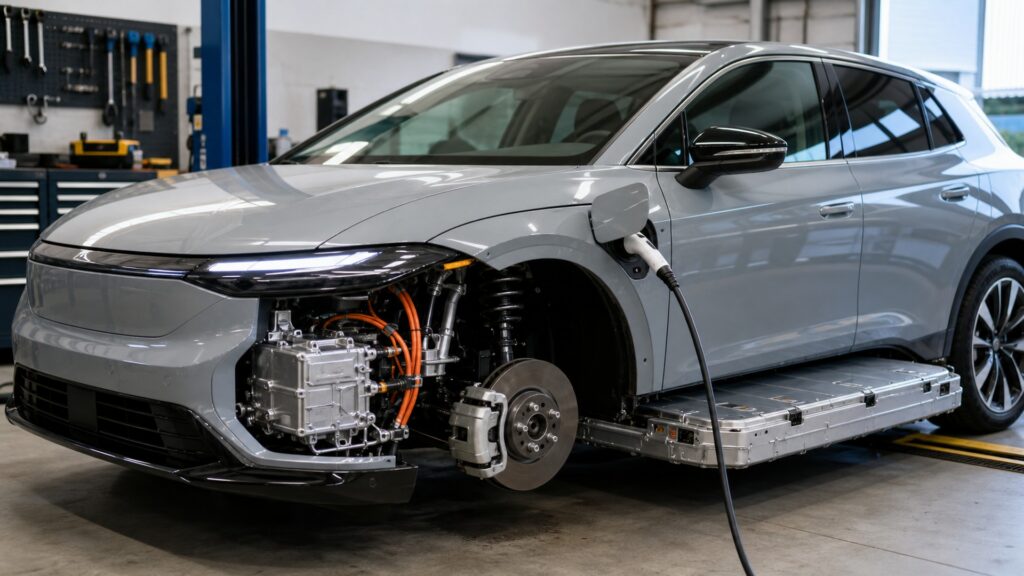
Connect storage, control, motion, recovery, and recharging.
Tip: This explanation concerns battery-electric cars; hybrids also contain a combustion engine and work differently.
Each component performs a distinct job in the energy path.
The traction battery stores energy for propulsion in interconnected cells managed as a pack.
The inverter and associated electronics regulate electrical delivery between the battery and drive motor.
The drive motor converts electrical energy into mechanical rotation.
Reduction gearing matches motor speed and torque to the driven wheels.
The onboard AC charger converts incoming alternating-current electricity into direct current for the battery.
The DC-DC converter supplies a lower-voltage electrical system from the higher-voltage battery system.
Tip: Storage capacity, motor power, and charging power describe different capabilities.
The traction pack contains cells and systems that monitor and manage their operation. The driver sees a charge percentage and usually an estimated remaining distance, but available distance depends on consumption. A larger energy store may support a longer journey, yet vehicle efficiency and conditions still matter.
The battery is an energy source within a controlled system, not an invitation to access or modify high-voltage components.
Pressing the accelerator requests output. Control electronics manage power delivery to the motor, which produces rotation and torque. Gearing and other drivetrain components transfer that motion to the wheels. Many EVs use a fixed reduction ratio, although designs vary. This arrangement can deliver smooth acceleration without the familiar sequence of engine gear changes.
DOE's component overview distinguishes the battery, power controller, motor, and transmission rather than treating them as one device. DOE: electric-car components.
During suitable deceleration, the electric drive system can act as a generator. Recovered energy returns through the electrical system to the battery, reducing some of the energy otherwise lost as heat. Recovery is incomplete and may be limited by battery state, temperature, traction, or the vehicle's control strategy. Friction brakes remain part of the car.
Chevrolet's guidance for its regenerative feature describes battery-condition limits and retains the normal brakes as essential controls. Chevrolet: regenerative-braking operation.
The car uses energy for cabin comfort, controls, lights, and temperature management as well as propulsion. The thermal system helps components remain within their operating range. The lower-voltage system serves functions distinct from the traction drive. These supporting loads help explain why the same route can use different amounts of energy in different weather.
A range change does not necessarily mean the battery suddenly lost capacity; it may reflect a different demand on the available energy.
With AC charging, the car's onboard charger converts the supply to DC for the battery. At a compatible DC fast charger, that conversion takes place in the external equipment, and the car manages the accepted DC supply. The battery-management system still sets limits. Charging power can change during a session, so the equipment's peak rating is not a guaranteed constant rate.
DOE's charging guide explains how vehicle and equipment capabilities, battery state, and other conditions affect charging time. DOE: charging equipment and rates.
Avoid comparing unlike measures.
Kilowatt-hours describe an amount of energy; consumption measures the energy used over a distance.
Together they help explain range, subject to conditions and usable capacity.
Kilowatts describe the rate of energy transfer or output. Motor and charging power have different roles.
A peak figure does not mean the same output continues under all conditions.
Keep the energy path and its limits clear.
Only some motion energy is recovered. Driving still consumes energy and external charging is required.
Mechanical components still transfer motor output to the wheels, often through reduction gearing.
The vehicle, connection, equipment, and battery conditions determine the accepted rate.
Tip: Understand where energy is stored, where it is converted, and where it is used.
Answers about motors, batteries, and charging.
No. It supplies electrical energy; motor and drivetrain components convert and transmit that energy as wheel motion.
Lower-voltage functions have their own electrical needs, supported by the vehicle's low-voltage system and DC-DC conversion.
No. Learn the vehicle's modes and limits and remain ready to use normal braking.
Compatible DC equipment can supply power through a different charging path, but actual speed depends on the vehicle, station, and battery conditions.
A battery-electric car combines stored energy, controlled motor output, mechanical drive, and managed charging.
Its supporting electrical and thermal systems make those functions usable, while consumption and operating limits determine the real journey.
Use these Review Streets paths to compare related categories and practical next decisions.
Separate electric propulsion from coupe body design.
Check EV parts, equipment, and installation compatibility.
Assess when a gasoline coupe fits your routine.
Choose a retailer
Prices checked regularly. We may earn a commission at no cost to you.