
Filter Media
A structured porous material that intercepts particles as air or liquid moves through its fibers and passages.
- Fiber structure sets capture behavior
- Pleats expand usable area
- Supports resist collapse
Engine filters work by sending an operating fluid through porous media that captures particles while the cleaned air, oil, or fuel continues toward sensitive components. Fiber size, depth, surface area, pleating, supports, adhesives, seals, and housing geometry determine which contaminants are retained and how much resistance the flow encounters.
The balance differs by circuit. An air filter protects cylinders and turbo machinery from dust; a full-flow oil filter cleans lubricant without starving bearings; a fuel filter protects pumps and injectors and may separate water. As loading increases, pressure drop rises. Correctly calibrated bypasses, restriction limits, service intervals, and careful installation preserve flow without surrendering the clean-side seal.
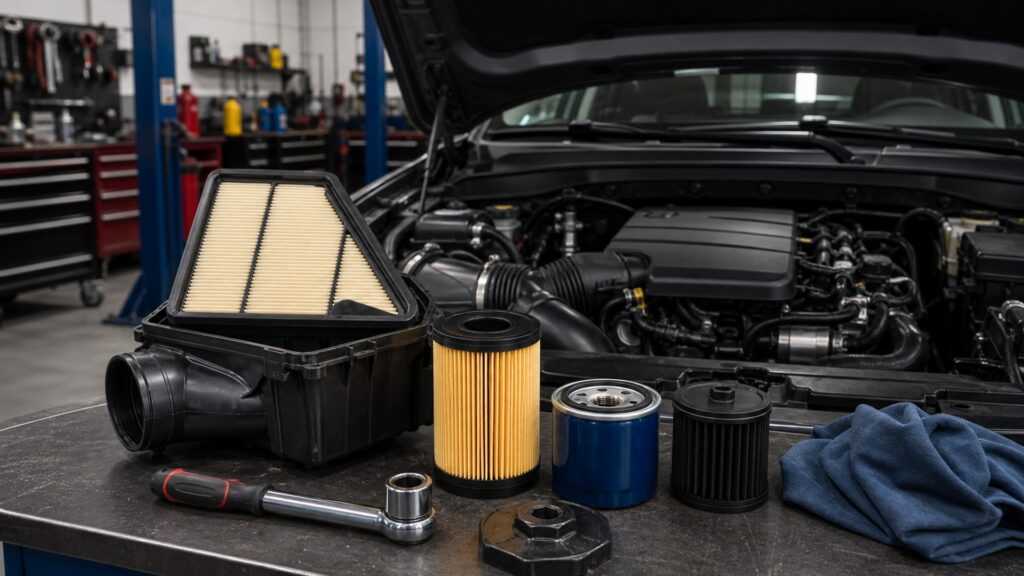
A filter succeeds only when fluid crosses suitable media, captured material stays contained, seals prevent bypass leakage, and the circuit retains required flow under its hardest normal condition.
Tip: Never wipe or drop debris into an exposed intake, oil gallery, or fuel outlet; one careless filter change can place contamination downstream of the protection being renewed.
These terms describe the trade among contaminant capture, usable flow, service life, and sealed installation.
A structured porous material that intercepts particles as air or liquid moves through its fibers and passages.
The fraction of a defined contaminant size or distribution removed under a stated test procedure.
The mass of contaminant retained before a specified terminal restriction or other test endpoint is reached.
The loss in fluid pressure across media, seals, and passages at a particular flow and condition.
A calibrated route that permits oil flow around restrictive media when pressure differential reaches its design threshold.
The downstream space after filtration that should remain protected from unfiltered fluid and service debris.
Tip: Efficiency and restriction must be read at stated test conditions; a finer-sounding claim without flow, capacity, and application context is incomplete.
Engine suction draws atmospheric air through a housing and pleated element. Dust embeds in media while the gasket prevents air from taking a shorter unfiltered route toward the mass-air sensor, compressor, valves, rings, and cylinders.
The best media cannot protect an engine when the airbox leaks around it.
The pump sends nearly all regulated oil flow through the filter. Media captures wear debris and soot, while anti-drainback and bypass features may manage restart drainback or excessive differential pressure according to the engine design.
Lubrication flow takes priority when dense oil or loaded media would otherwise starve critical surfaces.
Fuel media removes fine contamination before high-pressure equipment; some diesel systems coalesce or separate water into a drainable chamber. Housing seals must withstand fuel chemistry and system pressure without admitting air.
Clean fuel delivery requires both contaminant control and an airtight, pressure-capable installation.
As particles accumulate, some media captures finer debris more effectively, yet restriction rises. Service timing therefore follows the manufacturer's interval, condition, or restriction endpoint instead of color alone or constant early replacement.
A visibly used filter may still function; a damaged seal can fail while the media looks clean.
Wrong dimensions, doubled gaskets, twisted seals, loose housings, crushed pleats, overtightening, or debris on the clean side create failures that media specifications cannot correct. Final checks depend on the circuit.
Filter performance begins after a correct, contamination-free installation—not when the carton is opened.
Useful filtration removes damaging material, stores it securely, limits resistance, preserves required flow, and prevents fluid from bypassing the seal.
The correct element is fully sealed, pressure or restriction remains within limits, no leaks or warning conditions appear, and downstream components receive clean fluid at the required rate.
Service timing follows exact schedules, severe-duty guidance, measured endpoints, contamination events, and installation records rather than media color or a universal mileage claim.
A new filter cannot repair a weak pump, damaged sensor, leaking duct, worn engine, contaminated tank, incorrect lubricant, injector fault, or misdiagnosed warning code.
Media cannot protect the engine when debris is introduced downstream, a seal is displaced, the housing is damaged, the part has wrong bypass calibration, or operation exceeds circuit limits.
Filter myths usually maximize one attribute—fineness, airflow, or replacement frequency—without considering the circuit's complete operating envelope.
Higher efficiency can be valuable, but media must also pass required flow, retain enough contaminant, survive pressure and temperature, fit the housing, and match any bypass calibration. A single particle-size claim cannot establish suitability.
Color does not directly measure terminal restriction or remaining capacity. Follow the vehicle schedule and severe-duty guidance, or a specified restriction indicator where provided, while replacing any torn, wet, distorted, or poorly sealed element.
Excess handling can damage media, disturb seals, or introduce clean-side debris. Early service also discards unused capacity. Replace at the documented interval or condition endpoint and whenever damage or contamination exposure requires it.
A calibrated bypass can protect oil supply during cold starts or excessive differential pressure. Persistent bypass still needs diagnosis because wrong viscosity, incorrect filters, severe loading, or circuit faults can keep lubricant unfiltered.
Tip: Judge the exact element as a matched combination of capture, capacity, restriction, sealing, structure, valves, chemistry, and service procedure.
These answers cover filter types, service timing, media claims, bypass behavior, and verification after installation.
No. Intake filters target airborne dust, oil filters manage wear debris and combustion byproducts, and fuel filters protect delivery equipment from particles and sometimes water. Media, test methods, pressure, chemistry, and service differ.
Captured material occupies passages within and on the media, increasing resistance at a given flow. Air demand, liquid viscosity, temperature, media area, contaminant type, and loading pattern determine how quickly the endpoint arrives.
Replacing a genuinely restrictive element can restore lost flow, but a clean original system may already meet engine demand. Claims require measured restriction, airflow, calibration, and repeatable performance data for the exact vehicle.
Confirm the old gasket was removed, the new seal and filter are correct, oil quantity meets procedure, pressure builds normally, and no leak appears during operation or after shutdown. Recheck level as instructed.
Particles placed downstream during service bypass the media completely and can reach sensors, turbochargers, bearings, pumps, or injectors. Cover openings, clean housings carefully, use clean tools, and avoid striking dirty elements against outlets.
Engine filters protect air, oil, and fuel circuits by capturing contaminants while preserving the flow each circuit needs.
Their real performance comes from matched media, capacity, restriction, structure, seals, valves, fitment, and clean service. Follow exact intervals or measured endpoints, then verify pressure, sealing, leakage, and engine operation.
Related explainers connect filter mechanics to exact fitment, engine-system consequences, and the diagnosis-to-verification workflow for replacement parts.
Match dimensions, seals, threads, valves, media, and housing interfaces before relying on a filter specification.
Place clean air, pressurized oil, and conditioned fuel within the engine's combustion, lubrication, and control functions.
Use diagnosis, application control, installation procedure, and post-repair verification for any replacement component.
Choose a retailer
Prices checked regularly. We may earn a commission at no cost to you.