
Compression Sealing
Containment of compression pressure by rings, valves, head gasket, and chamber surfaces.
- Leakage reduces useful pressure
- Heat changes clearances
- Tests must consider valve timing
Engine components matter because combustion torque is the result of a sealed, timed, lubricated, cooled, and electronically controlled sequence. Cylinders must trap and compress the intended charge, fuel and ignition must arrive at the right moment, moving surfaces need an oil film, and cooling must keep metals and fluids within workable temperatures.
A fault in one path can damage another. An injector can wash oil from a cylinder, low oil pressure can ruin bearings, overheating can distort sealing surfaces, and incorrect timing can reduce compression or cause mechanical contact. Effective diagnosis follows evidence—codes, pressure, waveform, fluid, temperature, leakage, and noise—before selecting parts. Repair completion requires restored measurements, emissions control, and repeatable behavior under the original load.
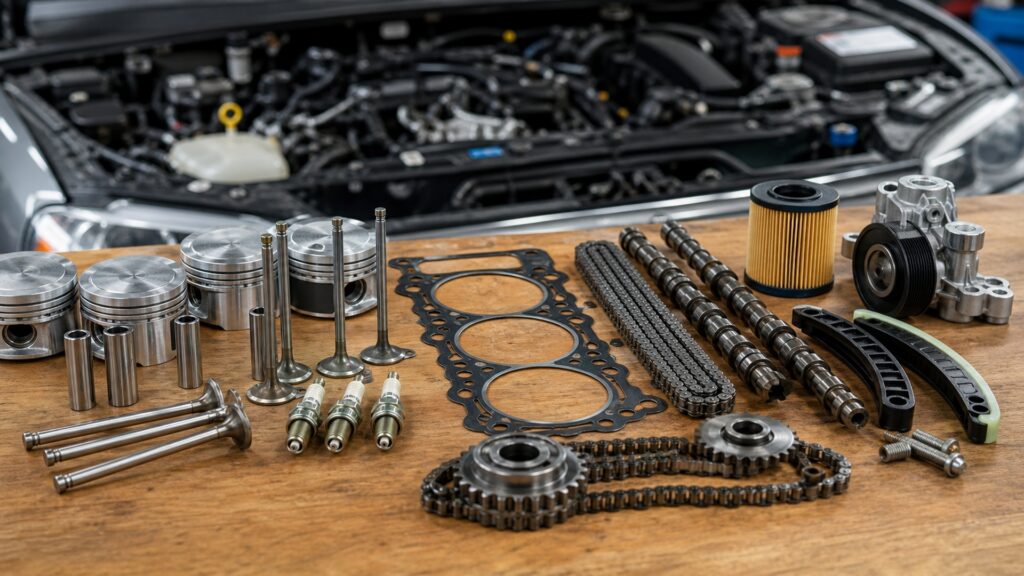
The engine produces dependable torque only when mechanical sealing, valve events, metering, ignition, lubrication, cooling, sensing, and exhaust treatment remain synchronized.
Tip: Before replacing a code-named component, write the expected signal or mechanical measurement and test power, ground, wiring, air leaks, pressure, and timing conditions that could create the same report.
These concepts define the engine's sealing, timing, fluid, and control boundaries.
Containment of compression pressure by rings, valves, head gasket, and chamber surfaces.
Relationship between crankshaft position and intake or exhaust valve events.
Control of air mass and delivered fuel for the operating condition.
Pressurized lubricant separating moving surfaces and carrying heat or debris.
Coolant, passages, pump, thermostat, radiator, fans, and controls moving waste heat.
Engine control module adjustment using sensors to compare commanded and measured engine behavior.
Tip: Treat the engine as coupled pressure, motion, fluid, and feedback loops; a symptom rarely respects catalog categories.
During intake, compression, power, and exhaust strokes, valve events establish the charge, compression raises pressure, controlled ignition releases energy, and the piston transmits force through the connecting rod to the crankshaft.
Useful torque begins with a sealed and correctly timed pressure event.
The engine control module estimates load, controls air-fuel ratio and spark timing, and uses oxygen and other sensors to correct operation. Vacuum leaks, weak delivery, injector faults, sensor bias, or exhaust restriction can create similar drivability symptoms through different mechanisms.
A trouble code identifies a detected condition, not an automatic parts order.
The pump supplies flow through galleries to bearings, camshafts, timing hardware, piston cooling, and variable mechanisms. Pressure emerges from flow resistance and clearances; a gauge reading alone does not prove adequate cleanliness or delivery everywhere.
Lubrication failure can turn a small control problem into irreversible mechanical wear.
Combustion heat moves through metal into coolant and oil, then to the radiator and air. Low coolant, trapped gas, pump loss, thermostat faults, blocked airflow, or combustion leakage can produce local overheating before a dashboard gauge tells the full story.
Temperature control preserves clearances, sealing, lubricant, and knock margin together.
A completed repair should reproduce normal starting, idle, load response, temperature, pressure, fuel correction, emissions monitoring, and absence of leaks or abnormal noise. Readiness monitors and a condition-specific road test may require time beyond clearing codes.
Clearing a warning is not proof that the causal chain has been repaired.
Engine systems can be measured and repaired, but heat, fluids, timing, and controls allow one fault to propagate quickly.
Sealing, timing, metering, ignition, lubrication, and cooling together produce repeatable torque, efficient operation, manageable emissions, and durable loaded surfaces.
Systematic measurement can separate electrical, fluid, combustion, and mechanical causes before expensive disassembly or component replacement.
A replacement sensor cannot correct low compression, unmetered air, wiring resistance, fuel pressure, exhaust restriction, or incorrect mechanical timing that distorted its readings.
Severe overheating, oil starvation, contamination, or debris can damage multiple interfaces, making a narrow repair unreliable without inspecting the entire affected path.
Engine myths turn maintenance, diagnostic codes, and one familiar measurement into universal answers.
A code reports a condition recognized by control logic. Wiring, power, ground, leaks, mechanical timing, pressure, contamination, or another component can produce the same result, so the circuit and system require testing.
Pump wear is one possibility, but oil level, viscosity, dilution, pickup leakage, restriction, bearing clearance, relief-valve behavior, temperature, and sender accuracy can alter pressure. Confirm with the specified mechanical test.
A thermostat can fail, yet coolant loss, trapped air, radiator restriction, fan control, pump damage, head-gasket leakage, incorrect mixture, or load can overheat an engine. Temperature distribution and pressure evidence matter.
Octane indicates resistance to knock, not energy content or guaranteed output. Engines designed to adapt ignition may benefit under certain conditions; others gain little. Use the manufacturer-required or recommended fuel.
Tip: Use load-specific data and understand how pressure, timing, fluids, heat, and feedback interact before declaring a component failed.
These questions cover compression, timing systems, oil consumption, overheating, and the evidence needed before major repair.
It compares a cylinder's ability to build pressure during cranking or running, depending on method. Results reflect sealing and valve timing together; a leak-down test and waveform or mechanical inspection can further locate the loss.
Follow the vehicle maker's interval, inspection criteria, and component-specific evidence. Belts may have age or mileage schedules; chain systems depend on wear, tension, lubrication, codes, noise, and measured timing rather than one universal interval.
No. Leaks, crankcase ventilation, valve guides or seals, turbocharger bearings, cylinder condition, oil specification, operating pattern, and measurement method can contribute. Quantify consumption and inspect paths before internal repair begins.
Continuing can compound damage. Reduce load, stop safely, and follow the owner's manual; never open a hot pressurized cooling system. Determine coolant loss, temperature behavior, and possible mechanical damage before returning to service.
Use confirmed diagnosis, compression or leakage, oil pressure, contamination, cooling-system integrity, timing condition, bore or bearing evidence where accessible, repair scope, parts support, warranty, and the condition of the remaining vehicle.
Engine components matter because cylinder pressure, valve timing, metering, ignition, lubrication, cooling, sensing, and exhaust treatment must remain synchronized to create reliable torque.
Measure the causal path before buying parts, inspect secondary damage when fluids or heat fail, and verify operation under the original load rather than declaring success when a code disappears.
Use the full vehicle and reliability frameworks to translate engine measurements into repair scope, future service, and a defensible ownership decision.
Apply engine condition, repair scope, warranty, downtime, and remaining-vehicle evidence to the keep-or-replace decision.
Place combustion torque inside the transmission, driveline, tires, braking, steering, and electronic-control chain.
Assess whether engine faults are isolated, recurring, predictable, and recoverable in normal ownership.
Choose a retailer
Prices checked regularly. We may earn a commission at no cost to you.