
Wear Layer
The exposed material that receives repeated shoe contact, sliding, pressure, abrasion, and chemical contamination before the cabin carpet does.
- Texture changes traction
- Thickness spreads load
- Damage reveals service life
Vehicle floor protection is a sacrificial interface between shoes, cargo, cabin carpet, and the shaped floor pan. It receives concentrated heel loads, abrasive grit, water, road salt, mud, oils, and temperature swings before those stresses reach harder-to-clean interior materials. Ribs, channels, raised edges, and absorbent fibers manage different contaminants rather than providing one universal barrier.
Protection works only while the covering stays where the vehicle designer intended. Retention points, backing friction, contour, stiffness, and edge shape resist migration under repeated foot motion. The driver area adds a critical boundary: the mat must remain outside the full pedal envelope. Removal, cleaning, drying, and reinstallation complete the mechanism by safely taking captured material out of the cabin.
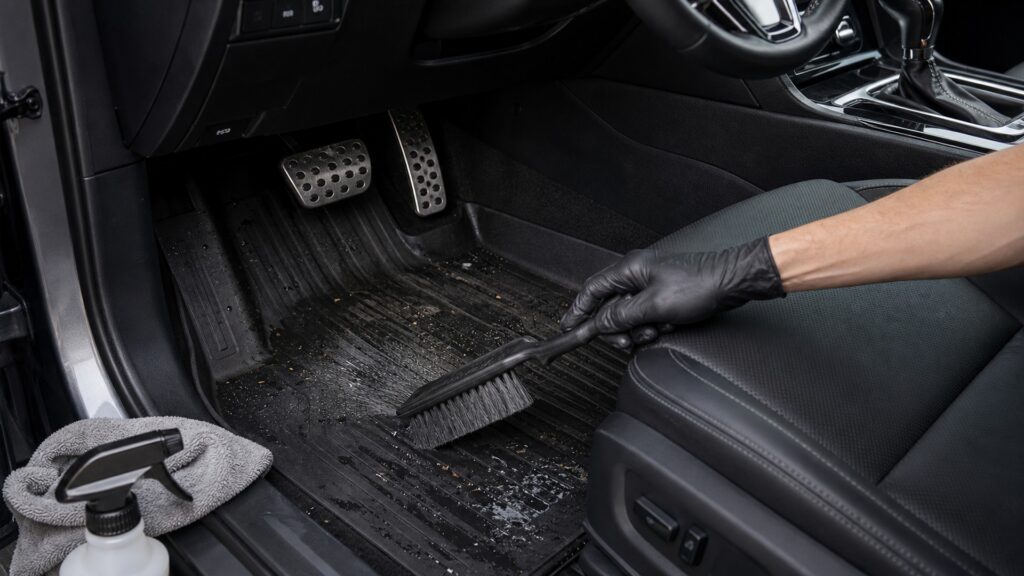
The mechanism connects surface wear, solid capture, liquid routing, positional control, vehicle clearance, and maintenance.
Tip: A floor liner protects only while it captures material, remains secured, and leaves every control and moving interior part unobstructed.
These terms describe the physical jobs performed between footwear and the vehicle floor.
The exposed material that receives repeated shoe contact, sliding, pressure, abrasion, and chemical contamination before the cabin carpet does.
A molded rib or raised boundary that redirects water and suspended debris toward a contained low area.
A vehicle-specific hook, post, clip, grommet, or lock that restrains movement at a defined location.
A locally reinforced region beneath frequent driver foot contact intended to resist concentrated wear and deformation.
Resistance to sliding between footwear and the top surface or between the protector and underlying carpet.
The bounded volume where channels and raised edges hold liquid away from carpet until controlled removal.
Tip: Evaluate load, containment, movement, and cleanout separately.
Footwear concentrates force at heels and pivots during pedal transitions. A durable surface and correctly placed reinforcement distribute that contact, while embedded grit must be removed before it acts like abrasive paper.
The top surface preserves the cabin by accepting damage in a replaceable component.
Grooves, fibers, and depressions give sand, crumbs, and dried mud somewhere to settle. Capacity depends on geometry; once filled, particles return to shoes, controls, carpet, and cabin air.
Capture works by separating loose solids from repeated foot movement.
Melted snow, rain, salt solution, and spills move under gravity, braking, cornering, and removal. Wall height, corner shape, material stiffness, and vehicle contour determine whether liquid remains contained.
Containment delays contact with carpet; it does not make trapped liquid disappear.
Repeated entry and foot motion push coverings forward and sideways. Correct retention, floor matching, stable edges, and suitable material stiffness keep the protector flat and outside pedals, seat tracks, vents, and trim.
Position is a functional requirement because a displaced mat can enter a control path.
Take the protector out without tipping contents onto carpet, clean it with material-compatible methods, inspect backing and anchors, dry it fully, clean the exposed floor, and reinstall it in the correct position.
Maintenance closes the protection cycle by exporting contamination instead of redistributing it.
A large mat can cover carpet yet fail through movement, shallow edges, trapped moisture, poor cleanout, or interference with pedals, seats, vents, and trim.
Wear appears on the replaceable surface while underlying carpet remains dry, clean, and undamaged.
The covering remains anchored and flat through entry, driving, removal, cleaning, and reinstallation.
Finite walls can overflow, absorbent materials can saturate, and liquid can spill during removal.
A floor protector cannot repair existing corrosion, mold, torn carpet, damaged anchors, or water entering elsewhere.
These myths confuse material toughness or visual coverage with complete contamination and movement control.
Mass may resist small disturbances, but repeated shoe force, curled edges, incompatible contours, missing anchors, and slick backing can still shift it. Positive retention and vehicle-specific geometry matter more than weight by itself.
Liquid can pass over low edges, escape at cutouts, spill during removal, enter from another leak, or remain trapped beneath the covering. Containment geometry, capacity, handling, and periodic under-mat inspection determine the result.
Layering can prevent proper anchor engagement, raise the surface into the pedal envelope, create sliding interfaces, and hide moisture. Use one compatible driver-side covering installed directly against the intended floor and retention system.
Grit can collect in recesses, water can remain beneath the protector, and debris can migrate around edges or through damaged attachment openings. Remove the covering periodically and inspect both its underside and the carpet.
Tip: Judge each layer by its load, containment, retention, and cleanout function.
These answers explain material choice, driver-side safety, liquid capacity, removal, and replacement evidence.
Choose by contaminant, climate, cleaning method, noise preference, flexibility, odor sensitivity, expected wear, edge geometry, and vehicle fit. Rubber-like liners emphasize liquid handling, while textile constructions may favor appearance and dry-debris capture.
They resist forward and rotational movement under repeated foot motion, helping keep the covering outside the accelerator, brake, clutch, footrest, and seat-track areas. Engage every intended anchor and replace damaged hardware.
Capacity depends on reservoir depth, area, wall stiffness, vehicle angle, acceleration, and removal technique. Empty it before liquid approaches the edges, then lift the liner level so captured water does not spill onto carpet.
Confirm the surface and backing are dry, edges remain flat, channels are open, anchors and grommets are intact, no residue makes either face slippery, underlying carpet is dry, and the protector reinstalls without movement.
Replace it when cracks leak, edges curl, channels collapse, heel wear creates a catch point, backing loses stability, retention features tear, contamination cannot be removed, odor persists, or correct pedal and seat clearance is lost.
Floor protection works by accepting wear, separating grit from foot contact, containing liquid temporarily, resisting migration, and carrying collected contamination out during maintenance. Those jobs depend on both material and vehicle-specific geometry.
Use one correctly retained covering in the driver footwell, respect its finite capacity, inspect beneath it, and verify full pedal travel after every reinstallation. Protection fails when captured material or the protector itself enters another vehicle system.
These explainers apply the load, containment, retention, and clearance model to a specific vehicle and cabin.
Check contour, anchors, pedal envelope, seat tracks, trim, vents, and removal clearance on the exact vehicle.
Place abrasion, moisture, stain, odor, maintenance, and resale effects in the broader protection decision.
Compare vehicle-shaped mats with size-based or trim-to-fit alternatives at retention and coverage boundaries.
Choose a retailer
Prices checked regularly. We may earn a commission at no cost to you.