
Vehicle-Specific Pattern
A floor-protection shape developed for a defined vehicle model, generation, and seating position.
- Production splits can still matter
- Left and right pieces differ
- Pattern accuracy does not prove installation
Custom and universal floor mats differ mainly in how the product establishes its boundary inside a particular footwell. A vehicle-specific pattern is designed around that model's contours, seat tracks, dead pedal, anchors, and control clearance. A universal mat relies on a size range, flexible shape, or user trimming to fit many interiors.
That does not make every custom product safe or every universal product unsuitable. Materials, manufacturing tolerance, retention design, orientation, installation, wear, and verification still decide performance. Custom fit usually buys coverage and a clearer relationship to factory anchors; universal fit buys lower cost, broader availability, portability, and more responsibility for the installer to prove that nothing can migrate into the pedals.
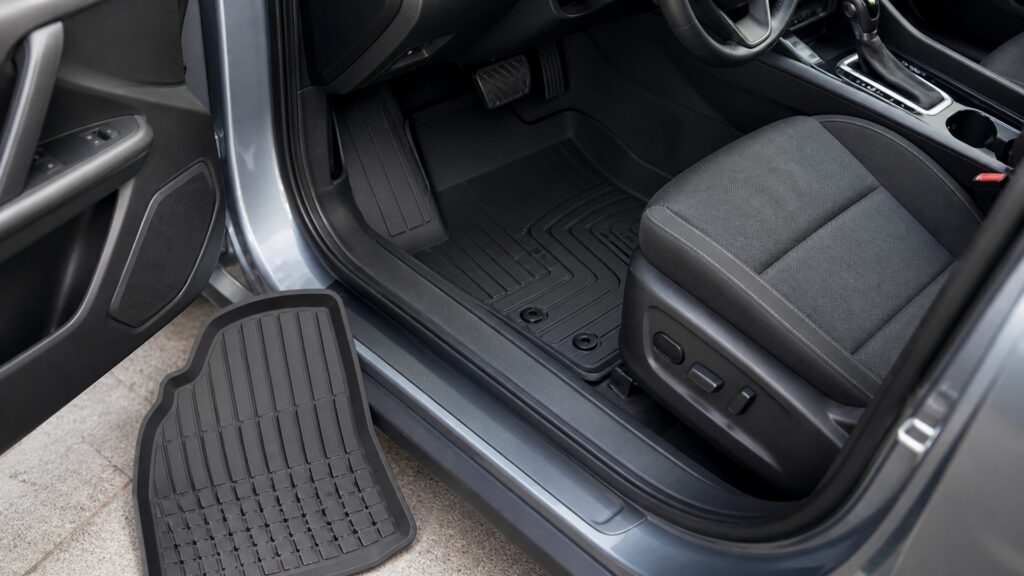
The meaningful difference appears where the mat meets the footwell, retainers, pedals, seat tracks, sill, console, and collected contamination.
Tip: Lay the driver's product in the empty footwell without another removable mat, engage every intended retainer, and reject it if any edge, movement, or thickness approaches the pedal sweep.
These terms make fit a measurable geometric relationship rather than a marketing category.
A floor-protection shape developed for a defined vehicle model, generation, and seating position.
A broadly sized product intended to serve multiple vehicle interiors without a unique molded boundary.
A universal design with marked regions that may be cut away to improve local clearance.
The connection between the mat and factory or product-specific anchors that resists migration.
The volume occupied by a pedal and nearby foot movement through full operation and return.
The outer edge separating protected floor from exposed carpet, trim, controls, and tracks.
Tip: A custom label describes intended application; safe performance still requires the correct part, seating position, anchors, and full pedal test.
A vehicle-specific mat can follow the sill, tunnel, seat mounts, dead pedal, and anchor locations with tighter boundaries. Molded sidewalls can increase coverage, but incorrect generation, drivetrain, body style, or seating position can make the nominally custom part incompatible.
Custom fit reduces geometric uncertainty only when the catalog application is exact.
Universal mats accommodate many cabins through smaller footprints, pliable materials, or removable sections. That can provide quick economical coverage, yet it leaves gaps and makes the user responsible for cutting cleanly without weakening retention or creating a curling edge.
The product's versatility comes from leaving final boundary decisions unresolved until installation.
A mat that covers more carpet but cannot engage the intended retainers may slide under repeated entry and braking. A smaller universal mat can be acceptable only if its approved retention, backing, and shape keep it away from the controls under realistic pulling forces.
Stable placement outranks maximum coverage in the driver's footwell.
Custom liners may extend up walls and around contours, while flat universal mats often emphasize basic abrasion protection. Higher walls hold more fluid but can spill during removal; carpet absorbs fine grit but needs thorough extraction and drying.
Coverage is valuable only when collected material can be removed without reaching the floor or controls.
Vehicle-specific protection earns a premium where weather, frequent use, resale goals, complex contours, or driver-footwell safety justify exact geometry. Universal mats can suit light-duty passenger areas, temporary use, older vehicles, or a verified simple footwell.
Buy precision where geometry and contamination demand it; buy flexibility only where verification leaves a generous safety margin.
Custom fit moves boundary decisions into the pattern and catalog; universal fit leaves more of those decisions to selection and installation.
Exact contours can improve carpet coverage, liquid containment, visual integration, and alignment with factory retention points.
A defined vehicle application can make replacement and position assignment clearer when the catalog and production details are correct.
A well-retained universal mat may be sufficient in a simple passenger footwell or temporary low-contamination use after thorough verification.
Custom products still fail when the wrong application is ordered, retainers are omitted, mats are stacked, edges deform, or pedal testing is skipped.
These myths turn custom and universal into absolute quality grades instead of two ways of resolving fit.
Catalog errors, production changes, wrong rows, packaging deformation, missing anchors, manufacturing tolerance, or an existing mat underneath can still create mismatch. Verify every edge and moving interface carefully after installation.
They must also remain clear after entry, braking, vibration, temperature changes, shoe movement, and hard pulling. Static appearance cannot prove that an unsecured or curling edge will never migrate forward.
Cutting may remove a retention hole, stiff perimeter, anti-curl feature, channel wall, or warranty coverage. Follow documented trim zones and reject the mat when safe fit would require cutting structural or uncertain areas.
Extra area can improve containment but may contact pedals, seat tracks, console trim, vents, or wiring and can complicate removal. The correct boundary protects useful floor area while preserving clearance and service access.
Tip: Compare the installed boundary, movement resistance, control clearance, containment, and maintenance process in the exact seating position.
These answers address catalog fit, trimming, passenger positions, retainers, and how to verify a purchase before regular driving.
Confirm exact model year, generation, body style, drivetrain tunnel, cab or row layout, left- or right-hand drive, seating configuration, factory carpet package, and any production-date exclusions listed by the manufacturer.
Only along the maker's documented trim zones and only if the remaining product stays structurally sound, retained, flat, and far outside the pedal sweep. Never improvise a close clearance around primary controls.
Often the risk is lower because there are no driver pedals, but the mat must still avoid seat tracks, heater vents, wiring, child-restraint use, door closure, passenger footing, and migration into the front footwell.
Use only a documented system compatible with the vehicle structure and mat. Improvised screws or hooks can damage wiring, corrosion protection, carpet, fuel or battery components, and may still provide unreliable load resistance.
Remove the old mat, install the correct orientation, engage anchors, pull and rotate firmly, adjust the seat, operate every pedal fully, check return, drive briefly, and repeat the inspection afterward.
Custom floor mats resolve more of the footwell boundary through vehicle-specific geometry and anchor alignment, while universal mats trade precision for availability, price, and portability.
Either type must stand alone, stay retained, remain flat, preserve full pedal sweep, contain the intended load, and return safely after cleaning.
These explainers connect product fit with contamination control and the broader rules for installing anything inside an occupant compartment.
See how abrasion, liquid, salt, containment, drying, retention, and pedal clearance determine whether any floor product performs.
Place mats inside the cabin's larger system of controls, restraints, sensors, vents, materials, and crash movement.
Use staged vacuuming, compatible cleaning, residue removal, and complete drying for both mats and the floor beneath.
Choose a retailer
Prices checked regularly. We may earn a commission at no cost to you.