
Roof-hinged hatch
The hatch pivots near the rear roof edge to open the luggage entrance.
- Example: rear glass rising with the door
- Check: the overhead space needed to open it
- Limit: the open door extends beyond the closed body
A hatchback combines passenger space and a rear luggage area behind an upward-opening door. The door normally includes the rear window, so opening it exposes a larger entrance than a separate trunk lid. Folding rear seats, where fitted, allow some passenger space to become cargo space.
That flexibility comes from the body and interior layout, not a particular engine or drivetrain. Hatchbacks can use gasoline, hybrid, or electric propulsion. Understanding the hatch mechanism, seat locks, floor shape, and cargo cover explains what the design can do—and which limits remain even when the seats are folded.
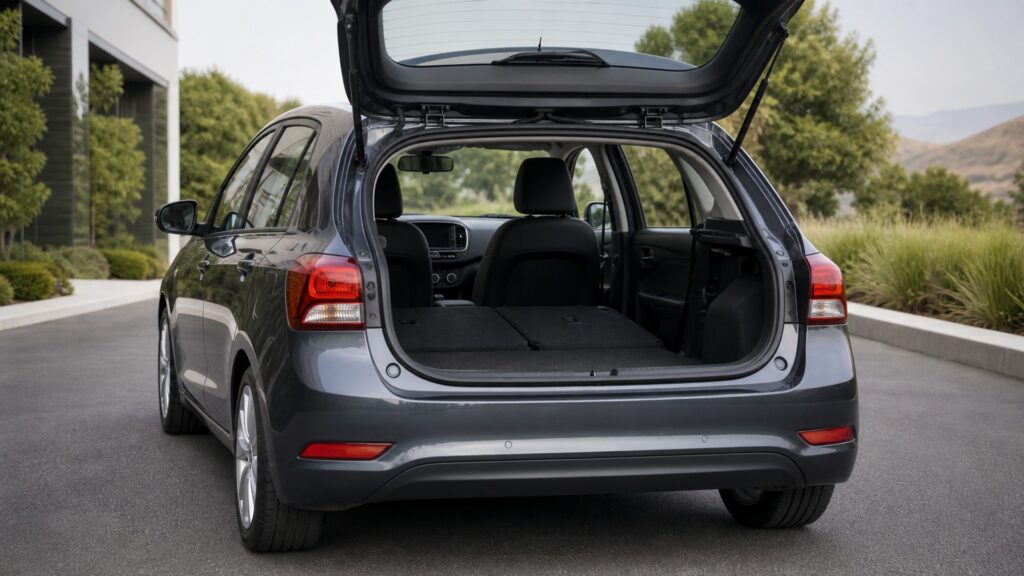
See how the door and interior layout create useful flexibility.
Tip: A wider opening improves access; it does not automatically increase the permitted load.
Each component has a specific job in access or interior use.
The hatch pivots near the rear roof edge to open the luggage entrance.
Hatch supports help lift or hold the door in its intended open position.
The latch retains the rear door in its closed position.
A split-folding backrest lets separate rear-seat sections fold individually.
A luggage cover screens the cargo area from view.
The load floor is the surface supporting items in the luggage area.
Tip: Consult the vehicle manual for the actual mechanism and allowed configurations.
The hatch rotates upward around hinges near the roof. A manual design commonly uses supports to reduce lifting effort and hold the door open; powered versions add an operating mechanism and controls. The open position needs clearance above and behind the vehicle. Support behavior should be checked before reaching into the luggage area.
Mazda cautions against loading under a partially opened liftgate that could fall; the useful opening must also be securely supported. Mazda: liftgate operation.
Closing brings the hatch into its latch and compresses the weather seals around the opening. The load must leave room for this movement. A tall item touching the glass or latch area can prevent proper closure even when most of it fits inside. Follow the car's indicated method of confirming the hatch is shut.
The rear opening is for access while parked; it is not an invitation to carry an oversized item with the hatch unlatched.
Rear backrests extend the luggage area when folded, but the available arrangement depends on the car. Head restraints, belts, cushions, or front-seat position may need attention first. When restoring passenger use, the backrest must lock correctly and the belts must remain accessible and untwisted.
Mazda's seat instructions illustrate the importance of keeping belts clear and verifying the restored backrest, rather than treating folding as a single lever pull. Mazda: folding and restoring rear seats.
Published luggage volume cannot describe every shape you will carry. Wheel housings narrow parts of the floor, a sill changes the lift into the car, and sloping rear glass reduces height near the closed hatch. A removable cover can expose more vertical space, but removing it also changes concealment and does not secure the load.
For a bicycle or rigid box, a trial loading often tells you more than comparing two volume figures.
Once the load is arranged, the hatchback drives using its own engine, hybrid system, or electric drivetrain. The rear opening does not dictate which wheels are driven, how much power is available, or how the suspension is tuned. Nor does folding the seats raise the vehicle's carrying allowance.
Judge driving behavior and load capacity separately from the convenience of getting objects through the rear door.
Interior flexibility has useful but specific limits.
More length or a different cargo shape can become available behind the front seats.
A split backrest may let you retain some rear passenger seating.
The opening, roof profile, floor strength, and permitted carrying weight still constrain the load.
Passengers still require designated seats and appropriate restraints.
Understand what the design changes and what it does not.
Its main purpose is concealment. Use the intended cargo-securing provisions.
Some leave a slope or step. Check the actual car and floor position.
The body can be paired with different propulsion systems.
Tip: Check both the loading configuration and the return to passenger use.
Answers about the rear door and convertible interior.
It is a hinged opening into the body, so three-door and five-door descriptions generally include it.
No. Many have a manually operated hatch with supports. Equipment varies by model and trim.
No. Check the seat arrangement and procedure for the exact car.
The closed door and rear glass occupy space above or behind the floor. Check closed clearance without forcing the hatch.
A hatchback works by combining a large rear opening with an adaptable passenger-and-luggage layout.
Use the hatch, seats, and floor as instructed, then respect the same restraint and loading limits that apply to the vehicle in ordinary use.
Use these Review Streets paths to compare related categories and practical next decisions.
Compare cargo needs and dependable charging.
Understand the openings and seating layouts.
Check equipment compatibility and clearance.
Choose a retailer
Prices checked regularly. We may earn a commission at no cost to you.