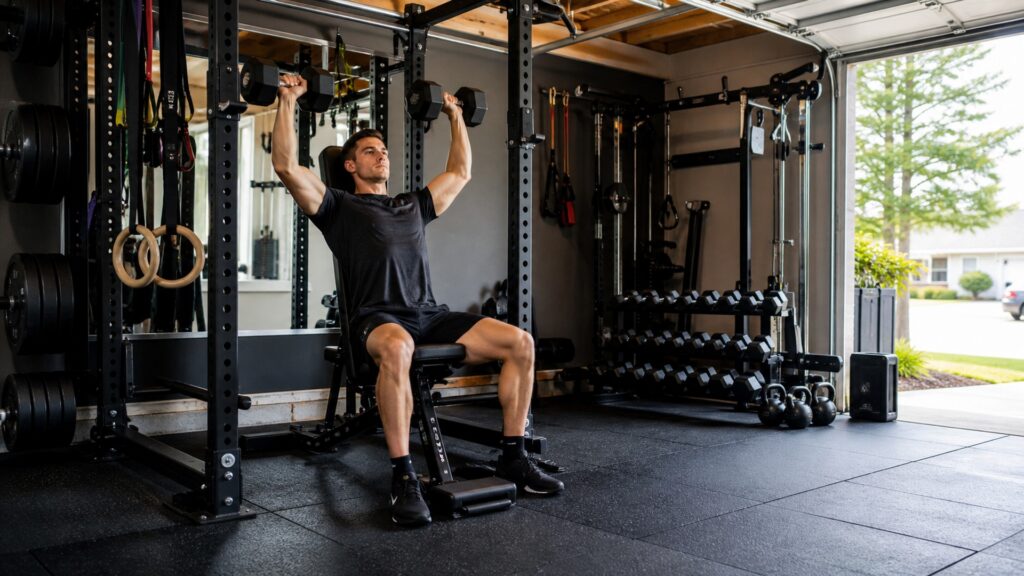
Home gym equipment
Home gym equipment is training gear selected to create resistance, support movement, or organize workouts inside a personal space.
- It must fit the room as well as the exercise plan.
- Its value depends on repeated use rather than commercial-gym variety.
- Space, noise, storage, and setup time are part of how it works.
Resistance source
The resistance source is what creates load: plates, selectorized stacks, bands, cables, bodyweight, magnets, or motors.
- Each source changes the feel and adjustment speed.
- Some are compact while others need storage and clearance.
- The source shapes the exercises the setup can support.
Training station
A training station is the place where exercises are performed, such as a rack, bench area, cable column, or mat zone.
- Stations need room for movement, loading, and safe entry or exit.
- Crowded stations reduce practical exercise variety.
- The layout can matter as much as the equipment list.
Load path
Load path is the route resistance takes through the body and equipment.
- A dumbbell, cable, guided bar, and band each pull differently.
- The path changes stability demand and movement freedom.
- Home users need enough setup control to keep the path predictable.
Adjustment speed
Adjustment speed is how quickly weight, angle, height, or attachments can change between exercises.
- Fast adjustment helps circuits and shared spaces.
- Slow adjustment can discourage exercise variety.
- It is part of routine friction, not a minor convenience.
Space constraint
A space constraint is a room limit such as floor area, ceiling height, wall clearance, noise, or storage.
- It can decide whether a rack, trainer, bench, or cardio piece is realistic.
- Ignoring it turns good equipment into an awkward room problem.
- Home gyms work only when the room supports the movement.