
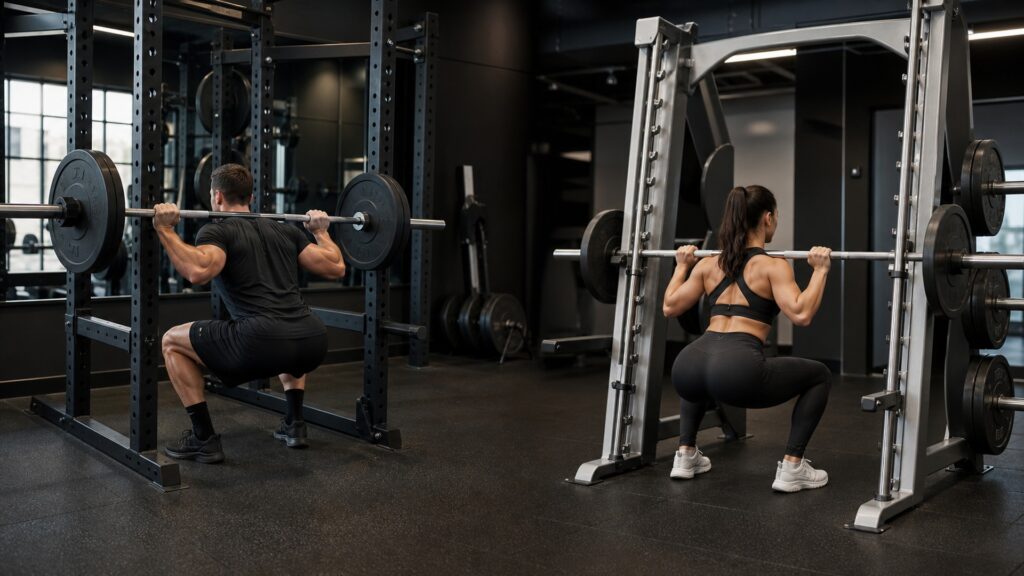
What Makes Power Racks Different from Smith Machines

Power racks and Smith machines look similar because both frame a barbell station, but they control movement differently. A power rack holds a free barbell before and after the set. A Smith machine attaches the bar to rails, guiding the path throughout the rep.

That difference changes technique, stabilization, safety setup, exercise selection, space planning, and how the lift feels. The comparison is not a universal winner story. It is a question of free bar control versus a fixed or guided bar path.

By: Review Streets Research Lab
Updated: August 31, 2026
Explainer · 8-12 min read
power racks explainer hero image for Review Streets
What You'll Learn

How Free Barbell Control Differs from a Guided Rail Path

Power racks and Smith machines separate most clearly by who controls the bar path: the lifter or the machine.

  • Why a power rack keeps the barbell free during the lift
  • How Smith-machine rails constrain the bar path
  • Why safeties and J-hooks matter in rack setup
  • How stabilization demand changes the exercise
  • Where guided paths can help or interfere
  • Why body proportions and movement goals change the better fit

Tip: Why a power rack keeps the barbell free during the lift before comparing products or routines.

Definitions

Key Concepts That Define Power Racks vs Smith Machines

A power rack is a frame that supports a free barbell on J-hooks and catches missed lifts with safeties when set correctly. The cards below clarify the terms that most often change real setup decisions.

Power rack

A power rack is a frame that supports a free barbell on J-hooks and catches missed lifts with safeties when set correctly.

  • The bar still moves freely in three dimensions.
  • The lifter controls bar path and stabilization.
  • Rack size, hole spacing, and safety setup decide how usable it feels.

Smith machine

A Smith machine holds the bar on rails so it travels along a guided path.

  • The rails reduce freedom and change the movement pattern.
  • Some designs use vertical rails; others are angled.
  • The fixed path can help setup consistency but may not match every body or lift.

Free bar path

Free bar path is the route a barbell takes when the lifter controls it without rails.

  • It changes naturally with stance, limb length, and lift technique.
  • It demands more stabilization and coordination.
  • It also requires better setup discipline.

Guided bar path

Guided bar path is the rail-defined motion of a Smith machine.

  • It can simplify balance demands.
  • It can also force the body to work around the machine's path.
  • The path should match the exercise before load increases.

Safety setup

Safety setup means placing pins, straps, or arms where they can catch a failed rep without blocking the lift.

  • Power racks depend heavily on correct safety height.
  • Smith machines may use hooks or stops, but setup still matters.
  • No safety feature replaces judgment.

Stabilization demand

Stabilization demand is how much the lifter must control balance and bar position during the rep.

  • Power racks preserve more of that demand.
  • Smith machines reduce some demands by constraining the bar.
  • The training effect changes with that constraint.

Tip: A Smith machine holds the bar on rails so it travels along a guided path.

Movement Path

A Rack Holds the Bar; a Smith Machine Guides It

The central difference is control. In a power rack, the bar leaves the hooks and the lifter controls its path. In a Smith machine, the bar stays connected to rails that define the path.

  • Power racks preserve free-bar movement.
  • Smith machines reduce side-to-side and forward-backward freedom.
  • The guided path can simplify balance.
  • The same constraint can feel unnatural for some lifts.
  • Movement path affects both setup and training effect.

The bar path is the real divider.

Safety Hardware

Both Need Setup, but the Failure Plan Differs

Power racks rely on properly set safeties, spotter arms, or straps. Smith machines often use hooks, stops, or rail catches. In both cases, hardware helps only when adjusted for the lifter and exercise.

  • J-hooks need a practical unrack height.
  • Safety arms should catch below the working range.
  • Smith stops must match the exercise and body position.
  • Bench setup changes safety height requirements.
  • No catch system makes reckless loading sensible.

Safety equipment is useful only when set for the actual lift.

Training Effect

Freedom Changes Stabilization and Technique

A free bar asks the lifter to coordinate balance and bar path. A guided bar reduces some stabilization demands and can shift how a squat, press, lunge, or row feels.

  • Power racks suit barbell practice where technique path matters.
  • Smith machines can make some machine-like variations easier to set up.
  • The fixed path may change joint angles or stance demands.
  • Stabilizers are not eliminated from training, but the task changes.
  • The target exercise should match the equipment's movement constraint.

Different movement freedom creates different training.

Home Gym Fit

Footprint, Attachments, and Versatility Differ

Power racks often anchor a broader free-weight setup with pull-up bars, safeties, landmines, and storage. Smith machines may add guided pressing or squatting but can be less flexible for free-bar practice.

  • Racks need barbell and plate clearance.
  • Smith machines need rail clearance and enough room to enter safely.
  • Some units combine rack, Smith, and cable functions.
  • Attachments can expand or clutter the setup.
  • Ceiling height matters for pull-ups and overhead work.

The best station is the one the room can support.

Decision Boundary

Choose by How Much Bar Path Control You Want

A power rack fits users who want free-bar squats, bench presses, pulls, and adaptable safety setup. A Smith machine fits users who specifically want a guided bar path for selected exercises.

  • Choose a rack for free-bar practice and broad barbell versatility.
  • Choose Smith guidance when the rail path supports the chosen movement.
  • Avoid forcing a lift into a path that feels wrong.
  • Set safeties or stops before loading seriously.
  • Use coaching or qualified help for technique and pain concerns.

The difference is not frame versus frame; it is free movement versus guided movement.

Quick Reality Check

Where Power Racks vs Smith Machines Helps and Where It Needs Context

A practical balance between the useful explanation and the limits that keep the article honest.

What This Clarifies

It explains how power racks vs smith machines changes movement setup, training flow, or equipment decisions.

It helps readers compare real mechanisms instead of relying on vague performance or convenience claims.

What It Cannot Prove

It cannot prove that one product or method fits every body, room, routine, or goal.

It cannot replace qualified guidance for pain, medical concerns, rehabilitation, or individualized programming.

Common Myths

Misconceptions About Power Racks vs Smith Machines

Common shortcuts and misunderstandings can make the topic seem simpler than it is.

Power Racks vs Smith Machines is automatically useful for everyone

Usefulness depends on the exercise, setup, body position, space, and the exact problem the tool or concept is meant to solve.

The more advanced option is always better

Advanced features can help, but they can also add friction, cost, dependency, or setup demands that make the simpler option more practical.

One specification tells the whole story

A headline spec needs context from fit, stability, movement path, adjustment, and the user's actual training routine.

Feeling different means it is working better

A different sensation can be useful feedback, but it is not proof of better results, safer training, or faster recovery.

Fitness equipment can replace coaching or medical judgment

Equipment and metrics can support decisions, but symptoms, pain, technique problems, and health concerns need qualified human guidance.

Tip: For power racks vs smith machines, a claim is only useful when it names the mechanism and the conditions around it.

FAQ

Frequently Asked Questions About Power Racks vs Smith Machines

Concise answers to common questions readers may have after the main explanation.

What is the main thing to understand about power racks vs smith machines?

Look at the mechanism first: how it changes resistance, position, tracking, support, space, or routine flow in the specific fitness setting.

Is it necessary for every home gym or workout?

No. It matters only when it solves a real limitation or supports movements the user will repeat consistently.

How should beginners think about it?

Beginners should prioritize clear setup, repeatable movements, manageable resistance, and enough room to learn before chasing complicated features.

What is the biggest comparison mistake?

The biggest mistake is judging by category label alone instead of checking movement path, fit, adjustment, stability, and use conditions.

Can it prevent injury or guarantee results?

No. It can support better setup or clearer training decisions, but it should not be presented as a safety, rehabilitation, or performance guarantee.

Bottom Line

Power Racks vs Smith Machines matters when its mechanism changes a real training decision rather than merely adding another product label.

The practical takeaway is to match the tool, metric, or setup to the movement, room, routine, and limits that actually shape use.

Next Steps

Go Deeper or Compare Your Options

Use these related explainers to place power racks vs smith machines inside adjacent Fitness equipment and accessory decisions.

Quick Summary

Power Racks vs Smith Machines Explained

  • Why a power rack keeps the barbell free during the lift
  • How Smith-machine rails constrain the bar path
  • Why safeties and J-hooks matter in rack setup
  • How stabilization demand changes the exercise
  • Practical value depends on setup, repeated use, and honest limits.