
Primary Current
Low-voltage current flowing through the ignition coil's primary winding while the switching device commands charge.
- Dwell controls charge duration
- Supply voltage affects buildup
- Resistance creates heat
Ignition components work as a timed energy-transfer chain in spark-ignition engines. The control module determines crank and cam position, engine load, temperature, and knock margin; an igniter charges a coil's primary winding; current builds a magnetic field; switching the current off produces a much higher secondary voltage.
That voltage rises until it ionizes the spark-plug gap. Current then flows across the gap, creating a hot discharge that starts a flame kernel in the compressed mixture. Timing, coil energy, dwell, plug reach, heat range, gap, cylinder pressure, mixture, deposits, insulation, power supply, and grounding all affect success. Diesel compression ignition and many noncombustion drivetrains do not use this gasoline-style spark path.
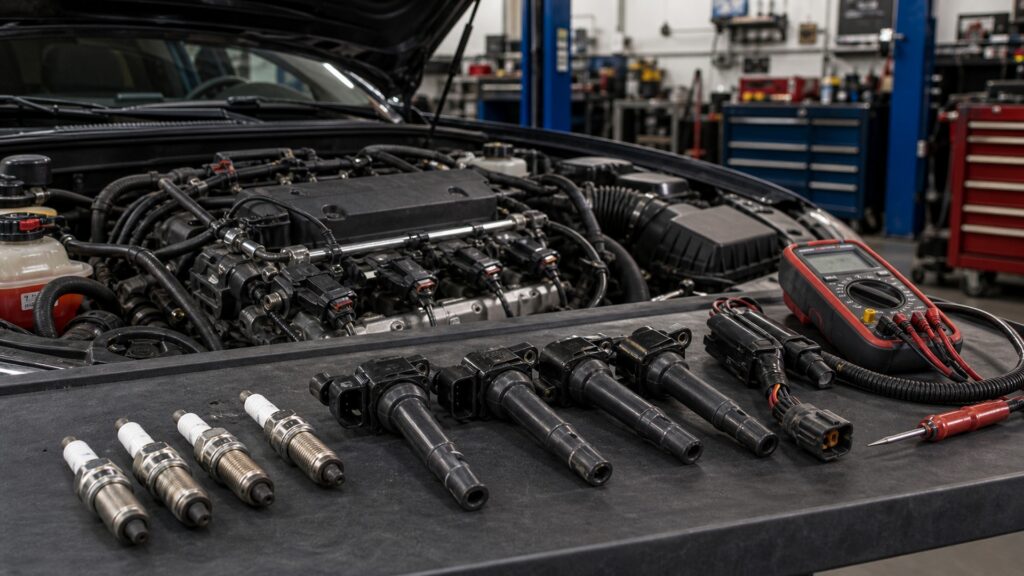
Reliable ignition requires correct timing information, sufficient coil energy, intact insulation, a suitable plug gap, and a combustible mixture at the instant the cylinder needs it.
Tip: A visible spark in open air does not prove the system can fire across the plug gap under cylinder pressure, mixture turbulence, heat, and actual coil dwell.
These terms connect electronic control, magnetic energy, electrical discharge, and combustion initiation.
Low-voltage current flowing through the ignition coil's primary winding while the switching device commands charge.
The controlled interval during which primary current builds magnetic energy before the firing event.
High potential induced in the coil's many-turn secondary winding when the magnetic field changes rapidly.
The moment voltage ionizes gases across the spark-plug gap and creates a conductive discharge channel.
The small burning region initiated near the plug that must grow into stable combustion through the chamber mixture.
The commanded crank-angle position at which the spark begins relative to piston motion and combustion needs.
Tip: Spark proves only one ingredient; fuel preparation, compression, valve timing, exhaust flow, and mechanical integrity must also support combustion.
Reluctor patterns and sensors identify speed and angular position. The controller combines those signals with load, temperature, throttle, knock, and calibration to select a firing event for each cylinder.
A coil cannot fire the correct cylinder at the correct moment without trustworthy position information.
A switching transistor connects the primary winding long enough for current to rise without overheating the coil. Battery voltage, resistance, inductance, temperature, engine speed, and control strategy shape the available energy.
Coil charging is controlled energy storage measured in milliseconds.
When primary current is interrupted, the magnetic field collapses and induces voltage in both windings. The secondary turns ratio allows voltage to climb until the easiest available path conducts.
High voltage will use a damaged insulation path instead of the intended plug gap.
The initial discharge crosses between center and ground electrodes, depositing energy into the nearby compressed mixture. Gap, electrode shape, deposits, pressure, fuel, dilution, and turbulence determine whether that kernel survives.
The spark initiates combustion; it does not supply the fuel, air, or compression needed to continue it.
The controller may advance timing for efficiency, retard it when knock appears, and infer misfire from crankshaft acceleration. These monitors report combustion behavior rather than proving a plug or coil failed.
Feedback closes the control loop but still requires causal testing before parts replacement.
Position sensing, coil charging, field collapse, insulation, gap breakdown, mixture ignition, and combustion feedback must align within milliseconds.
Position signals synchronize, primary current reaches the intended profile, secondary insulation holds, the correct plug fires, and combustion remains stable across cranking, idle, load, heat, and acceleration.
Power, grounds, connectors, dwell, timing, coil, boot, plug, mixture, compression, and control data support one causal explanation rather than a parts list.
Fuel pressure, injector delivery, intake sealing, compression, valve timing, exhaust flow, adequate battery cranking, or a mechanically healthy cylinder.
A spark seen outside the cylinder cannot guarantee sufficient energy under pressure, correct timing, proper mixture, safe catalyst temperature, or stable combustion at the condition that produced the complaint.
Ignition myths reduce a coordinated electromagnetic and combustion process to a plug that either sparks or does not.
Open-air pressure and mixture differ from a running cylinder. A coil may spark externally yet fail under compression, heat, high demand, incorrect dwell, damaged insulation, or excessive gap. Test under representative conditions safely.
The controller detects uneven combustion, which can originate in ignition, fuel, air, compression, timing, wiring, injectors, or mechanical faults. Cylinder counts and swaps guide diagnosis but do not replace confirmation.
The coil supplies only the voltage needed to break down the available path, within its limits. Excess demand from wide gaps or damaged boots increases insulation stress; correct energy and duration matter beside peak voltage.
Conventional diesels compress air until injected fuel ignites without a spark. Glow plugs can support cold starting, but they are heaters rather than gasoline-style timed spark plugs. Architecture must be identified first.
Tip: Follow energy and timing through every interface before treating a misfire code as a replacement instruction.
These answers address coil-on-plug systems, spark duration, timing, misfire diagnosis, and why battery condition still affects ignition.
Denser compressed gas requires greater voltage to ionize the plug gap. Boost, mixture, gap width, electrode condition, deposits, and temperature change breakdown demand, so a marginal coil or boot may fail only under load.
It stores magnetic energy from low-voltage primary current and, when switched, induces a high-voltage secondary pulse. The winding ratio, inductance, dwell, supply voltage, switching speed, losses, and load determine the discharge.
It uses crank and cam position with speed, load, temperature, throttle, knock, emissions, and calibration data. Timing is advanced or retarded so pressure develops usefully without excessive knock or component stress.
Low voltage can slow cranking, reduce coil charging, disturb modules, and increase demand on electrical connections. Test supply voltage and grounds, then confirm ignition, fuel, and mechanical causes rather than assuming the battery alone.
Incorrect gap, hidden insulator cracks, wrong heat range or reach, internal resistance, torque, coil-boot tracking, cylinder pressure, mixture, and intermittent heat behavior can fail without obvious deposits. Exact testing remains necessary.
Ignition components convert timed low-voltage electrical input into a high-voltage discharge that creates a flame kernel in a compressed mixture.
Reliable operation depends on position signals, dwell, coil energy, insulation, plug specification, gap, timing, battery supply, mixture, compression, and feedback. Diagnose the complete event under the condition that exposes the fault.
Related explainers connect ignition timing and energy with fitment controls, engine combustion, and diagnostic data that separates spark faults from other misfire causes.
Match plug reach, seat, heat range, gap, resistance, coil connector, boot, dwell compatibility, and installation torque.
Place spark initiation within air, fuel, compression, lubrication, cooling, exhaust, and engine controls.
Interpret misfire codes, freeze frames, and live data as evidence requiring confirmation.
Choose a retailer
Prices checked regularly. We may earn a commission at no cost to you.