What Makes Interior Organization Different from Floor Protection

A trunk organizer holds grocery bags, tools, cleaning supplies, sports gear, or emergency equipment in assigned compartments. A floor or cargo liner receives sand, road salt, muddy water, spilled liquid, and abrasion before those reach carpet. One manages identifiable objects. The other protects a broad surface from material that spreads.

The difference affects what to buy and how to test it. Organizers need suitable walls, lids, dividers, anchors, and retrieval access for the loaded items. Mats and liners need correct coverage, retention, edge shape, liquid capacity, and spill-free removal. In shared cargo areas or footwells, both products must remain stable and removable without blocking seats, vents, pedals, or exits.

By: Review Streets Research Lab
Updated: September 14, 2026
Explainer · 8-12 min read
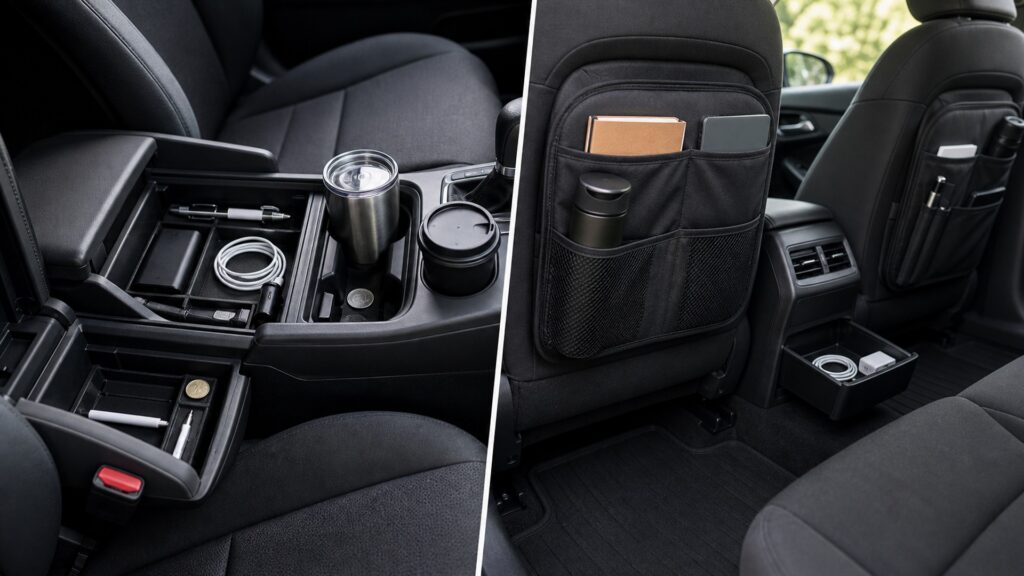
interior organization different from floor protection explainer hero image for Review Streets
What You'll Learn

Loose Objects and Dirty Floors Need Different Products

Compare the type of load, the boundary that controls it, the proof of performance, and how each system is emptied or reset.

  • Countable objects versus spreading debris or liquid
  • Compartments, lids, dividers, and cargo nets
  • Mat channels, raised edges, and wear layers
  • Organizer anchoring and item restraint
  • Mat retention and pedal clearance
  • Combined use in cargo areas and footwells
  • Restocking versus washing and drying

Tip: Ask what should leave the vehicle during service: selected objects from an organizer or captured contamination with the floor covering.

Definitions

Key Concepts That Define Interior Organization and Floor Protection Comparison

The terms below are specific to interior organization and floor protection comparison and the products a buyer will compare.

Discrete Object

An item with identifiable size, mass, shape, use, and retrieval requirements that remains individually handled.

  • List the object, its mass, and intended use
  • Choose a container or restraint sized for it
  • Check that the item remains individually retrievable

Dispersed Contaminant

Particles, liquid, dissolved material, residue, biological matter, or wear energy that spreads across or into a surface.

  • Describe sand, salt, water, mud, spills, or wear
  • Estimate where it lands and spreads
  • Choose coverage and capacity for that exposure

Storage Boundary

A pocket, wall, divider, lid, net, or enclosure assigning an object to a limited location.

  • Match pocket, bin, divider, lid, or net to item size
  • Load and close the boundary
  • Anchor the organizer so the whole unit cannot move

Wear Barrier

A sacrificial or durable surface that receives abrasion and debris before the underlying cabin material does.

  • Inspect mat material, channels, walls, backing, and anchors
  • Test removal before liquid reaches the edge
  • Check the carpet beneath after use

Liquid Capacity

The finite volume a floor covering can hold under expected movement before overflow, leakage, wicking, or spill during removal.

  • Estimate realistic liquid volume and vehicle movement
  • Watch low edges and seams for overflow
  • Empty early enough to avoid spills during removal

Cleanout Event

Removal and service that exports captured contamination, restores capacity, dries interfaces, and returns a protector to its retained position.

  • Lift out contamination without tipping it onto carpet
  • Clean and dry both faces and the floor beneath
  • Reinstall one intended layer with every anchor engaged

Tip: Apply each interior organization and floor protection comparison check with the actual occupant, product, load, and vehicle.

Different Inputs

Objects Retain Identity While Contaminants Spread

Organization begins with countable items, their mass, frequency, and consequence of movement. Protection begins with abrasive solids, moisture, chemicals, staining agents, and repeated foot contact that distribute across flooring. A bottle, tool, document, or grocery bag remains a discrete item; salt, sand, water, and abrasion spread across a surface.

  • Inventory objects individually
  • Characterize exposure type
  • Predict movement paths

Input form determines whether the control needs retrieval or cleanout.

Different Boundaries

Compartments Assign Homes While Floor Layers Intercept Exposure

Pockets, bins, lids, dividers, nets, and anchors create item zones and restraint. Fibers, channels, walls, textures, and backing separate debris or liquid from carpet and permit later removal. Bins and nets surround or restrain objects, while mat channels, raised edges, fibers, and backing control contamination at the floor.

  • Trace each object boundary
  • Trace contamination coverage
  • Identify finite capacity

Both use boundaries, but those boundaries act on different material behavior.

Different Proof

Retrieval and Restraint Differ from Dryness and Wear Control

Organization passes when items remain located through motion and can be appropriately found, obtained, and returned. Protection passes when the covering stays retained, preserves control clearance, contains expected load, and leaves underlying flooring acceptable. Drive with the loaded organizer, then inspect item movement; expose the liner realistically, then inspect retention, capacity, and carpet beneath.

  • Run a motion trial
  • Run an exposure trial
  • Inspect hidden interfaces

A tidy surface cannot prove carpet protection, and clean carpet cannot prove object restraint.

Shared Cabin Space

Footwells and Cargo Areas Can Force the Categories to Interact

Bins may press liner walls, prevent mat removal, block vents, or migrate near feet. Floor edges may reduce organizer stability or closure clearance. Test combined layers, loads, seat motion, exits, and cleaning access. A trunk bin can sit on a cargo liner only if both remain stable and each can be removed without spilling or damaging the other.

  • Install the final combination
  • Move seats and feet
  • Remove each system safely

Coexistence requires geometry and service access for both mechanisms.

Different Reset Cycles

Items Return to Zones While Contamination Leaves the Vehicle

Organization reset removes waste, restocks essentials, closes restraints, and revises overflow. Protection reset lifts the covering, exports material without spilling, cleans, dries, inspects anchors and carpet, and reinstalls one intended layer. Reset organizers by returning inventory and closing restraints; reset floor protection by exporting debris, washing, drying, and reanchoring.

  • Restore assigned inventory
  • Dry both floor surfaces
  • Reverify retention

Reset succeeds only when each system regains its distinct capacity.

Quick Reality Check

Waterproof Storage Is Not Automatically Floor Protection

A plastic bin may catch a local leak but still leave surrounding carpet exposed, slide on the floor, trap grit underneath, or spill while being moved.

What each category must prove

Objects remain assigned, contained, restrained, and appropriately retrievable.

Flooring remains acceptably dry and unworn after exposure, removal, and inspection.

Shared-space and load limits

Neither category may enter driver-control or occupant-safety space.

Local spill resistance does not automatically establish whole-floor protection capacity.

Common Myths

Misconceptions About Interior Organization and Floor Protection Comparison

Product-category myths

A cargo bin protects every surface beneath it

A bin may catch local spills yet leave gaps, concentrate grit, abrade carpet, leak at seams, trap moisture, or slide. Floor protection needs coverage, compatible backing, containment capacity, retention, removal, and hidden-surface evidence.

Raised mat edges can organize loose objects

Channels and walls are designed around contamination flow and vehicle fit, not object mass, impact, retrieval, or closure. Loose items on a floor covering can migrate toward pedals, seats, doors, or occupants.

If everything stays in place, both systems pass

Stable objects prove one organization outcome but say nothing about liquid overflow, grit abrasion, wicking, trapped moisture, carpet staining, mat anchors, or pedal clearance. Inspect the complete protection pathway separately.

Both categories use the same cleaning routine

Organizers may need inventory removal, compartment sanitation, closure and attachment inspection, and restocking. Floor coverings need spill-safe removal, top and underside cleaning, full drying, carpet inspection, anchor verification, and pedal-clear reinstallation.

Tip: Follow the load: objects are retrieved, contamination is removed.

FAQ

Frequently Asked Questions About Interior Organization and Floor Protection Comparison

Questions about bins, mats, and combined use

Which category handles charging cables?

Interior organization assigns cables routes and storage that prevent tangles, pinch points, control interference, and loose movement. Electrical condition and appropriate device use remain separate concerns that a pocket or clip cannot validate.

Which category handles melting snow?

Floor protection receives water and dissolved road material from footwear. Select adequate coverage and capacity, keep the covering retained, remove it before overflow, dry hidden carpet, and verify complete driver-control clearance.

Can one product serve both roles?

A compartmented waterproof cargo tray may contain objects and local spills, but verify each claim independently: load restraint, closure, retrieval, material compatibility, liquid capacity, leakage, surface abrasion, attachment, removal, and underlying condition.

How are combined products tested?

Load the organizer, install the floor covering, configure seats and occupants, check controls and vents, drive normally, inspect movement and contamination, retrieve intended items while parked, then remove each product without spilling or disturbing the other.

What is the clearest selection question?

Ask whether the failure concerns an identifiable object needing a location and restraint or material exposure threatening flooring. If both are present, specify two mechanisms, two capacities, and two acceptance tests.

Bottom Line

Use Organizers for Items and Floor Protection for Exposure

Bins, pockets, dividers, and nets give objects locations and restraint. Mats and liners shield carpet from wear, debris, and liquid. If both are installed, test the loaded combination for movement, coverage, removal, and every nearby vehicle clearance.

Next Steps

Mechanism and Fitment Guides

Use these pages to understand organization loads, floor-protection behavior, and the space both products occupy.