
Rolling Resistance
Force required to make tires or supports roll across a deformable surface.
- Soft ground increases it
- Flat tires add drag
- Excavation can reduce it
Recovery equipment matters because a vehicle that still runs can become immobilized by mud suction, sand excavation, snow compaction, a hung chassis, lost tire contact, a failed tire, or a grade it cannot climb. Shovels, boards, straps, winches, connectors, and inflation tools attack different parts of that resistance.
The same tools can create lethal stored energy when ratings, attachment points, geometry, inspection, or communication are wrong. Safe recovery begins by stopping wheelspin, assessing terrain and vehicle damage, reducing resistance, choosing a low-energy method, establishing exclusion zones, and connecting only through identified load paths. Equipment earns its place by making this sequence controlled and repeatable—not by enabling a harder pull.
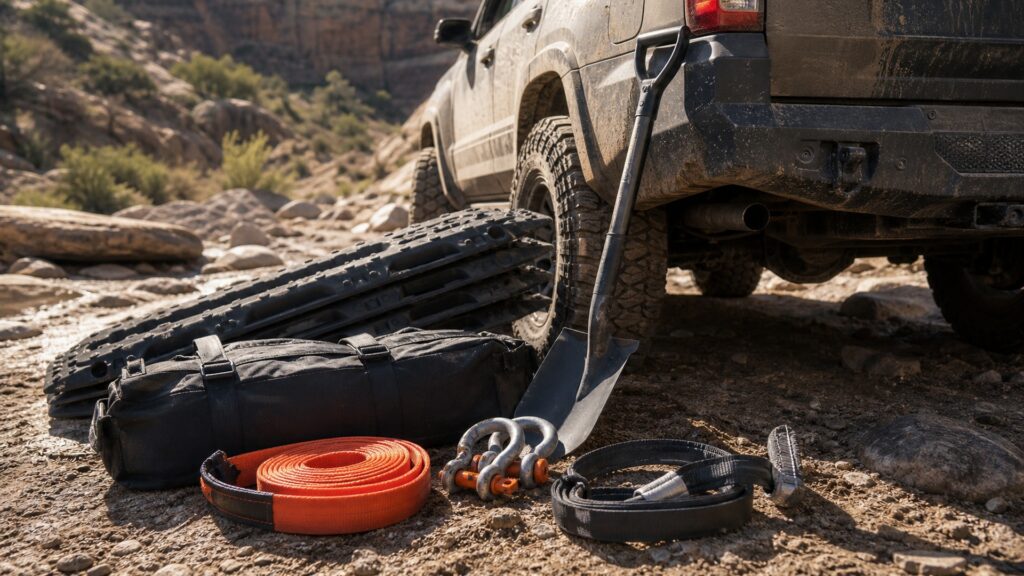
Diagnose what holds the vehicle, clear or support it mechanically, select the lowest-energy technique, and keep every component and person outside predictable failure paths.
Tip: Before travel, lay out the complete recovery chain and trace each component's rating, inspection state, connection orientation, and expected direction of force; an unrated link invalidates confidence in the system.
These terms describe resistance, equipment ratings, force paths, and stored-energy hazards.
Force required to make tires or supports roll across a deformable surface.
Additional resistance created when mud or water pressure holds buried surfaces.
Vehicle attachment specifically designed and identified for recovery-direction loads.
Maximum load permitted in normal service for a component under stated conditions.
Technique using controlled stretch and vehicle motion to store and release energy through a rated elastic device.
Area a loaded rope, strap, connector, or attachment could enter after failure.
Tip: Vehicle recovery can cause severe injury, rollover, fire, environmental damage, or structural failure; obtain hands-on instruction and follow vehicle and equipment manuals.
Clearing packed material from tires and underbody, building a gradual ramp, placing traction boards, adjusting tire pressure appropriately, and unloading selected mass can lower required force before any line stores energy.
The safest recovery force is the force that preparation makes unnecessary.
Boards provide a temporary surface under driven tires; tow straps transfer a relatively steady pull; kinetic ropes stretch during a bounded run; winches apply controlled line tension. These methods are not interchangeable and require different ratings.
Choose the method whose energy and control fit the resistance, space, anchors, and vehicle condition.
Force travels through connectors, recovery points, mounts, chassis, suspension, and the stuck vehicle. Side-loaded shackles, sharp bends, wide bridles, offset pulls, damaged points, and improvised tow balls concentrate stress unpredictably.
A high-rated rope does not strengthen the vehicle structure at either end.
Elastic stretch, elevated vehicles, tensioned winch rope, spinning tires, unstable ground, hot components, and rolling vehicles store energy. Bystanders, spotters, and drivers need defined positions, signals, escape paths, and stop commands.
Communication and positioning are recovery equipment because they control human exposure to the load.
Abrasion, ultraviolet damage, chemical exposure, corrosion, bent pins, crushed rope, contaminated boards, missing gloves, buried storage, and incompatible sizes can disable equipment. Recovery loads also reveal vehicle damage that requires post-pull inspection.
A kit is ready only when its ratings, condition, interfaces, and deployment order are known.
The system matters because it combines mechanical advantage, rated load paths, stored-energy management, communication, and inspection.
It supports excavation, traction, tire-pressure control, controlled pulling, compatible connection, safe zones, and clear communication without relying on a single maximum-force technique.
Every component has a known rating and role, fits the vehicle's identified points, remains accessible, and has been practiced under low-risk conditions.
Unstable slopes, deep water, fire, structural damage, traffic exposure, unknown anchors, absent rated points, medical risk, or loads beyond training may require professional recovery.
Equipment does not legalize access, prevent environmental damage, guarantee traction, or remove stored energy from elastic and tensioned systems.
These myths replace force assessment and rated load paths with familiar-looking hardware.
A stronger strap can transfer greater load into weaker recovery points, connectors, or vehicle structure. Correct method, compatible ratings, minimized resistance, aligned geometry, bounded energy, and safe zones matter more than the largest printed number.
Transport or shipping loops may be designed for restraint, not multidirectional extraction loads. Use only points the vehicle manufacturer or a qualified system identifies for recovery, including their mounting, direction, and connector requirements.
A winch stores substantial energy in rope and loaded structure even at low speed. Anchor failure, side loading, rope damage, vehicle movement, electrical heat, and fairlead pinch points still require strict controls.
Uncoordinated wheelspin can shock-load the line, throw debris, bury tires, move the vehicle sideways, overheat components, or overrun helpers. Apply only the agreed vehicle input while the recovery director maintains visibility and control.
Tip: Recovery begins with diagnosis, resistance reduction, and people placement before any rope or strap is tensioned.
These answers address minimum kits, attachment points, dampers, wet gear, and stopping criteria.
Match the route and vehicle, but commonly include shovel, traction aids, accurate gauge, inflation equipment, rated vehicle-specific connections, gloves, communication, visibility aids, and documented procedures. Add winching or kinetic gear only with training.
Consult the vehicle and recovery-system instructions for exact location, mounting, load direction, connector, and limitations. A loop's thickness, paint color, or resemblance to another vehicle's point is not reliable identification.
No. A damper may influence a failed line, but cannot contain every connector, anchor, rope, or vehicle failure. Keep people well outside the entire loaded system and never step over a tensioned line.
Rinse contamination as allowed, inspect fibers and hardware, dry completely away from damaging heat or sunlight, lubricate only where specified, record damage, and store gear ventilated and accessible without exposing occupants to loose heavy objects.
Stop when attachments shift, gear damages, communication fails, people enter the zone, the vehicle becomes unstable, water rises, traffic approaches, force exceeds the plan, or conditions move beyond equipment ratings, training, or environmental permission.
Recovery equipment matters because it lets a trained team reduce terrain resistance, restore traction, and apply controlled force through rated vehicle load paths while managing stored energy and people.
Select methods by resistance and environment, use compatible identified equipment, control geometry and communication, exclude bystanders, inspect continuously, and call professional recovery when the safe system boundary is uncertain.
These explainers compare surface-building boards with force-transferring straps and place both inside a broader recovery system.
Compare recovery boards and recovery straps by mechanism, load path, energy, terrain, vehicle requirements, and failure exposure.
Build a complete vehicle recovery capability around assessment, tire mobility, excavation, traction, pulling, connections, communication, and post-event inspection.
Place recovery tools within the larger overlanding system of payload, accessibility, navigation, communication, shelter, power, and exit planning.
Choose a retailer
Prices checked regularly. We may earn a commission at no cost to you.