How Paint Protection Works

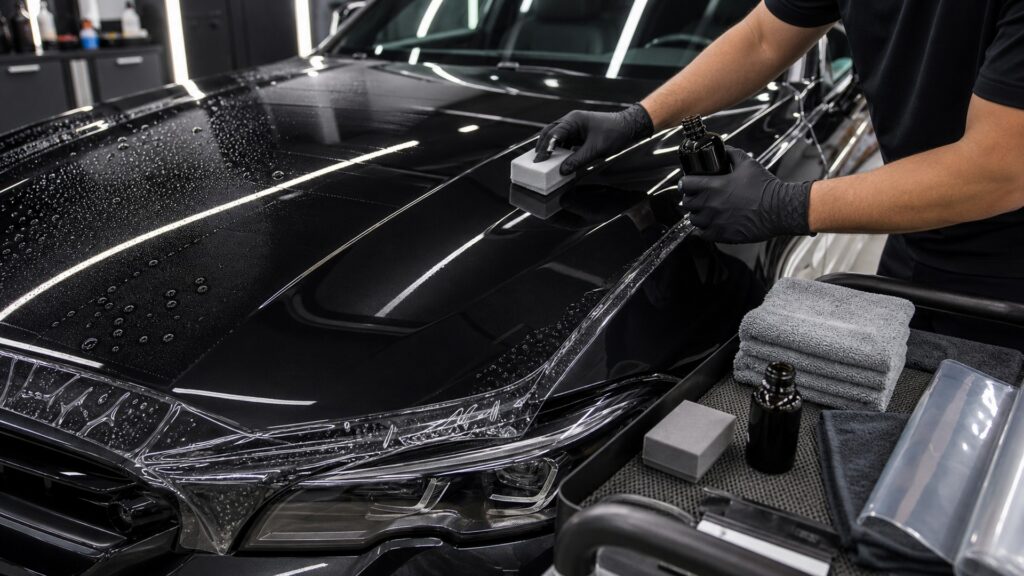
Paint protection works by placing a defined material between automotive paint and selected exposures. Wax or sealant forms a replenishable film; a liquid coating wets prepared clear coat, flashes, levels, and cures; paint-protection film uses adhesive to retain a thicker polymer sheet. Each system changes only specific surface interactions.

Preparation is part of the mechanism because contamination, oils, moisture, defects, and prior products can disrupt wetting or adhesion. After application, time, temperature, humidity, leveling, edges, and water avoidance govern cure. Maintenance then removes contamination without abrading, chemically attacking, or lifting the installed layer. Protection reduces risk; it does not make paint invulnerable.

By: Review Streets Research Lab
Updated: September 1, 2026
Explainer · 8-12 min read
paint protection explainer hero image for Review Streets
What You'll Learn

Resolve Paint Protection Mechanism through Its Controlling Evidence

The explanation separates five mechanisms that decide paint protection mechanism instead of repeating a generic care sequence.

  • Protection Begins with a Clean Stable Substrate
  • Liquids Need Even Contact while Film Needs Controlled Placement
  • Time Converts Applied Material into Its Service State
  • Thin Films Change Surface Interaction; PPF Adds Physical Thickness
  • Washing and Inspection Preserve or Reveal Installed Performance
  • How to verify the finished state

Tip: Use the first failed paint protection mechanism gate to choose the next test; do not compensate with unrelated force, chemistry, or product.

Definitions

Key Concepts That Define Paint Protection Mechanism

These definitions anchor paint protection mechanism to exact materials, mechanisms, limits, and observable evidence.

Substrate Preparation

Substrate Preparation locates the interface where paint protection mechanism under the named surface and operating conditions.

  • Measure substrate preparation before work
  • Observe how substrate preparation changes
  • Record substrate preparation after verification

Surface Wetting

Surface Wetting sets the usable boundary for paint protection mechanism under the named surface and operating conditions.

  • Measure surface wetting before work
  • Observe how surface wetting changes
  • Record surface wetting after verification

Film Formation

Film Formation explains the material response during paint protection mechanism under the named surface and operating conditions.

  • Measure film formation before work
  • Observe how film formation changes
  • Record film formation after verification

Adhesive Bond

Adhesive Bond measures the transfer created by paint protection mechanism under the named surface and operating conditions.

  • Measure adhesive bond before work
  • Observe how adhesive bond changes
  • Record adhesive bond after verification

Coating Flash Time

Coating Flash Time reveals the failure condition within paint protection mechanism under the named surface and operating conditions.

  • Measure coating flash time before work
  • Observe how coating flash time changes
  • Record coating flash time after verification

Crosslinking Cure

Crosslinking Cure records the verified outcome after paint protection mechanism under the named surface and operating conditions.

  • Measure crosslinking cure before work
  • Observe how crosslinking cure changes
  • Record crosslinking cure after verification

Tip: Use each paint protection mechanism term at its defined interface rather than as a generic synonym for cleaning or protection.

Preparation Interface

Protection Begins with a Clean Stable Substrate

Wash, decontamination, selected correction, and residue removal expose the surface the layer must contact. Evidence joins substrate preparation with adhesive bond; surface-energy change sets the next limit. Record impact-energy distribution before changing environmental exposure. Compare substrate preparation after surface-energy change stabilizes, then use adhesive bond to confirm whether impact-energy distribution produced the intended result. For row 209, surface wetting establishes the baseline beside coating flash time. If sacrificial thickness changes first, hold substrate preparation constant and inspect environmental exposure. A valid decision connects surface wetting to impact-energy distribution, preserves coating flash time, and documents sacrificial thickness after the applicable drying or curing interval.

  • Inspect paint and repairs
  • Remove incompatible residue
  • Control temperature
  • Verify dryness

A layer reproduces the condition beneath it.

Application and Wetting

Liquids Need Even Contact while Film Needs Controlled Placement

Applicators meter coatings; slip and tack solutions position film; both require clean tools and coverage control. Evidence joins surface wetting with coating flash time; sacrificial thickness sets the next limit. Record edge adhesion before changing maintenance compatibility. Compare surface wetting after sacrificial thickness stabilizes, then use coating flash time to confirm whether edge adhesion produced the intended result. For row 209, film formation establishes the baseline beside crosslinking cure. If impact-energy distribution changes first, hold surface wetting constant and inspect maintenance compatibility. A valid decision connects film formation to edge adhesion, preserves crosslinking cure, and documents impact-energy distribution after the applicable drying or curing interval.

  • Work small sections
  • Avoid contamination
  • Control product amount
  • Inspect edges

Placement errors become cured or bonded defects.

Flash and Cure

Time Converts Applied Material into Its Service State

Solvent evaporation, leveling, polymer interaction, or adhesive build occur within product-specific windows. Evidence joins film formation with crosslinking cure; impact-energy distribution sets the next limit. Record environmental exposure before changing substrate preparation. Compare film formation after impact-energy distribution stabilizes, then use crosslinking cure to confirm whether environmental exposure produced the intended result. For row 209, adhesive bond establishes the baseline beside surface-energy change. If edge adhesion changes first, hold film formation constant and inspect substrate preparation. A valid decision connects adhesive bond to environmental exposure, preserves surface-energy change, and documents edge adhesion after the applicable drying or curing interval.

  • Observe flash cues
  • Level excess
  • Protect from water
  • Respect full cure

Dry touch is not complete cure evidence.

Protection Mechanism

Thin Films Change Surface Interaction; PPF Adds Physical Thickness

Surface energy can alter release and water behavior, while thicker film can distribute selected abrasion and impact. Evidence joins adhesive bond with surface-energy change; edge adhesion sets the next limit. Record maintenance compatibility before changing surface wetting. Compare adhesive bond after edge adhesion stabilizes, then use surface-energy change to confirm whether maintenance compatibility produced the intended result. For row 209, coating flash time establishes the baseline beside sacrificial thickness. If environmental exposure changes first, hold adhesive bond constant and inspect surface wetting. A valid decision connects coating flash time to maintenance compatibility, preserves sacrificial thickness, and documents environmental exposure after the applicable drying or curing interval.

  • Name the exposure
  • Separate coating from PPF
  • Avoid hardness myths
  • Keep limits explicit

No layer controls every damage mechanism.

Maintenance Lifecycle

Washing and Inspection Preserve or Reveal Installed Performance

Compatible chemistry, clean media, prompt contaminant removal, edge care, and records support the layer over exposure. Evidence joins coating flash time with sacrificial thickness; environmental exposure sets the next limit. Record substrate preparation before changing film formation. Compare coating flash time after environmental exposure stabilizes, then use sacrificial thickness to confirm whether substrate preparation produced the intended result. For row 209, crosslinking cure establishes the baseline beside impact-energy distribution. If maintenance compatibility changes first, hold coating flash time constant and inspect film formation. A valid decision connects crosslinking cure to substrate preparation, preserves impact-energy distribution, and documents maintenance compatibility after the applicable drying or curing interval.

  • Wash gently
  • Dry mineral water
  • Inspect high-load areas
  • Refer delamination

Protection remains a maintained system, not a one-time event.

Quick Reality Check

Where Paint Protection Mechanism Helps—and Where It Stops

The method is useful only when its mechanism, material, conditions, and verification remain inside the documented paint protection mechanism boundary.

Evidence Supporting Use

substrate preparation and surface wetting remain controlled while film formation produces the expected material response.

adhesive bond, coating flash time, and crosslinking cure can be observed independently without masking residue or an unstable finish.

Evidence Requiring a Stop

Stop when surface-energy change, sacrificial thickness, or impact-energy distribution cannot be verified within the supported process window.

Unknown material, uncontrolled edge adhesion, incompatible environmental exposure, or failed maintenance compatibility requires another method, location, repair, or qualified service.

Common Myths

Misconceptions About Paint Protection Mechanism

These myths replace paint protection mechanism evidence with shortcuts that fail across materials and conditions.

Ceramic coating prevents every scratch

A thin coating can change release and chemical behavior but cannot stop all abrasion, impacts, gouges, or poor wash technique. Verify paint protection mechanism on the named material after complete drying.

PPF makes paint damage impossible

Film has finite thickness and coverage; severe impacts, edge lift, adhesive issues, and uncovered areas remain vulnerable. Check paint protection mechanism against vehicle guidance and the observed residue. Record paint protection mechanism factor 2 before final acceptance.

Water beading proves protection thickness

Beading reflects surface energy and contamination, not a direct measurement of layer type, coverage, adhesion, or durability. Confirm paint protection mechanism with a controlled test before broader application. Record paint protection mechanism factor 3 before final acceptance.

More product creates more protection

Excess coating can high-spot or cure unevenly, while excess installation solution can compromise film placement and edges. Reinspect paint protection mechanism under stable light, temperature, and moisture conditions. Record paint protection mechanism factor 4 before final acceptance.

Tip: Test the claimed paint protection mechanism mechanism and inspect the dried or cured result before accepting it.

FAQ

Frequently Asked Questions About Paint Protection Mechanism

These answers resolve the remaining material, process, safety, and verification questions around paint protection mechanism.

Must paint be polished first?

Correct only as condition and goals justify; preparation, not maximum clear-coat removal, is the universal requirement. Document paint protection mechanism, the affected surface, and the final functional check. Record paint protection mechanism factor 5 before final acceptance.

What is coating flash?

It is the product-specific transition before leveling when carrier evaporation and early film development change appearance or drag. Keep paint protection mechanism within the product label and recovery capacity. Record paint protection mechanism factor 6 before final acceptance.

How does PPF protect differently?

Its polymer thickness can intercept selected chips and abrasion while adhesive keeps the sheet positioned on prepared paint. Judge paint protection mechanism by transferred soil rather than immediate appearance. Record paint protection mechanism factor 7 before final acceptance.

Why avoid washing during cure?

Water, chemistry, pressure, and contact can disrupt developing coating or film adhesion during the specified post-installation window. Stop paint protection mechanism when color, texture, grip, or adhesion changes. Record paint protection mechanism factor 8 before final acceptance.

How is protection checked later?

Clean conservatively, inspect coverage, edges, contamination, staining, clarity, and behavior, then compare product-specific maintenance records. Compare paint protection mechanism with the untreated area after all residue leaves. Record paint protection mechanism factor 9 before final acceptance.

Bottom Line

How Paint Protection Works depends on substrate preparation, surface wetting, and film formation; later evidence adds adhesive bond, coating flash time, and crosslinking cure.

Accept the result only after surface-energy change, sacrificial thickness, and impact-energy distribution remain stable under the documented material and operating conditions.

Next Steps

Continue the Paint Protection Mechanism Decision

These article-level destinations extend the mechanism, fitment, or category boundary for paint protection mechanism without padding the module with taxonomy ancestors.