
Baseline Test
Recorded stock or current-condition measurement used to judge change and detect existing faults.
- Repeatability matters
- Ambient conditions need control
- More than peak power is recorded
Performance and tuning products work by changing how a vehicle converts fuel, air, electrical energy, and tire force into acceleration, response, braking, or cornering. An intake may reduce pressure loss, a calibration may request more torque, forced induction may raise air mass, and dampers may alter how tire load changes over time.
Each change moves load into another subsystem. More cylinder pressure increases heat and driveline torque; lower ride height changes alignment and travel; freer exhaust can affect noise, catalysts, sensors, and calibration. A sound build begins with a measured baseline, defines a use case, changes one constrained mechanism, validates data under repeatable conditions, and preserves emissions, diagnostics, braking, cooling, durability, and legal operation.
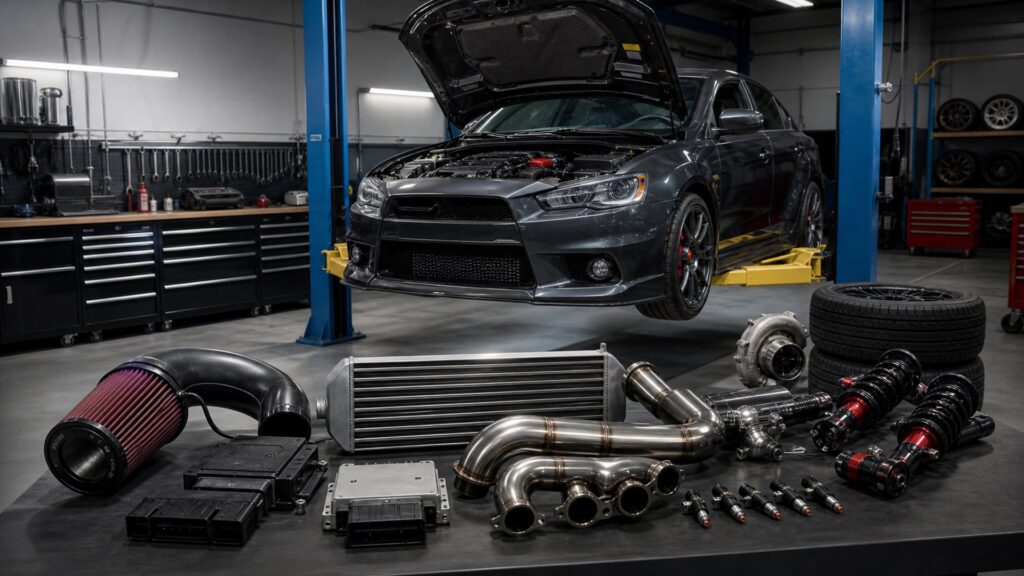
Set measurable goals and limits, establish baseline condition, identify the real bottleneck, install compatible parts, calibrate where required, and validate the entire vehicle under its intended duty.
Tip: Use the same fuel, test method, tire condition, weather correction, and operating temperatures before and after each change; an uncontrolled comparison can turn noise or adaptation into imaginary performance.
These terms explain why a catalog of parts is not a coherent tune.
Recorded stock or current-condition measurement used to judge change and detect existing faults.
Component or operating limit that most constrains the desired output in the current system.
Software values and strategies controlling fuel, ignition, torque, boost, airflow interpretation, diagnostics, and protection.
Difference between observed component temperature and the verified limit during sustained use.
Control strategy moderating delivered torque to protect traction, shifts, driveline parts, emissions, or stability.
Repeated cycle of measuring, changing, testing, reviewing, and correcting under controlled conditions.
Tip: Performance modifications can affect emissions compliance, noise, insurance, warranty coverage, structural safety, and road legality; verify exact parts, calibration, jurisdiction, and intended use.
Power rises when the engine safely traps and burns more usable air-fuel mixture at effective timing. Intakes, exhaust, cams, boost, injectors, pumps, intercooling, and calibration alter mass flow, pressure, temperature, mixture, and combustion stability.
An airflow part creates power only when fuel, timing, combustion, and downstream flow can use the change.
Combustion, compression, friction, drivetrain loss, braking, and tires convert energy into heat. Coolant, oil, charge air, exhaust valves, catalysts, transmission fluid, brakes, and tires each need temperature control and recovery.
Peak output without thermal repeatability is a temporary condition, not a reliable tune.
Clutch, converter, gearbox, shafts, differentials, axles, mounts, wheels, and tires transmit torque. Gear selection and tire grip determine acceleration, while wheel hop, heat, shock loading, and stability-control intervention expose limits.
Engine output is useful only to the extent the driveline and tire contact patches can deliver it repeatedly.
Springs support weight, dampers control motion, alignment shapes tire loading, and brakes turn kinetic energy into heat. Lowering or stiffening one element changes travel, bump-stop use, geometry, balance, ride, and grip on imperfect surfaces.
A balanced vehicle can be faster and safer with less peak engine output than a powerful vehicle that cannot place or remove energy.
ECUs estimate torque and coordinate throttle, boost, fueling, ignition, transmission, stability control, catalysts, and diagnostics. A part that changes sensor flow or exhaust behavior may need validated calibration and emissions approval rather than fault suppression.
Deleting a warning or monitor does not validate the mechanism that caused it.
Useful gains require the engine, calibration, cooling, driveline, tires, suspension, brakes, diagnostics, and compliance strategy to support the same duty cycle.
It solves a measured limitation for a defined use, preserves safeguards, and produces repeatable improvements in response, speed, consistency, or control rather than a single favorable number.
Each stage is documented, reversible where practical, and followed by mechanical, electronic, thermal, emissions, and road-behavior verification.
A new restriction, heat limit, traction ceiling, fuel shortfall, driveline weakness, brake fade, poor alignment, or illegal emissions state can erase or invalidate the gain.
Marketing horsepower cannot establish durability, safe calibration, lap consistency, street legality, noise compliance, warranty outcome, or performance on a different vehicle and environment.
These myths treat performance parts as independent additions whose advertised gains accumulate automatically.
Parts interact, baselines differ, and multiple products may remove the same restriction. ECU adaptation, test method, fuel, weather, drivetrain loss, and new bottlenecks prevent simple addition; measure the final compatible combination under controlled conditions.
Suppressing a diagnostic does not correct wrong airflow, catalyst behavior, sensor scaling, misfire, fuel pressure, knock, or emissions. Diagnose the mechanism, retain required monitoring, and use a validated compliant calibration rather than hiding evidence.
Excess stiffness or lost travel can unload tires on imperfect pavement, force bump-stop contact, change roll balance, disturb alignment, and reduce braking or cornering grip. Spring, damping, geometry, tires, and surface must be tuned together.
A brief pull may not expose heat soak, oil temperature, fuel depletion, repeated knock correction, clutch slip, transmission protection, brake fade, or tire overheating. Durability requires repeated duty-cycle testing and post-test inspection.
Tip: Trace energy and load through the complete vehicle, then verify the intended result and every shifted limit.
These answers cover modification order, dyno testing, warranties, emissions, and balanced street builds.
Begin with maintenance, tires, brakes, alignment, and baseline data; then address the measured limitation for the intended use. The correct first power part depends on engine, calibration, legal constraints, and actual airflow or thermal evidence.
A dyno measures controlled power behavior and useful logs, but cannot fully reproduce road airflow, cornering, braking, transient traction, elevation, long heat soak, or every transmission and stability-control interaction. Add duty-specific testing.
Coverage depends on jurisdiction, warranty terms, and whether the modification caused or contributed to the failure. Preserve records and original parts, use qualified installation, and obtain written guidance before assuming either universal coverage or automatic denial.
Check current federal, state, and local requirements plus vehicle-specific documentation. In California, many applicable aftermarket parts require a valid Executive Order covering the exact part, vehicle, engine, and installation configuration.
Repeatable response, suitable tires, adequate braking and cooling, preserved ride and travel, functional diagnostics, manageable sound, reliable fuel supply, conservative calibration, legal emissions, and serviceable components matter more than maximizing one peak number.
Performance and tuning products work by changing airflow, combustion, heat rejection, torque delivery, tire loading, braking, or control logic within one interconnected vehicle system.
Define the duty, repair the baseline, identify the bottleneck, preserve compliance and safeguards, change one mechanism deliberately, validate repeated thermal and dynamic behavior, and document every new load placed on adjacent systems.
These explainers deepen the electronic, gas-flow, forced-induction, and suspension mechanisms that must remain coordinated.
See how ECU calibration converts sensor inputs and driver demand into torque while protecting combustion, hardware, emissions, and diagnostics.
Trace restriction, temperature, air mass, pressure waves, filtration, sensors, and exhaust flow before assuming that a larger pipe increases power.
Understand how springs, dampers, alignment, travel, roll balance, tires, and surface determine whether chassis changes create usable grip.
Choose a retailer
Prices checked regularly. We may earn a commission at no cost to you.