
Mass Airflow
Mass of air crossing a reference point per unit time.
- Mass Airflow has a configuration-specific meaning within performance airflow
- Density makes volume alone misleading
- Verify mass airflow directly on the vehicle before deciding
Performance airflow matters because an engine produces torque from the mass of oxygen trapped in each cylinder, not from pipe diameter or intake sound. Pressure loss, air temperature, filtration, valve timing, runner waves, throttle area, exhaust pulses, catalysts, and turbine behavior determine how much usable charge arrives.
A larger component can slow gas velocity, disturb a mass-airflow sensor, weaken exhaust scavenging, admit heat, or move the bottleneck elsewhere. Sound evaluation measures pressure, temperature, airflow, mixture, and repeatable torque across speed and load while protecting filtration, water separation, emissions equipment, clearance, and calibration accuracy.
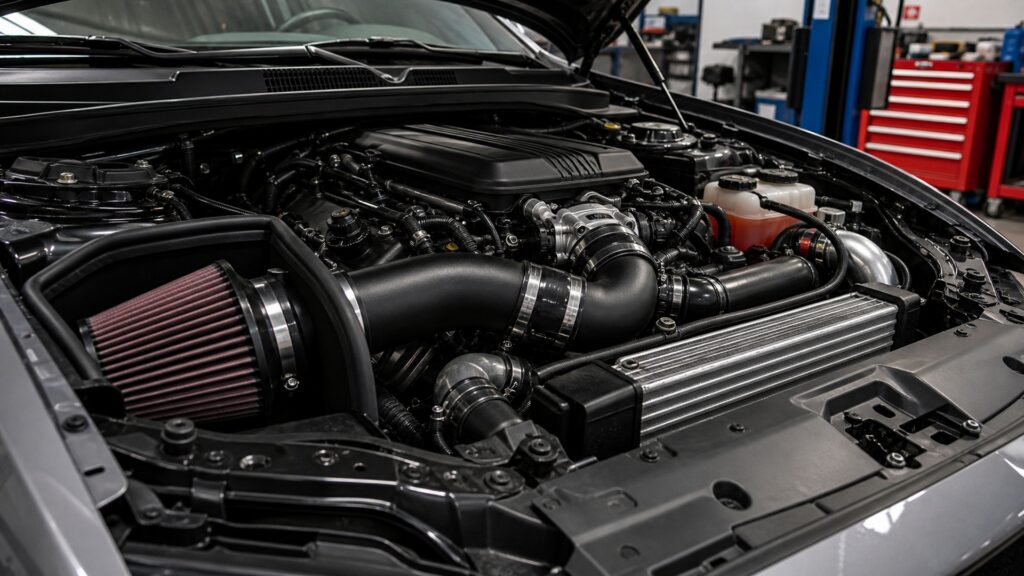
For Performance Airflow, follow physical inputs, control decisions, limiting conditions, and verification evidence to determine whether the claimed result is useful.
Tip: Record the performance airflow configuration and a repeatable baseline before changing it; uncontrolled comparisons cannot identify which mechanism caused the result.
These six terms locate the controlling variables inside performance airflow.
Mass of air crossing a reference point per unit time.
Loss of static or total pressure across a component.
Trapped cylinder charge relative to geometric displacement.
Measured temperature used to estimate charge density and protection.
Exhaust-pulse action helping remove residual gas and start cylinder filling.
Pressure opposing exhaust discharge at a defined location and condition.
Tip: Apply performance airflow concepts with exact service data, calibrated instruments, and a recorded complete configuration.
The engine needs dense, filtered air delivered with acceptable pressure loss. Diameter, bends, surface, filter area, throttle, compressor, and temperature combine differently at idle, transient demand, and high speed.
A visually larger intake is valuable only when the complete tract supplies more usable charge.
Pressure waves reflect through runners and manifolds as valves open and close. Length, area, cam timing, plenum volume, and engine speed decide whether a wave helps filling or reverses flow.
Flow capacity and tuned-wave behavior solve different problems.
Headers and collectors organize discrete pulses so low pressure can assist another cylinder. Oversized passages, poor junctions, leaks, or conflicting firing order can weaken the effect despite low bench restriction.
Exhaust performance is a timed gas-dynamics problem, not simply pressure elimination.
Mass-airflow housing shape, turbulence, sensor position, leaks, and temperature placement affect estimated charge. A mismatch changes fuel, torque, diagnostics, and protection before any true airflow benefit is established.
Inaccurate measurement can turn added flow into unstable combustion.
Measure pressure before and after suspected restrictions at the operating point that matters. Once one loss is reduced, valves, ports, compressor range, catalyst capacity, fuel, cooling, or calibration may become limiting.
An airflow part has no independent horsepower value outside its system and test condition.
For Performance Airflow, isolate the operative mechanism from conclusions still requiring complete-vehicle testing.
Performance airflow matters when lower losses, suitable temperature, accurate sensing, and timed gas exchange increase trapped oxygen across the intended speed range.
A credible performance airflow result repeats after temperature stabilization while its connected safeguards remain functional.
A larger or louder passage alone cannot prove additional cylinder charge, safe fueling, emissions compliance, filtration quality, or useful torque.
Within performance airflow, sound, sensation, a peak number, or a product label cannot establish durability, legality, or improvement throughout the operating range.
Common performance airflow myths confuse a visible feature with complete-vehicle behavior.
Excess area can reduce velocity, weaken pressure-wave tuning, disturb sensor flow, increase heat exposure, or shift torque outside the useful speed range. Diameter must match mass flow, pulse timing, packaging, and the engine's intended operation.
Engines generally benefit from effective gas exchange, not resistance for its own sake. Poorly sized systems may lose pulse energy or scavenging when restriction falls, which is a wave-timing problem rather than a need for pressure.
Temperature affects density, but the controller, airflow limit, vehicle speed, enclosure, weather, heat soak, fuel, and test method determine whether cooler inlet air creates measurable cylinder charge and repeatable torque.
Filtration efficiency, dirt capacity, sealing, sensor contamination, water behavior, pressure loss, and service condition all matter. A small restriction difference cannot justify unfiltered air or unreliable airflow measurement over the engine's service life.
Tip: Test each performance airflow claim under controlled conditions; then inspect the heat, force, flow, and control demands created specifically by performance airflow.
The following answers resolve practical decisions specific to performance airflow.
Measure pressure relative to atmosphere at relevant points while the engine operates under controlled load, then compare clean repeatable runs. Filter condition, vehicle speed, temperature, throttle position, and sensor accuracy must remain documented.
Cooler air is denser at equal pressure, but torque changes only if the engine traps and burns additional oxygen within calibration and hardware limits. Heat soak, timing protection, compressor efficiency, and ambient correction alter the result.
Required area depends on mass flow, temperature, pulse timing, cylinder count, firing order, power target, speed range, turbine, catalysts, sound control, and packaging. Use validated application data rather than one universal displacement formula.
Yes, especially when sensor housing, injector demand, boost control, load estimation, cam behavior, or exhaust monitoring changes. Log trims, mixture, pressure, knock, and diagnostics to determine whether the original model remains accurate.
Fans, hood position, ambient correction, tire temperature, gear selection, adaptation, heat soak, fuel, restraint, and measurement smoothing influence results. Repeat matched tests and examine the complete curve before attributing a difference to airflow.
Performance airflow matters when lower losses, suitable temperature, accurate sensing, and timed gas exchange increase trapped oxygen across the intended speed range.
A larger or louder passage alone cannot prove additional cylinder charge, safe fueling, emissions compliance, filtration quality, or useful torque.
Use these adjacent mechanisms to plan, validate, and troubleshoot the complete performance airflow decision.
Compare cold-air and short-ram layouts through temperature, length, water exposure, and sensing.
Trace exhaust pulses, sizing, catalysts, sound control, and thermal constraints.
See how a compressor changes pressure ratio, temperature, density, and engine demand.
Choose a retailer
Prices checked regularly. We may earn a commission at no cost to you.