Why ECU Tuning Matters

ECU tuning matters because a modern controller interprets pedal demand, airflow, pressure, temperature, oxygen, knock, speed, and gear signals, then coordinates throttle, injection, ignition, boost, torque limits, transmission requests, diagnostics, and protective actions. Those decisions determine how installed hardware behaves together.

Changing injectors, fuel, compression, exhaust, airflow measurement, or boost can invalidate original assumptions. Responsible calibration restores an accurate model while retaining cold-start behavior, thermal protection, knock response, onboard diagnostics, catalyst control, and predictable drivability. Validation must cover load, temperature, altitude, transients, and fault conditions—not one favorable dyno pull.

By: Review Streets Research Lab
Updated: August 31, 2026
Explainer · 8-12 min read
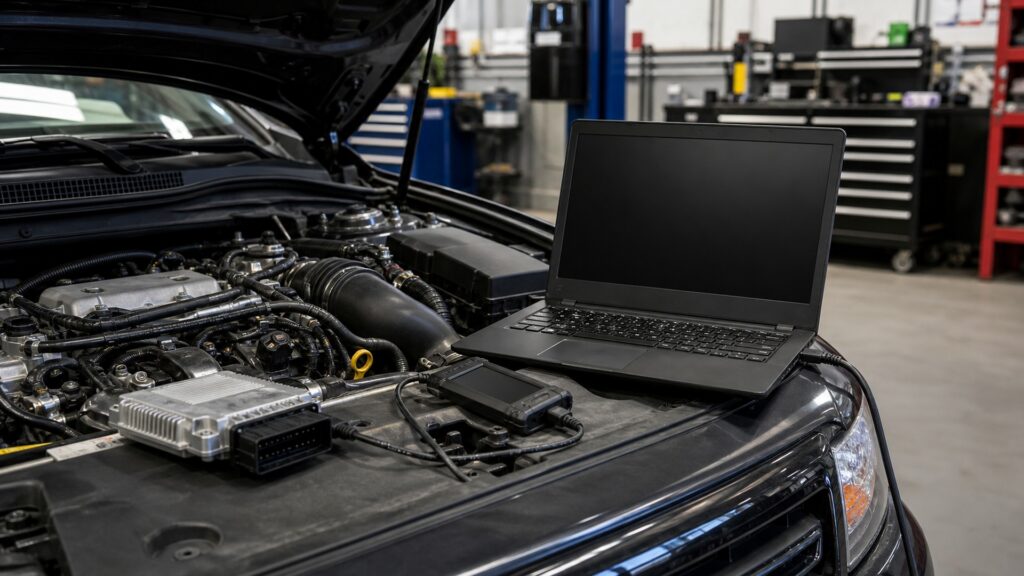
ecu tuning explainer hero image for Review Streets
What You'll Learn

Trace the Operating Chain behind ECU Tuning

For ECU Tuning, follow physical inputs, control decisions, limiting conditions, and verification evidence to determine whether the claimed result is useful.

  • How Signals Become an Engine-State Estimate
  • Why Fuel and Spark Must Follow Charge Conditions
  • How Driver Demand Reaches the Powertrain
  • Why Protective Logic Is Part of Performance
  • What Separates Development from Guesswork
  • Where ecu tuning measurement separates improvement from impression

Tip: Record the ecu tuning configuration and a repeatable baseline before changing it; uncontrolled comparisons cannot identify which mechanism caused the result.

Definitions

Key Concepts That Define ECU Tuning

These six terms locate the controlling variables inside ecu tuning.

Calibration Map

A table or model relating operating conditions to a commanded value.

  • Calibration Map has a configuration-specific meaning within ecu tuning
  • Interpolation between cells matters
  • Verify calibration map directly on the vehicle before deciding

Load Axis

The controller estimate of cylinder filling or requested effort.

  • Load Axis has a configuration-specific meaning within ecu tuning
  • Its calculation varies by strategy
  • Verify load axis directly on the vehicle before deciding

Spark Advance

Ignition timing used to position cylinder-pressure development.

  • Spark Advance has a configuration-specific meaning within ecu tuning
  • More advance is not always more torque
  • Verify spark advance directly on the vehicle before deciding

Fuel Trim

Closed-loop correction after measured mixture differs from command.

  • Fuel Trim has a configuration-specific meaning within ecu tuning
  • Correction can expose mechanical faults
  • Verify fuel trim directly on the vehicle before deciding

Knock Retard

Timing reduction following vibration associated with abnormal combustion.

  • Knock Retard has a configuration-specific meaning within ecu tuning
  • Noise and actual knock require distinction
  • Verify knock retard directly on the vehicle before deciding

Torque Request

Desired output translated into throttle, boost, fuel, and spark actions.

  • Torque Request has a configuration-specific meaning within ecu tuning
  • Delivered torque may be limited elsewhere
  • Verify torque request directly on the vehicle before deciding

Tip: Apply ecu tuning concepts with exact service data, calibrated instruments, and a recorded complete configuration.

Sensor Interpretation

How Signals Become an Engine-State Estimate

Airflow or manifold pressure combines with speed, temperature, oxygen, and modeled efficiency to estimate trapped charge. Incorrect scaling corrupts fueling, torque calculation, and protection even when the engine appears smooth.

  • Validate sensor ranges
  • Compare redundant load estimates
  • Check trims across conditions
  • Reject implausible signals

Calibration accuracy begins with trustworthy physical measurements.

Combustion Commands

Why Fuel and Spark Must Follow Charge Conditions

Injection controls mixture while timing positions peak pressure. Fuel quality, charge temperature, residual gas, compression, and boost change the safe torque-producing window.

  • Confirm fuel pressure under load
  • Monitor cylinder knock response
  • Test transient enrichment
  • Inspect hot restart behavior

Peak output cannot justify unstable combustion or exhausted fuel margin.

Torque Coordination

How Driver Demand Reaches the Powertrain

The controller arbitrates driver request against traction, shift, temperature, component, and emissions limits. Removing one limiter can transfer unmodeled load into the transmission, axles, or tires.

  • Log requested and delivered torque
  • Preserve shift intervention
  • Test each drive mode
  • Review traction-control behavior

Torque modeling links engine output to every downstream component.

Safeguards and Diagnostics

Why Protective Logic Is Part of Performance

Temperature enrichment, boost reduction, knock control, catalyst protection, misfire detection, and limp strategies respond outside the normal envelope. Disabling them hides evidence rather than increasing capacity.

  • Exercise plausible failsafes
  • Retain required monitors
  • Scan permanent codes
  • Verify protection thresholds

A warning suppressed in software is not a fault repaired in hardware.

Validation and Compliance

What Separates Development from Guesswork

Repeatable tests cover steady state, acceleration, deceleration, heat soak, altitude, fuel variation, and diagnostic readiness. Emissions obligations remain when software changes the control strategy.

  • Archive the stock file
  • Document hardware and fuel
  • Retest after heat stabilization
  • Verify application-specific approval

A defensible tune is a documented operating envelope, not an unexplained file.

Quick Reality Check

What ECU Tuning Can Change—and What It Cannot Prove

For ECU Tuning, isolate the operative mechanism from conclusions still requiring complete-vehicle testing.

Evidence of a Coherent Result

ECU tuning matters because software coordinates air, fuel, spark, torque, protection, diagnostics, and emissions across changing operating conditions.

A credible ecu tuning result repeats after temperature stabilization while its connected safeguards remain functional.

Claims Requiring More Evidence

Calibration cannot create fuel capacity, cooling margin, mechanical strength, legal approval, or accurate sensor information the vehicle does not possess.

Within ecu tuning, sound, sensation, a peak number, or a product label cannot establish durability, legality, or improvement throughout the operating range.

Common Myths

Misconceptions About ECU Tuning

Common ecu tuning myths confuse a visible feature with complete-vehicle behavior.

A tune is safe if air-fuel ratio looks correct

Mixture is only one combustion variable. Timing, charge temperature, fuel pressure, knock activity, cylinder balance, exhaust temperature, torque modeling, and transient response may reveal serious risk while a wideband reading still appears plausible.

Deleting torque limits always unlocks hidden power

A limit may protect shifts, traction, catalysts, turbo speed, coolant temperature, or driveline hardware. Removing it without identifying its purpose transfers stress and can make delivered torque less repeatable instead of more useful.

The ECU automatically learns any bolt-on part

Adaptive trims correct bounded deviations; they do not rewrite sensor transfer functions, injector data, boost control, torque models, or protection logic. Large hardware changes can move operation far beyond the strategy's corrective authority.

No check-engine light means the tune is correct

Many errors remain inside thresholds, appear only at temperature or load, or have been hidden through altered monitor settings. Correctness requires logs, readiness verification, mechanical inspection, and repeatable behavior across the intended envelope.

Tip: Test each ecu tuning claim under controlled conditions; then inspect the heat, force, flow, and control demands created specifically by ecu tuning.

FAQ

Frequently Asked Questions About ECU Tuning

The following answers resolve practical decisions specific to ecu tuning.

When does a vehicle actually need ECU tuning?

Calibration may be required when hardware changes sensor interpretation, injector behavior, fuel type, boost, cam timing, torque capacity, or exhaust operation beyond factory assumptions. Confirm the platform because some supported modifications remain within normal adaptation.

Can ECU tuning improve fuel economy?

Software can alter throttle, torque, shift, and mixture behavior, but economy depends on duty cycle and driver demand. Gains are not guaranteed, and stronger torque availability often encourages consumption that offsets calibrated efficiency.

What data should be logged after a tune?

Review commanded and measured mixture, fuel pressure, ignition, knock, load, airflow, boost, throttle, temperatures, torque intervention, misfire counts, trims, and diagnostic status. Platform-specific channels and sensor accuracy determine valid conclusions.

Can a tuned ECU be returned to stock?

A stock file can often be restored, but counters, learned values, incompatible hardware, locked modules, or earlier software changes may remain relevant. Preserve verified backups and confirm every original monitor and function afterward.

Does ECU tuning affect emissions legality?

Yes. Calibration changes involving diagnostics, catalysts, fueling, airflow, or boost can affect regulated emissions and anti-tampering rules. Use documentation valid for the exact vehicle and jurisdiction instead of assuming a vendor label proves compliance.

Bottom Line

ECU tuning matters because software coordinates air, fuel, spark, torque, protection, diagnostics, and emissions across changing operating conditions.

Calibration cannot create fuel capacity, cooling margin, mechanical strength, legal approval, or accurate sensor information the vehicle does not possess.

Next Steps

Continue from ECU Tuning to Its Dependent Systems

Use these adjacent mechanisms to plan, validate, and troubleshoot the complete ecu tuning decision.