
Starter Inrush Current
The large electrical demand as a stationary starter motor begins turning the engine.
- It is brief but severe
- Engine temperature and viscosity change it
- A weak connection magnifies voltage loss
A portable jump starter matters because it carries its own stored energy to the disabled vehicle. It can supply the short, high-current burst a starter motor needs without positioning a donor vehicle, stretching live cables between engine bays, or depending on another driver's battery and charging system.
Independence is not the same as certainty. The pack must be charged, warm enough, correctly sized, and connected to a compatible electrical system through clean, low-resistance contact. Protection electronics may refuse an extremely low battery; override modes can remove safeguards. After a successful start, the original cause—discharged battery, poor terminal, failing starter, or charging fault—still needs diagnosis.
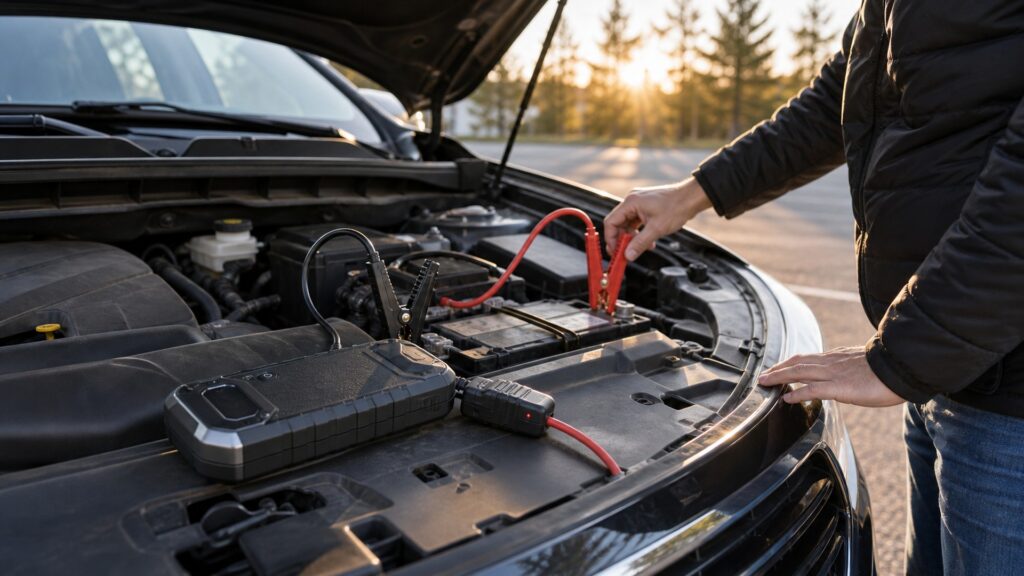
The useful question is not the advertised peak number; it is whether the pack can hold adequate voltage through its cells, switches, cables, clamps, vehicle connections, and starter during the crank event.
Tip: Before relying on a pack, use it once on the actual vehicle under controlled conditions and confirm that its clamps can reach the designated jump points without resting near belts, fans, or hot exhaust.
These electrical terms determine whether a compact pack can deliver a useful crank rather than merely show a full-charge indicator.
The large electrical demand as a stationary starter motor begins turning the engine.
Drop in terminal voltage while current flows through the source and circuit resistance.
Opposition inside the pack, vehicle battery, cables, and connections that converts current into heat and voltage loss.
Fraction of usable energy presently stored in the jump pack.
Electronic control that blocks output when clamp polarity is detected as incorrect.
Mode that forces some jump packs to energize when an extremely discharged battery is not automatically detected.
Tip: Always follow the vehicle and jump-starter manuals; some vehicles specify remote posts or contain high-voltage systems that change the approved procedure.
The starter asks for far more current than most portable electronics, but only for a short interval. Cell chemistry, pack architecture, switch capacity, cable cross-section, clamp pressure, and connection cleanliness determine whether voltage remains high enough for the solenoid, starter, and engine controller.
A four-digit peak-amp label cannot describe voltage under the actual vehicle's load.
Automatic packs look for correct polarity and sufficient battery voltage before closing their internal switch. A deeply discharged or disconnected battery may fall below the detection threshold. Product-specific override can bypass that logic and must never become a routine first step.
The refusal may be the safety system working exactly as designed.
Cold slows electrochemical reactions and increases engine cranking demand, while hot storage accelerates battery aging. Consecutive attempts heat cells, switches, and cables. Rated rest intervals protect the pack from a sequence that turns a simple no-start into equipment damage.
A pack that worked in a garage may behave differently after months in a freezing or sun-baked vehicle.
Displacement provides a rough demand clue, but diesel compression, oil viscosity, ambient temperature, battery condition, cable reach, system voltage, and engine mechanical state change the event. Manufacturer application limits and independent load behavior matter more than adding peak-current claims.
Correct sizing includes the electrical architecture and environment, not just liters.
If a boost produces normal cranking, the battery state, connections, charging history, or parasitic load deserve testing. Slow cranking with strong external support can indicate resistance or starter problems; no engagement can point toward control, interlock, security, or mechanical faults.
Portable starting power buys mobility and diagnostic time; it does not restore battery capacity.
A jump pack replaces the donor vehicle only when its stored energy, connections, safeguards, and upkeep remain credible.
It is charged on schedule, sized for the vehicle and climate, stored securely, and supplied with clamps that reach the approved points.
The owner knows the normal connection sequence, indicator meanings, attempt limits, and the exact hazard introduced by any override function.
Do not energize damaged, frozen, leaking, swollen, wrong-voltage, or unidentified battery systems, or improvise around inaccessible terminals and high-voltage components.
Repeated failed cranks, smoke, hot cables, strong fuel odor, abnormal mechanical resistance, or a vehicle manual prohibition are stop signals, not invitations to try a larger pack.
Jump-starter myths often turn one headline current rating into a promise of universal starting ability.
Peak current may be measured under conditions unlike a real crank and does not show duration or voltage retention. Cable loss, temperature, cell resistance, protection limits, and the vehicle's starter demand determine usable performance.
Self-discharge, standby electronics, heat aging, and cold output loss continue during storage. The pack needs periodic inspection and charging according to its manual, plus removal from conditions outside its specified storage limits.
Override exists for narrowly defined low-voltage situations on some products. It may disable reverse-polarity and spark protections, making a connection error far more dangerous without increasing the pack's underlying thermal or energy capacity.
Alternator charging may restore some energy, but a deeply discharged, aged, damaged, or sulfated battery can remain unreliable. Short trips and idle time may be insufficient, and the discharge cause can immediately repeat.
Tip: Evaluate the whole high-current path, the safety logic, and the condition that discharged the vehicle before trusting a successful demonstration.
These answers cover charge scheduling, cold weather, diesel use, battery diagnosis, and safe storage.
Follow the model's manual and check it before long trips or severe weather. Recharge after use and at the stated storage interval, because indicator lights, temperature, age, and standby drain make one universal calendar unreliable.
Only within its rated operating range. Cold can reduce pack output while the engine demands more torque, so warm the pack as the manufacturer permits, keep it dry, and never heat or charge it with improvised methods.
It can when the model is approved for that diesel displacement, system voltage, battery arrangement, and expected temperature. Glow-plug demand and higher compression increase the burden, so generic gasoline-engine ratings are not interchangeable.
A boost result alone cannot separate them. Test battery condition, charging voltage and current, terminal voltage drop, and key-off drain under the vehicle's procedure; inspect belts and warnings before assuming one component failed.
Secure it against crash movement in a dry location within its temperature limits, with protected terminals and accessible instructions. Avoid loose metal objects, direct sun, wet compartments, and any position where cargo can crush or puncture it.
Portable jump starters matter because they bring an independent, controlled source of cranking energy to a disabled vehicle without requiring a donor car.
Their real value depends on charge, temperature, circuit resistance, correct sizing, safe connection, and disciplined follow-up diagnosis after the engine turns.
The next explanations separate the donor-cable alternative from the broader roadside incident that surrounds a no-crank event.
Compare self-contained jump energy with a donor-battery circuit through dependence, cable loss, connection order, storage, upkeep, and failure modes.
Place the no-crank event inside the warning, communication, exposure, and escalation sequence that comes before repair.
Build charge checks, cold-weather planning, contact procedures, and backup transportation into the trip rather than relying on one device.
Choose a retailer
Prices checked regularly. We may earn a commission at no cost to you.