
Rated Capacity
The manufacturer's stated load or operating boundary for equipment under specified setup and use conditions.
- Capacity depends on geometry and condition
- Side loading can invalidate the rating
- The weakest support component controls
Automotive tools and garage equipment control force, vehicle weight, electrical state, fluid pressure, temperature, motion, fastener clamp, and measurement. A useful garage is not defined by drawer count. It is defined by whether each task has safe support, an appropriate tool, trustworthy information, and a way to verify the result.
The workflow begins before a wrench turns. Identify the system and hazards, preserve evidence, isolate energy, lift only at approved points, and choose equipment whose rating and geometry fit the vehicle. During reassembly, cleanliness, sequence, torque, fluid specification, and calibration matter. The last step is functional proof: leak checks, scan data, road behavior, reinspection, and documentation close the repair instead of assuming that new parts equal success.
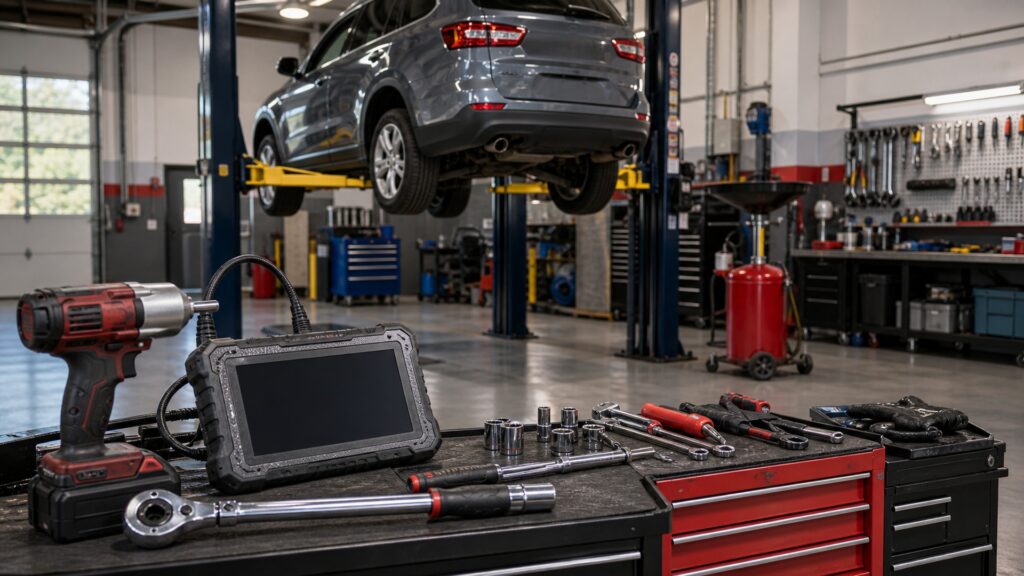
Each category of equipment should own a distinct job: diagnose, stabilize, access, remove, measure, assemble, contain, protect, and prove.
Tip: Lay out the support points, escape path, removed-part location, fluid containers, and final checks before disabling the vehicle. Workspace design is part of the repair method.
These definitions link garage objects to the risk or uncertainty they are intended to control.
The manufacturer's stated load or operating boundary for equipment under specified setup and use conditions.
A vehicle location engineered or designated to receive lifting or supporting force in a specified manner.
Potential energy retained in raised mass, springs, pressure, capacitors, rotating parts, heat, or chemical systems.
A voltage, pressure, temperature, dimension, signal, or mechanical observation used to test a fault hypothesis.
Documented comparison and adjustment that establishes a measuring tool's performance against a suitable reference.
A planned test showing the original fault is gone and the serviced system performs safely under relevant conditions.
Tip: A tool is appropriate only when its range, geometry, condition, rating, and procedure match the exact task—not when it merely fits the fastener.
A scan tool, meter, pressure gauge, smoke machine, stethoscope, straightedge, or dial indicator should answer a specific question. Service information supplies expected values, connector views, test conditions, and known hazards. Random tool use merely creates more observations.
Diagnosis is controlled comparison, not accessory-driven guessing.
A floor jack moves the vehicle; approved stands or a locked lift support it. Capacity, reach, saddle shape, surface level, wheel restraint, lift-point condition, and load shift all matter. Never rely on hydraulic pressure alone beneath a raised vehicle.
Access is safe only when gravity has a redundant, rated path to the floor.
Bearings, ball joints, springs, pulleys, seals, and bushings often need fixtures that apply load to the correct race or surface. Improvised hammering can mushroom shafts, launch parts, damage new components, or store dangerous off-axis energy.
A special tool often protects the mechanic by protecting the geometry.
Torque tools, angle gauges, feeler gauges, micrometers, seal drivers, funnels, and fluid-transfer equipment manage final dimensions and contamination. Thread condition, lubricant, one-time-use hardware, seal orientation, and sequence come from the service procedure.
The most expensive component can be ruined by one unmeasured interface.
Exhaust, fuel vapor, refrigerant, battery gas, grinding sparks, hot surfaces, solvents, and trailing cords can turn a routine task into an incident. Appropriate PPE, ventilation, spill control, extinguisher access, lighting, and orderly storage create the boundaries within which tools remain useful.
A technically correct repair performed in an uncontrolled bay is not a safe process.
The bay works when equipment controls diagnosis, weight, force, contamination, exposure, assembly specification, or verification with no unsupported gap.
Current service information defines the task; measuring tools establish the fault; rated supports and special fixtures control energy; clean assembly tools restore specified interfaces.
Lighting, ventilation, PPE, fire and spill controls protect the work, while leak checks, scan results, road tests, and reinspection demonstrate that the vehicle is genuinely ready.
A large toolbox cannot supply training, current procedures, safe lift-point condition, calibration, judgment, or a stopping rule when airbags, high voltage, refrigerant, fuel, springs, or machining exceed competence.
No jack, stand, scan tool, torque wrench, or code reader proves the repair alone; each result needs correct setup, interpretation, compatible range, and final functional verification.
Garage myths confuse access to equipment with control of the physical hazard or diagnostic question that equipment was designed to manage.
A jack is primarily a lifting device and can lose height through leakage, movement, valve error, or unstable ground. Use approved support equipment at designated points and verify stability before any body part enters the crush zone.
A scan tool retrieves data and commands functions; fault codes identify monitored conditions, not guaranteed failed parts. Wiring tests, mechanical checks, service information, symptom reproduction, and post-repair data must complete the diagnosis.
Drive size, wall thickness, material, impact rating, fastener geometry, access angle, and torque demand matter. A loose or unsuitable socket can round hardware, fracture, slip under force, or hide incorrect fastener engagement.
Oversized equipment may not fit lift points, operate accurately at low range, or provide suitable control. Correct rating includes usable geometry, range, condition, and setup; excessive capacity cannot compensate for unstable placement or side loading.
Tip: Name the energy, force, measurement, and proof required by the job before choosing a tool or deciding the work belongs outside a home garage.
These answers address first purchases, lift safety, battery tools, calibration, ventilation, and the boundary between home service and specialist work.
Start with current service information, eye protection, lighting, wheel chocks, a reliable pressure gauge, quality hand tools, and task-specific measuring equipment. Add lifting gear only after understanding ratings, approved points, floor requirements, and support procedure.
Choose stands with adequate rated capacity, stable bases, suitable height range, and saddles compatible with designated support points. Use matched equipment on firm level ground, inspect condition, and follow both stand and vehicle-maker instructions.
They can run fasteners down when the procedure permits, but impact energy can overshoot or damage threads. Final clamp work should follow specified sequence, thread condition, torque, and angle using appropriate measuring tools within range.
Follow the manufacturer, quality system, usage severity, storage history, and criticality of the measurement. Recheck after overload, impact, unusual drift, repair, or doubtful results; record status so a past reading can be trusted.
Stop when the task exceeds training, information, environmental controls, or rated equipment—especially high-voltage systems, airbags, refrigerant recovery, fuel tanks, major springs, machining, welding near hazards, or unstable and corroded lift structures.
Automotive tools and garage equipment work by controlling diagnosis, vehicle weight, stored energy, force, measurement, contamination, exposure, assembly specification, and final proof in a deliberate sequence.
Build capability around actual procedures and safe stopping rules, keep rated and calibrated equipment within its range, and treat support, ventilation, cleanliness, and post-repair testing as tools rather than background details.
The related explainers deepen three high-consequence garage controls: measured fastener clamp, fault diagnosis, and safe service of wheel and brake assemblies.
Learn how a torque wrench turns specified thread conditions and a tightening sequence into controlled fastener input—and where torque alone remains imperfect.
Use OBD-II data as one diagnostic input rather than a parts-replacement command.
Apply support, measurement, cleanliness, torque, and final verification to safety-critical brake service.
Choose a retailer
Prices checked regularly. We may earn a commission at no cost to you.