
Tightening Torque
The rotational moment applied to a fastener during installation, expressed in specified force-distance units.
- It is measured at the tool drive
- Most input overcomes friction
- It only estimates resulting tension
A torque wrench matters because automotive joints depend on controlled fastener clamp. Too little preload can allow movement, leakage, fretting, or loosening; too much can stretch the fastener, crush a gasket, distort a rotor or housing, or strip threads. The wrench measures applied torque so the technician can follow a defined specification and sequence.
Torque is an indirect route to bolt tension. Most input is consumed by friction at the threads and under the head or nut, so lubricant, coatings, corrosion, reused hardware, washers, and tightening speed can change clamp load at the same reading. Correct work includes the exact procedure, thread condition, staged sequence, appropriate tool range, smooth technique, calibration control, and any required angle step or new fastener.
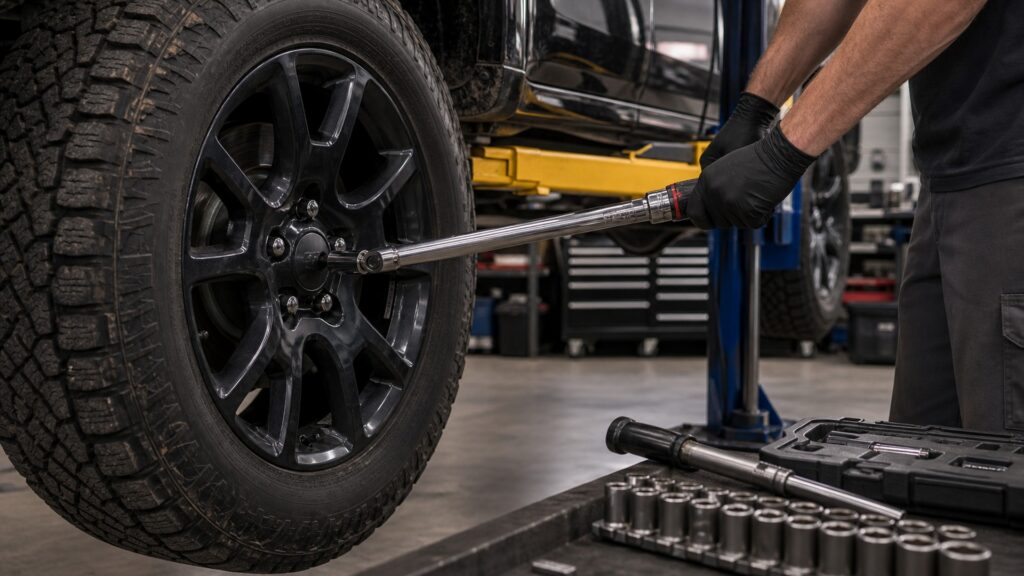
The wrench is one link between a written specification and the clamp load that seals, locates, and holds real automotive components together.
Tip: Before tightening, read whether the specification assumes clean dry threads, oil, sealant, threadlocker, a new bolt, a washer, or a multi-stage torque-plus-angle procedure. Friction preparation is part of the number.
These terms distinguish the wrench reading from the fastener tension and joint behavior it is intended to control.
The rotational moment applied to a fastener during installation, expressed in specified force-distance units.
The compressive force holding joint members together after a fastener has been tensioned.
Resistance between mating threads that consumes a large portion of the applied tightening torque.
A controlled fastener rotation applied after a defined snug or torque stage to create additional stretch.
A bolt intentionally tightened into or near a controlled plastic-stretch region under a specified procedure.
The span over which a torque tool's accuracy has been established for stated direction and conditions.
Tip: A torque value without units, thread condition, sequence, fastener policy, and tool range is not a complete automotive instruction.
Turning the nut or bolt spends torque in thread friction, bearing-surface friction, and elastic fastener stretch. Small friction changes can therefore create large clamp-load differences. A specification is valid only with its intended coatings, lubricant, washers, and mating surfaces.
Matching the number while changing friction can miss the intended joint completely.
Cylinder heads, covers, manifolds, wheels, and multi-bolt flanges can distort when one fastener reaches full torque too early. Cross patterns, center-out sequences, and staged values distribute seating and gasket compression while adjacent fasteners interact.
A perfect final reading in the wrong order can still leave an uneven joint.
Some procedures establish a preliminary torque to seat the joint, then specify additional degrees. Thread pitch converts rotation into elongation, helping control fastener stretch—but only with the correct bolt, starting stage, sequence, and reuse policy.
An angle specification is a distinct measurement, not an approximate final torque.
A click wrench should be loaded smoothly at its intended handle position and stopped at the signal. Jerking, double-clicking, side loading, using the wrong range, or adding certain adapters can change effective input. Crowfoot geometry requires calculation when it changes lever length.
The tool cannot correct a lever arm or technique that differs from its calibration setup.
Breakaway torque includes static friction, corrosion, threadlocker, embedment, heat history, and direction change. It cannot prove how a fastener was installed. Verification instead relies on controlled assembly records, witness marks where appropriate, tool status, and procedure-specific rechecks.
A high removal reading is history plus friction, not a certificate of correct preload.
The method works because controlled friction, geometry, sequence, and tool behavior make applied torque reasonably repeatable—not because torque and bolt tension are identical.
The exact procedure defines units, thread preparation, hardware reuse, stages, sequence, angle, and target; the chosen wrench is calibrated and suitable within its operating range.
The fastener is hand-started, seating surfaces are correct, the pull is smooth at the proper grip point, and final documentation preserves what was actually done.
It cannot detect every wrong bolt, damaged thread, bottomed hole, trapped fluid, cracked component, contaminated seat, yielded reusable fastener, unit conversion error, or incorrect service specification.
It cannot directly measure clamp load, validate an unspecified lubricant, justify torque derived from a similar vehicle, or reconstruct installation quality from breakaway torque afterward.
Torque-wrench myths treat the click as an independent truth rather than the end of a carefully defined joint-preparation and tightening process.
The wrench measures rotational moment at its drive. Clamp load is inferred through a friction-sensitive relationship, so thread coatings, lubricant, washers, corrosion, seating surfaces, and joint geometry can change tension even when indicated torque is identical.
The wrench can click on a cross-threaded, bottomed, seized, dirty, or already over-tightened fastener. Correct hardware, clean mating surfaces, hand starting, staged sequence, and procedure-specific verification must establish that the joint actually seated.
Breakaway force changes with static friction, corrosion, heat, threadlocker, embedment, and elapsed service. The removal reading cannot reliably reconstruct installation torque or clamp load and should not replace recorded assembly procedure.
Tool types and models have stated ranges and accuracy conditions. Very low settings on a high-capacity wrench may be unsuitable, while overload, impact, poor storage, side loading, or unapproved extensions can invalidate expected accuracy.
Tip: Trace units, friction, hardware, sequence, tool range, technique, and any angle stage before accepting the number as evidence of correct assembly.
These answers address wrench types, storage, calibration, extensions, wheel fasteners, and what to do when a tightening event does not feel normal.
Click, beam, split-beam, dial, and electronic tools can all be appropriate. Choose the drive, range, direction, access, readability, angle capability, durability, and calibration support that fit the procedures—not one supposedly universal mechanism.
Follow the tool manufacturer's storage instruction. Many call for returning the setting to the lowest marked value rather than forcing it below scale, which can protect the spring while avoiding an uncalibrated or damaging position.
Use the manufacturer's interval, quality-system rules, cycle count, severity, and joint consequence. Check sooner after overload, dropping, repair, suspected drift, or improper storage, and maintain traceable records for safety-critical work.
A straight socket extension generally does not change the lever arm, though flex and technique still matter. A crowfoot or adapter aligned to lengthen the wrench changes effective leverage and requires the specified calculation; ninety-degree orientation often avoids length change.
A staged star or cross pattern seats the wheel progressively against a clean hub, reducing uneven clamp and runout risk. Use correct seats and hardware, avoid impact-tool final tightening, and follow vehicle guidance for reinspection or retorque.
Torque wrenches matter because automotive joints need controlled clamp input, and applied torque provides a practical—though friction-sensitive—way to reproduce the specified assembly process.
Use the exact units, thread condition, sequence, stages, range, grip, and angle procedure; maintain the tool and document critical work, because the click cannot rescue a wrong fastener or undefined joint.
The related explainers place torque control inside the garage workflow, wheel attachment, and safety-critical brake service where preparation and verification matter most.
Place the torque wrench within a complete process of diagnosis, rated support, special-tool force control, cleanliness, hazard containment, and post-repair proof.
Trace wheel-fastener clamp through the hub, rim, tire, and road-force path.
See how fastener sequence, surface condition, fluid control, measurement, and verification affect a safety-critical brake repair.
Choose a retailer
Prices checked regularly. We may earn a commission at no cost to you.