
GCWR
Gross Combined Weight Rating for the loaded tow vehicle and loaded trailer operating together.
- Actual combined weight must remain below it
- It does not replace individual axle limits
- Altitude heat and grade still affect performance
Towing turns two vehicles into one articulated system. The tow vehicle supplies propulsion, steering, cooling, electrical power, and much of the braking; the hitch and coupler transmit force; the trailer carries its own load through frame, axles, tires, suspension, brakes, and cargo restraints. Every connection has a separate rating.
A safe combination is built from actual weights, not one advertised maximum. Tongue load consumes tow-vehicle payload and changes axle distribution. Cargo position influences yaw stability. Speed, crosswind, tire pressure, brake adjustment, hitch height, and controller setup determine behavior after motion begins. Match ratings, measure the loaded configuration, connect and inspect, set braking and mirrors, perform a low-speed test, and recheck after the first miles.
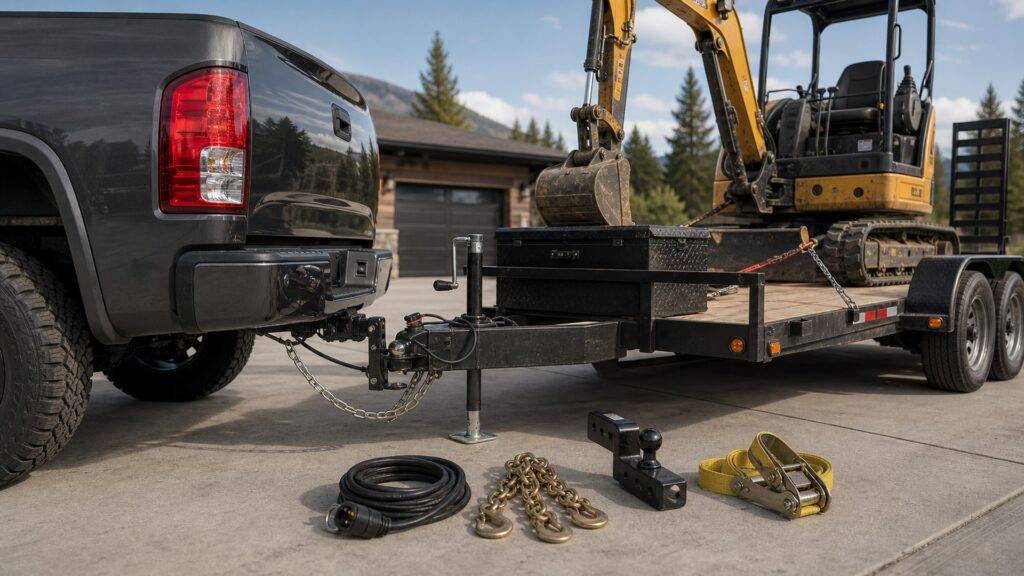
Treat vehicle, hitch, trailer, tires, brakes, wiring, and cargo as one force path whose lowest applicable rating sets the limit.
Tip: Use axle-scale readings with the trailer connected and configured for travel. A total weight can look acceptable while rear GAWR, payload, a tire pair, receiver, or trailer axle already exceeds its limit.
These terms keep vehicle limits, actual weights, connection hardware, and dynamic behavior from collapsing into one tow-rating number.
Gross Combined Weight Rating for the loaded tow vehicle and loaded trailer operating together.
The downward load a conventional trailer applies at the hitch ball or coupling point.
A vehicle-mounted structure accepting a rated ball mount or other coupling insert to transfer trailer forces.
Independent connections intended to retain the trailer temporarily if the primary coupler separates.
A trailer system applying its brakes after separation when a dedicated switch is pulled.
Yaw oscillation in which the trailer rotates side to side relative to the tow vehicle.
Tip: Every value must identify whether it is a rating, measured weight, or recommended load fraction for the exact equipment.
GVWR, front and rear GAWR, payload, GCWR, receiver, ball mount, ball, coupler, trailer GVWR, axle, tire, wheel, and cargo-restraint ratings apply simultaneously. A strong hitch cannot add axle, brake, frame, or cooling capability to the tow vehicle.
The combination is legal and mechanical only when every path remains within its own boundary.
A conventional hitch applies vertical load aft of the rear axle, increasing rear-axle load and unloading some front-axle load. Passengers, bed cargo, accessories, and the hitch itself also consume payload before trailer weight is considered.
Trailer capacity can be available while tow-vehicle payload is already gone.
Trailer brakes, where fitted and required, reduce the demand on tow-vehicle brakes. The controller, wiring, magnets or actuators, adjustment, grounds, breakaway battery, and gain setting must work together without locking or lagging.
A brake controller cannot compensate for inoperative or maladjusted trailer brakes.
Moving cargo rearward reduces tongue weight and can make trailer yaw less self-correcting. High or shifting cargo adds roll and steering effects. Restraints must hold in braking, turning, bumps, and repeated vibration rather than merely keep items in place while parked.
A perfectly connected trailer can still be unstable because the cargo moved the center of mass.
Confirm coupler latch, pin, chains, breakaway cable, jack, wiring, lights, tires, lugs, doors, load restraints, mirrors, and clearance. Pull forward slowly, test braking and turning, then stop after the first miles to inspect heat, looseness, and movement.
The first road load is the combination's commissioning test.
Actual axle loads, hitch components, trailer systems, cargo position, tires, brakes, and road conditions must all agree.
Loaded scale weights remain within every vehicle, axle, tire, wheel, hitch, and trailer limit; tongue load and cargo position support stable behavior; the trailer sits at approved attitude.
Coupler, pin, chains, breakaway, wiring, lighting, brakes, tires, restraints, mirrors, and clearances pass a walkaround and low-speed test, then are rechecked after initial movement.
Overloaded axles or payload, uncertain tongue weight, incompatible hitch geometry, damaged tires, weak attachment, inoperative brakes or lights, shifting cargo, unresolved sway, excessive heat, or unsafe weather require unloading, repair, or delay.
No weight-distribution hitch, sway device, brake controller, larger truck, or lower speed makes an unrated component, poor cargo restraint, unverified weight, missing breakaway function, or fatigued driver acceptable.
Towing myths isolate one advertised number or accessory while the actual rig behaves as a connected network of loads and controls.
Trailer weight is only one limit. Tow-vehicle payload, front and rear GAWR, GCWR, receiver and ball ratings, trailer axles, tires, brakes, tongue load, cargo position, cooling, and required equipment can become limiting first.
Mass ratio can help, but poor tongue load, rearward cargo, speed, wind, tire condition, hitch geometry, and abrupt steering can still produce yaw instability. Correct loading and verified equipment remain essential with any tow vehicle.
Chains need enough length for full articulation without binding yet should not drag or allow the tongue to strike the road after separation. Follow trailer and hitch instructions for crossing, attachment, twist, and rated hardware.
Underinflation, overload, age, internal damage, and heat may not be visually obvious. Check cold pressure, load capacity, tread, sidewalls, date and service history, valve condition, wheel attachment, and temperature changes during travel.
Tip: Use scales, component markings, manufacturer instructions, and a dynamic test so each claimed capability is tied to the part of the combination it governs.
These answers cover scale use, payload, hitch height, inspections, cargo restraint, and the first response to trailer sway.
Measure the tow vehicle alone and the connected travel configuration, capturing front axle, rear axle, trailer axle group, total combination, and tongue or pin load with appropriate methods. Include occupants, fuel, cargo, hitch equipment, and accessories.
The downward hitch load, hitch hardware, passengers, and cargo all bear on the tow vehicle and consume available payload. Because the coupling sits behind the rear axle, measured front and rear changes matter more than subtraction alone.
Follow the trailer and hitch maker's allowed attitude. A markedly nose-high or nose-low setup can alter axle loading, clearance, and stability; correct it with approved hitch geometry rather than cargo placement that creates wrong tongue load.
Inspect before every departure, after coupling, after loading changes, shortly after initial travel, and at sensible fuel or rest stops. Recheck tires, heat, latches, pins, chains, wiring, brakes, doors, jacks, and restraints.
Hold the steering steady, ease off acceleration, avoid abrupt steering or heavy tow-vehicle braking, and apply manual trailer brake control if the equipment maker recommends it. Stop safely and correct loading or equipment before continuing.
Towing, trailer, and hauling equipment works by carrying and transmitting load through a rated combination while brakes, tires, hitch geometry, electrical systems, cargo restraint, and driver inputs keep that combination controllable.
Measure the loaded rig, honor every separate limit, set tongue load and cargo position deliberately, prove braking and lighting, and treat the first miles as a test that must end in reinspection.
The related explainers deepen trailer braking, hitch-load redistribution, and tire capacity—the systems most likely to be misunderstood by a single maximum tow number.
Understand how proportional or time-based controller logic requests trailer braking and how gain, boost, wiring, adjustment, and manual override shape the result.
See how spring bars apply moments through the hitch to restore part of the tow vehicle's front-axle load and redistribute coupling forces.
Keep tow-vehicle and trailer tires within pressure-based capacity after real axle loads are measured.
Choose a retailer
Prices checked regularly. We may earn a commission at no cost to you.