
Electrochemical Cell
A sealed or vented unit whose separated materials and electrolyte convert chemical potential into electrical voltage and current.
- Chemistry sets nominal voltage
- Construction limits current
- Cells form larger batteries
A vehicle battery separates reactive materials so their chemical potential can drive electrons through an external circuit while ions move inside each cell. Connecting cells in series raises battery voltage. During discharge, that electrochemical process supplies direct current; a rechargeable chemistry can be driven in the reverse direction when the charging system applies controlled voltage and current.
The same principle serves two very different architectures. A conventional low-voltage battery cranks an engine and stabilizes accessories and control modules, then receives energy from an alternator or DC-DC converter. A traction pack combines many monitored cells to propel an electric motor through power electronics. Its battery-management and thermal systems restrict current, voltage, and temperature so usable energy stays inside protected limits.
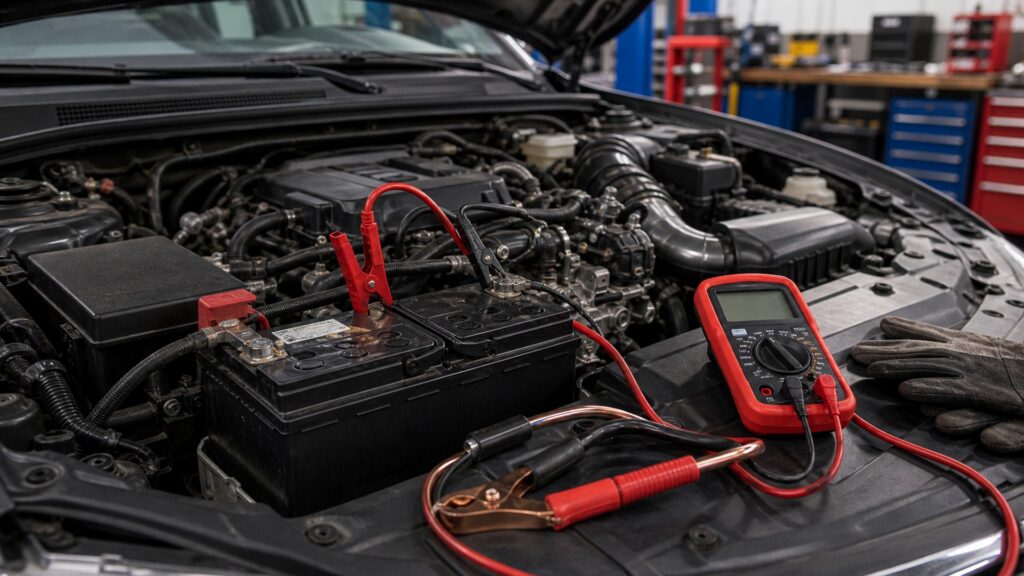
The mechanism becomes clear when internal ion movement, external current, cell stacking, charging control, and the battery's exact vehicle role are kept on one map.
Tip: Never infer traction-pack safety from a dashboard state-of-charge display; high-voltage conductors can remain hazardous even when the indicated charge is low.
These terms connect the cell reaction to starter operation, low-voltage electronics, and electric propulsion.
A sealed or vented unit whose separated materials and electrolyte convert chemical potential into electrical voltage and current.
The ion-conducting medium inside a cell that completes internal charge movement between electrode reactions.
An arrangement joining cells end to end so their individual voltages add across the battery terminals.
The terminal potential measured with no external current, after conditions have stabilized enough for meaningful interpretation.
A battery's ability to receive electrical energy at a given temperature, state, chemistry, and applied charging condition.
Sensors, logic, contactors, and communications that estimate condition and constrain traction-battery voltage, current, temperature, and imbalance.
Tip: Always name the battery architecture and chemistry before interpreting voltage, current, capacity, or service access; the same word can describe radically different energy levels.
During discharge, chemical reactions release electrons at one electrode and consume them at the other. Ions cross the electrolyte or separator so charge does not accumulate and halt the external circuit.
Ion movement stays inside; useful electrons travel through the vehicle circuit.
The voltage difference pushes electrons through cables and loads, where electrical energy becomes motion, magnetic fields, light, heat, or computation before the circuit returns to the opposite terminal.
A battery delivers energy only when the external circuit provides a complete path.
Six lead-acid cells create a nominal 12-volt battery; traction packs use far more cells grouped into modules. Configuration, cell matching, fusing, contactors, and buswork determine the usable electrical envelope.
Pack ratings emerge from cell arrangement, not from case size alone.
Every cell and connection has resistance. Current through that resistance produces voltage loss and heat; cold slows reaction and charge acceptance, while excess heat accelerates aging and can require active cooling.
Usable power is the chemical source minus losses and protective limits.
A conventional alternator or an electrified vehicle's DC-DC converter replenishes the auxiliary battery. External charging and regenerative braking feed traction packs while management logic limits cells and temperature.
Charging is controlled energy conversion, not simply forcing voltage into any battery.
Auxiliary batteries support starting and low-voltage controls; traction batteries store propulsion energy behind contactors, power electronics, thermal controls, and high-voltage safety systems.
Electrode reactions, electrolyte ion transport, external electron flow, cell series arrangement, internal resistance, temperature, state of charge, charging control, and the loads that consume power.
The vehicle architecture identifies whether an alternator, DC-DC converter, external charger, regenerative braking, inverter, starter, or motor participates in the energy loop.
Knowing how a cell works cannot establish capacity, state of health, isolation integrity, balance, cranking ability, reserve, charging performance, or the cause of a warning without architecture-specific tests.
Do not open, probe, bypass, or attempt to jump a traction battery. High-voltage diagnosis and service require the manufacturer's isolation process, trained personnel, specialized protective equipment, and rated instruments.
The familiar rectangular case hides important differences between chemical storage, low-voltage support, and high-voltage propulsion.
The battery stores chemical potential, not a tank of free electrons. Electrode reactions and internal ion movement create a terminal voltage that drives electrons through a completed external circuit when a load is connected.
Conventional engines commonly use alternators, but many hybrids and electric vehicles use a DC-DC converter to support the 12-volt network. Traction packs receive energy through charging equipment and, where designed, regenerative braking.
The displayed usable state follows a protected control window and does not certify de-energization. Contactors, capacitors, cells, and exposed damage can remain hazardous. Only the specified isolation and verification procedure establishes a service state.
Voltage is only one factor. Chemistry, capacity, cell count, configuration, temperature, state of charge, resistance, and control limits determine usable energy and power. Two batteries at similar voltage can behave very differently.
Tip: Keep ions, electrons, cells, vehicle loads, and charging controls in their proper locations so simple explanations do not become unsafe service advice.
These answers clarify cell chemistry, charging, auxiliary versus traction roles, and why voltage alone cannot describe battery health.
Current flowing through internal and connection resistance creates voltage loss. Chemical reaction limits, temperature, state of charge, aging, cable resistance, and load size all shape the sag, so terminal and path measurements need context.
It supplies high current through cables and a switching circuit to the starter motor, which turns the crankshaft. At the same time, it supports modules, fuel delivery, and ignition until combustion becomes self-sustaining.
The drive motor operates as a generator during suitable deceleration, and power electronics route controlled electrical energy toward the pack. Battery temperature, charge level, traction limits, and management logic can reduce accepted regeneration.
Cell reactions, resistance, power delivery, charge acceptance, aging, and safety all depend on temperature. Heating or cooling keeps cells within an intended range, although that support can consume energy that otherwise could propel the vehicle.
No. Electrified vehicles generally retain a low-voltage system for controllers, lighting, accessories, and contactor operation. A DC-DC converter may replenish it, but a failed auxiliary battery can still prevent normal startup or system activation.
Vehicle batteries use electrochemical reactions and internal ion flow to drive direct current through an external circuit; controlled charging reverses the rechargeable reaction and restores chemical potential.
Cell arrangement establishes voltage and capacity, while resistance and temperature limit delivery. In the vehicle, distinguish low-voltage starting and control support from high-voltage propulsion, management, and thermal protection before testing or servicing anything.
Related explainers extend the battery mechanism into operating limits, exact replacement fitment, and the safe boundaries between auxiliary and traction systems.
Examine how charge state, resistance, current demand, temperature, and charging control shape usable performance.
Match architecture, chemistry, dimensions, terminals, ratings, venting, management settings, and mounting.
Separate low-voltage acid and short-circuit hazards from high-voltage isolation, arc, and thermal hazards.
Choose a retailer
Prices checked regularly. We may earn a commission at no cost to you.