
State of Charge
An estimate of the currently available energy relative to the battery's permitted charged operating range.
- Recent use affects estimates
- Chemistry changes voltage relation
- Controls preserve buffers
A battery's operating function is to maintain usable voltage while delivering the current and energy a vehicle demands, then accept replenishment without leaving its chemistry's safe range. That performance changes with charge level, internal resistance, temperature, aging, connection losses, and the length and intensity of the load. A resting voltage is therefore only one snapshot.
The function also depends on architecture. A 12-volt starting battery must support starter current and keep modules awake, while an auxiliary battery in an EV enables controls and contactors. A traction pack must provide sustained propulsion power, accept charging and regeneration, keep cell groups balanced, and obey thermal and isolation limits. Controls may intentionally reduce power or charging to protect the battery.
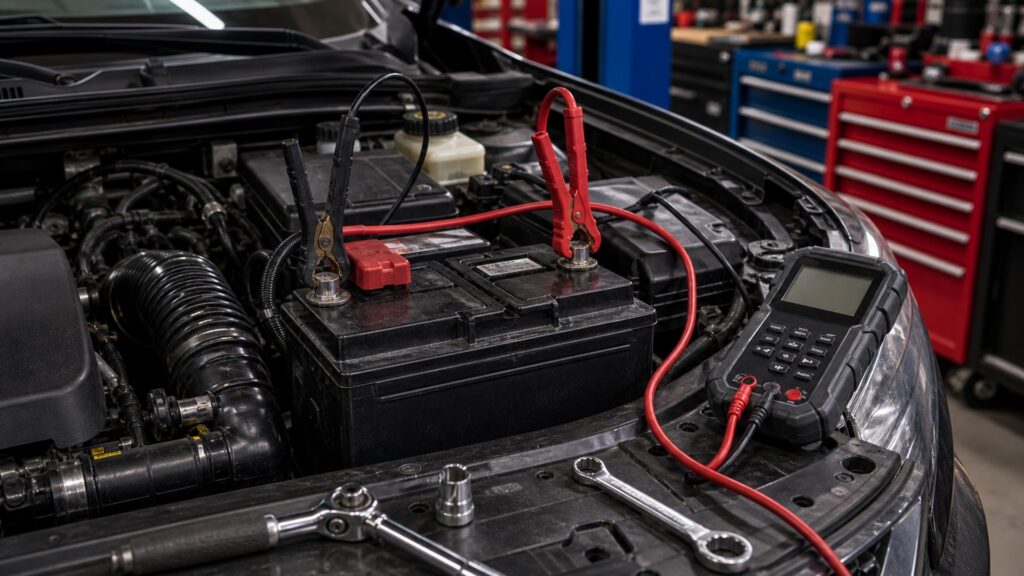
Operating function is revealed by voltage and current under a defined load, over time, at a known temperature, with the charging and management systems visible.
Tip: Do not bypass a battery-management power limit merely to prove the pack can move the vehicle; the limit is part of its operating function and safety strategy.
These terms separate present charge, long-term condition, instantaneous power, sustained energy, and control intervention.
An estimate of the currently available energy relative to the battery's permitted charged operating range.
An estimate comparing present capacity, power capability, resistance, or other condition indicators with an accepted reference state.
Combined opposition within cells and interconnects that causes loaded voltage loss and heat as current flows.
The amount of electric charge a battery can deliver under specified current, voltage endpoint, and temperature conditions.
The rate at which a battery can safely deliver or accept energy within voltage, current, temperature, and control limits.
The closeness of monitored cell-group voltage or state within a series pack so one group does not reach a limit prematurely.
Tip: Always attach units, temperature, load duration, and measurement location to a battery result; isolated numbers invite incorrect comparisons.
Open-circuit voltage can support charge estimation after suitable stabilization, but it cannot alone reveal cranking ability, reserve, capacity, cell imbalance, or behavior under a traction demand.
A plausible resting number can coexist with severe voltage collapse under current.
As current rises, internal and connection resistance consume part of terminal voltage. Starting batteries reveal this during cranking; traction packs reveal it during acceleration, fast charging, or regenerative acceptance.
Performance depends on how the battery holds voltage, not merely where voltage began.
Low temperature can reduce power and charging acceptance. High temperature can increase degradation and trigger cooling or protective derating. The management system may spend energy conditioning the pack before delivering full performance.
A temperature-based limit can be correct operation rather than proof of a failed pack.
Capacity describes sustained charge under stated conditions; power capability describes how quickly energy can move without crossing voltage, heat, or current limits. Aging can reduce either by a different amount.
Long runtime does not guarantee strong cranking, and strong acceleration does not guarantee full capacity.
Alternators, DC-DC converters, chargers, inverters, contactors, and battery-management logic regulate energy flow. Faults outside the cells can mimic battery weakness; intentional limits can preserve life and safety.
The battery's operating function includes its supervised relationship with the rest of the energy system.
Charge state, resistance, capacity, power, balance, charging response, and protective controls describe different dimensions of battery performance.
Stabilized open-circuit voltage, loaded voltage, current, duration, temperature, terminal and cable losses, capacity or reserve, charge acceptance, charging-source behavior, cell-group spread, and relevant management commands.
The test matches the battery's actual role: cold cranking and low-voltage stability, accessory reserve, auxiliary wake-up support, sustained traction energy, acceleration power, regenerative acceptance, or external charging.
A dashboard percentage, conductance score, resting voltage, range estimate, fast-charge rate, or single weak cell code cannot independently describe all battery functions or identify every upstream and downstream fault.
High-voltage performance data must be interpreted by qualified personnel using manufacturer procedures. Do not probe pack connectors, defeat contactors, bypass thermal limits, or force charging to overcome a protective restriction.
Simple battery checks are useful, but they become misleading when a result loses its load, time, temperature, chemistry, or control context.
Resting voltage can indicate charge after stabilization, but elevated resistance, reduced capacity, weak connections, imbalance, or poor charge acceptance may appear only under load or over time. Match the test to the complaint.
State of charge describes current energy availability within a permitted range; state of health compares present capability with a reference condition. A worn battery can be fully charged yet deliver reduced power or capacity.
A larger rating cannot compensate for wrong voltage, chemistry, fitment, charging control, temperature range, or power capability. Capacity is measured under defined conditions and must belong to an approved, correctly installed application.
Controls may limit output because of low or high temperature, low charge, high charge, cooling faults, isolation concerns, inverter limits, or transient conditions. Read the operating evidence before assigning irreversible battery degradation.
Tip: Use each measurement for the operating dimension it actually represents, then correlate dimensions before declaring the battery healthy or failed.
These answers distinguish charge, health, capacity, power, temperature effects, cell balance, and protective limits in conventional and electrified vehicles.
High internal resistance, cable voltage drop, terminal corrosion, starter demand, cold temperature, incorrect oil viscosity, or mechanical drag can pull voltage down despite high charge. Measure current, terminal voltage, path loss, and cranking speed together.
Cell voltage, temperature, balance, chemistry, charger capability, and longevity controls can reduce accepted power as the pack approaches its upper operating window. The charging curve is supervised behavior, not a fixed charger output.
Capacity expresses delivered charge under specified conditions, often in ampere-hours. Reserve capacity is a particular standardized duration under a defined load and voltage endpoint. Neither alone describes instantaneous cranking or traction power.
Yes. Series current passes through every group, so the first group reaching a voltage or temperature boundary can constrain the pack. Qualified diagnosis evaluates repeatability, sensors, balance, load, and thermal context.
Record architecture, chemistry, identifiers, state estimate, voltage, current, load duration, temperature, resistance or conductance method, capacity endpoint, cell spread, charging source, cable drops, relevant faults, and conditions before and after correction.
Vehicle-battery operating function matters because usable electrical service is shaped jointly by charge state, resistance, capacity, power demand, temperature, cell balance, charging support, and protective control.
Judge the battery in its real role with synchronized voltage, current, time, and temperature. Separate cell limitations from cables, starters, chargers, converters, thermal systems, and intentional derating before deciding what requires repair.
Related explainers connect the cell mechanism, exact fitment, and maintenance observations needed to interpret operating evidence without reducing the battery to a voltage reading.
Follow electrode reactions, ion flow, external current, cell arrangement, and controlled charging.
Confirm that chemistry, ratings, terminals, retention, venting, sensing, and control configuration match the vehicle.
Track charge condition, connections, charging behavior, storage, and trends before operating margin disappears.
Choose a retailer
Prices checked regularly. We may earn a commission at no cost to you.