
Group Size
A standardized description of selected low-voltage battery dimensions, terminal arrangement, and hold-down features rather than total compatibility.
- Height must clear covers
- Terminals still need verification
- Ratings vary within groups
Battery fitment is electrical, mechanical, thermal, and digital at the same time. A replacement must belong to the correct voltage architecture and chemistry, fit its tray without stressing the case, place terminals where cables cannot cross or short, accept the designed hold-down and vent path, and meet the vehicle's starting, reserve, or propulsion requirements.
Modern vehicles add monitoring and control assumptions. The charging strategy may distinguish flooded lead-acid, enhanced flooded, absorbent glass mat, or another approved chemistry; a battery sensor may track current and temperature; replacement can require a specified reset or registration. Traction packs add matched connectors, cooling, isolation, structure, software, and crash protection. Catalog similarity is never enough for a safe interchange.
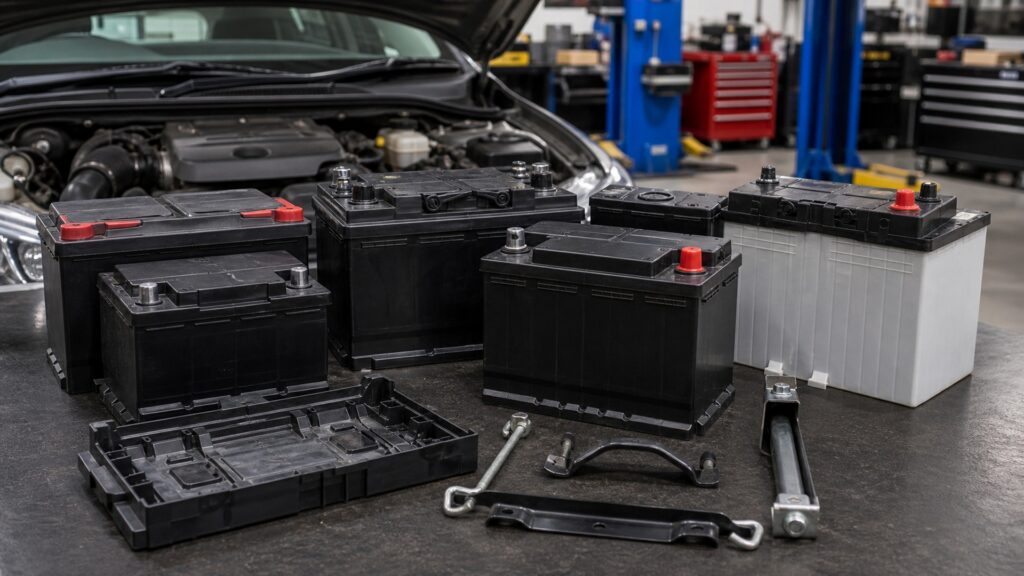
A battery can bolt in yet still be wrong because current capacity, polarity, chemistry, venting, monitoring, and retained crash loads are part of the installation.
Tip: Before loosening terminals, compare the replacement and installed battery side by side for polarity, terminal type, vent location, sensor routing, and hold-down features.
These terms define the interfaces a battery must satisfy beyond length, width, and height.
A standardized description of selected low-voltage battery dimensions, terminal arrangement, and hold-down features rather than total compatibility.
The fixed positive and negative orientation that must agree with the vehicle cable routing and electrical system.
A standardized low-temperature current rating used to compare a starting battery's ability to maintain specified voltage under a defined test.
A standardized duration describing how long a charged battery can supply a defined current before reaching a stated terminal voltage.
A current, voltage, and sometimes temperature measuring device used by vehicle controls to estimate battery condition and manage charging.
A manufacturer-specified procedure informing low-voltage battery monitoring logic that a qualifying replacement or service event occurred.
Tip: A cross-reference is a candidate list, not release evidence. Confirm the vehicle identifier, powertrain, build date, option content, label, and service information.
Installing an unapproved chemistry or nominal voltage changes charge acceptance, resting voltage, temperature response, and protective limits. The vehicle may chronically undercharge, overcharge, or misestimate condition.
A battery is not compatible merely because its posts measure familiar voltage at rest.
A reversed layout can place positive hardware near grounded metal or tempt stretched and crossed cables. Terminal diameter, taper, thread, cover, fuse block, and sensor interfaces must seat exactly.
Improvised cable routing turns a catalog mismatch into a short-circuit and reliability hazard.
A battery that slides, rocks, or sits on debris can crack, abrade, damage terminals, or become a heavy projectile. Correct case footprint, flange, clamp, fasteners, and orientation keep loads out of the posts.
Terminals are electrical connections, never structural restraints.
Some low-voltage installations route battery gases outside an enclosed cabin or luggage space. Traction batteries rely on sealed structures and managed liquid or air cooling whose interfaces cannot be casually substituted.
An omitted vent elbow or crushed cooling seal defeats fitment even when the case is secure.
Battery sensors and control modules may estimate age, charge state, and demand. The specified reset, registration, or configuration procedure aligns those calculations with the approved replacement and preserves diagnostics.
Software acknowledgment completes fitment only after the physical and electrical installation is correct.
Dimensions, voltage, chemistry, terminals, ratings, retention, venting, sensing, software, cooling, and high-voltage isolation form one compatibility contract.
Exact vehicle application, battery role, nominal voltage, approved chemistry, group geometry, polarity, post type, CCA and reserve requirements, vent location, tray, hold-down, cable reach, sensor routing, and service procedure.
For traction systems, only an exact manufacturer-supported assembly and qualified process can address module compatibility, contactors, isolation, cooling, structure, communications, calibration, transport, and commissioning.
It requires cable stretching, polarity improvisation, terminal adapters, loose tray packing, disabled sensing, blocked venting, altered cooling, unapproved chemistry, missing insulation, or unsupported control configuration.
Do not use voltage, external size, marketing claims, or a marketplace title as the sole match. Ambiguous traction-battery fitment is a stop condition requiring manufacturer documentation and qualified high-voltage service.
Battery listings often compress compatibility into group size or a promise of extra power, obscuring interfaces that the vehicle assumes will remain exact.
Group size covers selected dimensions and terminal features, but chemistry, ratings, venting, polarity details, sensor compatibility, cover clearance, option content, and manufacturer approvals can still differ. Confirm the complete vehicle application and label.
Additional rating does not correct wrong chemistry, poor reserve, incompatible charging, case mismatch, or cable strain. Use the specified minimum and approved range while preserving every other interface; marketing magnitude cannot override system compatibility.
Mass increases the need for retention. Vibration, braking, cornering, and collision loads can move an unsecured battery, damage its case or terminals, short positive hardware, and turn the assembly into a dangerous projectile.
A reset changes monitoring history or initialization; it cannot change voltage, chemistry, dimensions, ratings, polarity, venting, temperature limits, or connection geometry. Perform it only for a physically correct, approved battery when instructions require it.
Tip: Treat every physical, electrical, thermal, and digital interface as an independent gate; one failed gate rejects the replacement.
These answers cover group size, ratings, AGM substitution, venting, battery monitoring, and why traction-pack fitment is specialist work.
Only when the manufacturer approves that chemistry and the charging strategy, mounting, venting, and application support it. AGM behavior differs; do not assume apparent size, voltage, or a seller's cross-reference establishes compatibility.
A cable can reach while remaining twisted, stretched, unsupported, or too close to grounded metal. Correct position preserves strain relief, fuse-block alignment, insulating covers, service clearance, and the intended short-circuit protection geometry.
Current may flow outside the sensor's measured path, corrupting state estimates and charging decisions. The vehicle can mismanage loads, set faults, or age the replacement prematurely. Restore the original routing and connector condition.
No universal rule exists. Some vehicles require a reset, registration, coding, or relearn; others do not. Follow exact service information for the vehicle and replacement type rather than applying a procedure from another model.
No. Cell chemistry, module configuration, isolation, connectors, cooling, structure, sensors, contactors, software, condition, crash history, transport rules, and commissioning all matter. Qualified manufacturer-supported assessment is required before any high-voltage replacement decision.
Vehicle-battery fitment matters because the battery must satisfy an electrical rating, a physical restraint system, a safe terminal and vent layout, a charging strategy, and any monitoring or thermal controls simultaneously.
Confirm the exact application and every interface before connection. Reject improvisations, complete the specified reset or commissioning step, and reserve traction-battery decisions for qualified high-voltage personnel using manufacturer-supported parts and procedures.
Related explainers show the underlying battery mechanism, the safety consequences of excess energy, and the operating variables that fitment must preserve.
See how cell chemistry, current flow, series connections, charging, and vehicle architecture establish battery requirements.
Review short-circuit, acid, gas, mass, high-voltage, isolation, and thermal hazards before replacement.
Connect current rating, resistance, charge acceptance, temperature, and control strategy to real operating performance.
Choose a retailer
Prices checked regularly. We may earn a commission at no cost to you.