
Energy Source
The fuel, traction battery, hydrogen, or combination that stores energy before propulsion conversion.
- Energy density shapes range and packaging
- Refueling or charging sets operating rhythm
- Temperature changes usable output
A road vehicle is a collection of energy, force, and information systems. Fuel or a charged battery stores energy; an engine, motor, or both converts it into torque; gearing changes torque and speed; tires exchange forces with the road. Steering aims those forces, while friction brakes and regenerative systems remove motion.
That chain operates inside a network. Controllers compare accelerator, brake, and steering requests with wheel speed, temperature, battery state, traction, emissions, and safety limits. Cooling protects the powertrain, low-voltage electricity wakes computers, suspension keeps tires usable, and the body manages passenger space and crash energy. Those handoffs explain symptoms and prevent judging the whole vehicle by horsepower, battery size, or one warning.
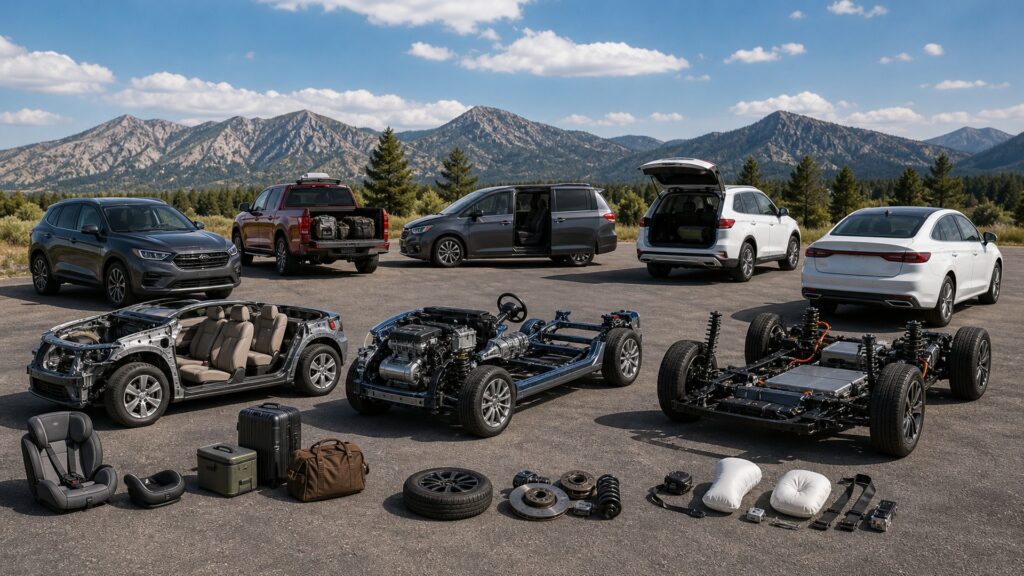
A vehicle works only when its conversion hardware, contact patches, controllers, and protective structures cooperate across changing speed, load, temperature, and grip.
Tip: Use the owner's manual for control behavior and warning meanings. A generic diagram can explain the physics, but hybrids, EVs, four-wheel-drive systems, brake blending, driver assistance, and fail-safe modes differ by model.
These terms name the principal handoffs that make a complete vehicle move, respond, and protect itself.
The fuel, traction battery, hydrogen, or combination that stores energy before propulsion conversion.
The engine, motor, transmission, reduction gear, driveshafts, and controls that create and route propulsion torque.
The usable longitudinal and lateral force tires can generate at the road surface.
Motor operation that converts some vehicle motion back into electrical energy while slowing the vehicle.
A computer that interprets sensor data and commands actuators within calibrated safety and performance limits.
The pumps, passages, radiators, valves, refrigerant loops, and controls that keep components within temperature ranges.
Tip: The same driving symptom can originate in energy conversion, control logic, tire force, or protection limits, so diagnosis begins by locating the handoff.
A combustion vehicle releases fuel energy as cylinder pressure, then sends crankshaft torque through a transmission and final drive. An EV meters battery current through an inverter to a motor and reduction gear. Hybrids divide the job between both paths.
Every conversion sheds heat, so efficiency and cooling are inseparable.
Axles apply torque to tires, but the road supplies the reaction force that accelerates the vehicle. Tire compound, pressure, temperature, load, water, snow, and alignment determine how much force remains for steering or braking.
Power reaches the road only through the available contact patches.
The steering system changes wheel angles; suspension lets each tire follow the road while controlling body and wheel motion. During cornering, braking, and acceleration, load transfers among tires, changing their individual force capacity.
Predictable handling comes from controlled tire loading, not the absence of body movement.
Friction brakes clamp rotating discs or expand against drums, dissipating kinetic energy. Electrified vehicles may first command motor regeneration, then blend friction braking as battery, speed, traction, or deceleration demands require.
A full battery or slippery surface can make familiar regenerative deceleration change.
Wheel-speed, position, pressure, temperature, oxygen, current, acceleration, and many other sensors feed controllers. They adjust torque, shifting, braking, cooling, emissions, and assistance, then record faults when expected and observed behavior disagree.
A warning is a clue to a monitored relationship, not a parts order.
Performance depends on the weakest current boundary: stored energy, conversion hardware, cooling, electrical supply, tire grip, brake capacity, structural load, or control confidence.
Requests produce repeatable acceleration, steering, and braking without abnormal noise, vibration, heat, odor, fluid loss, warning messages, or unexplained changes as temperature and load vary.
Maintenance records, correct tires and fluids, functioning safety systems, stable low-voltage power, and model-specific software or recall updates support the intended control strategy.
Brake or steering changes, overheating, electrical burning, high-voltage warnings, severe vibration, fluid loss, flashing malfunction lamps, reduced-power messages, or new instability deserve immediate attention under the owner's guidance.
A description of how vehicles work cannot identify a fault remotely; safe diagnosis needs the exact model, architecture, operating conditions, codes, measurements, service information, and inspection results.
Vehicle explanations often isolate the engine or motor and overlook the shared grip, heat, electricity, and feedback that make propulsion usable.
Delivered performance also depends on energy availability, inverter or transmission limits, cooling, final drive, vehicle mass, tire grip, control calibration, and protection strategies. Peak component output is not continuous road performance.
Drive layout can distribute propulsion torque among more tires, but the surface and tires set total friction. AWD does not create shorter stops and cannot cancel excessive speed, worn tread, or poor cornering technique.
Regeneration can reduce pad use, yet friction brakes still finish stops, handle emergencies, operate when regeneration is limited, and require inspection. Light use can introduce corrosion rather than remove the maintenance need.
A code reports a detected circuit or performance condition. Wiring, power supply, sensors, actuators, leaks, mechanical faults, calibration, or related systems may create it, so testing must confirm the cause.
Tip: Test any claim by tracing what supplies energy, what transmits force, what limits it, and what the controller observes.
These answers connect common architecture questions to the decisions a driver, shopper, or owner can actually make.
The powertrain applies wheel torque, and tire-road friction supplies the opposing force that accelerates the vehicle. The available result depends on gearing, mass, grip, energy and temperature limits, and electronic control.
Engines and motors operate efficiently over particular speed ranges. Gearing converts their speed and torque to useful wheel conditions; combustion vehicles usually need multiple ratios, while many EVs cover road speeds with one reduction.
Yes. EVs combine regenerative deceleration with hydraulic friction brakes. Friction hardware supplies low-speed completion, strong or emergency stops, parking functions, and braking whenever battery, temperature, traction, or system limits reduce regeneration.
Most modern vehicles use a low-voltage battery and distribution network to wake controllers, close relays, operate lights and accessories, and run diagnostics. A weak 12-volt supply can disable an otherwise charged electrified vehicle.
Sustained load creates heat in the engine, motor, battery, transmission, power electronics, brakes, and cooling system. Controllers may reduce output when temperature approaches a protective limit, even though stored energy remains.
A vehicle converts stored energy into wheel torque, exchanges force through its tires, changes direction through steering geometry, removes motion through braking, and coordinates every step through sensors, controllers, electrical power, and cooling.
Read the machine as connected handoffs: energy, torque, tire force, heat, and feedback. That view explains why a tire, weak 12-volt battery, cooling fault, or control limit can matter as much as the headline powertrain.
Related explainers can take the system view into reliability history, safety evidence, and the packaging tradeoffs between major vehicle types.
Evaluate how design complexity, duty cycle, maintenance, failure consequence, repair access, and service history shape dependable ownership.
Compare crash protection and crash avoidance evidence without blending unlike rating programs or trims.
See how ride height, enclosed cargo, seating, mass, aerodynamics, and chassis tuning change vehicle use.
Choose a retailer
Prices checked regularly. We may earn a commission at no cost to you.