
Sedan
A passenger-car body commonly using a fixed roof and a separate enclosed trunk behind the rear seating compartment.
- The trunk isolates cargo from occupants
- Lower packaging can reduce frontal area
- Rear opening size limits bulky items
A sedan usually packages passengers in a lower body with a separate trunk. An SUV places the cabin and cargo in a taller, continuous body reached through a liftgate; many crossovers create that shape on unibody platforms. These categories describe packaging, not one universal chassis or drivetrain.
That packaging changes decisions. SUVs can offer upright entry, taller cargo, third rows, ground clearance, and a high sightline. Sedans often answer with lower mass, less frontal area, a lower center of gravity, an isolated trunk, and more efficient highway motion. Neither label guarantees AWD, off-road ability, safety, comfort, or reliability. Exact dimensions, payload, tires, seats, test results, visibility, and the buyer's routine matter more than silhouette.
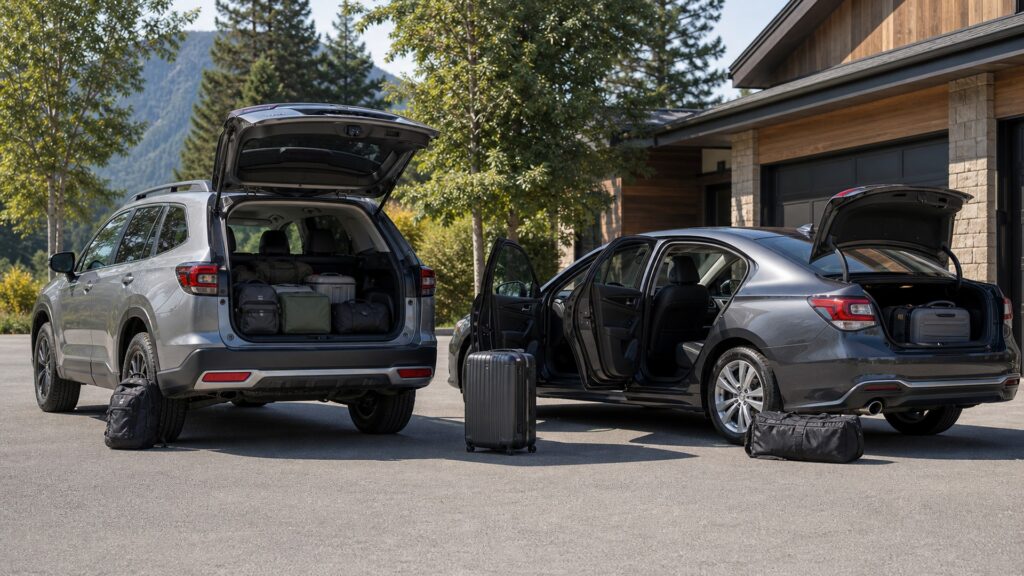
Measure passengers, child seats, mobility, cargo shape, parking space, trip speed, weather, and roads against the exact vehicle.
Tip: Cargo volume figures use methods that may not match across regions or body types. A cubic-foot advantage can be unusable if the opening, floor length, seat-fold geometry, spare-tire hump, or roof slope rejects the objects you carry.
These terms locate the genuine packaging and dynamics differences without treating every tall vehicle or low car alike.
A passenger-car body commonly using a fixed roof and a separate enclosed trunk behind the rear seating compartment.
A taller passenger vehicle with an integrated rear cargo area, liftgate, and utility-oriented seating and load packaging.
An SUV-shaped vehicle generally built with unibody construction and passenger-car-like platform or dynamics.
The effective point through which a vehicle's mass acts during acceleration, braking, cornering, and rollover motion.
Whether luggage shares the passenger body's open volume or sits in a separately enclosed trunk.
The projected front size moving through air, working with drag coefficient to determine aerodynamic resistance.
Tip: Platform sharing narrows some mechanical differences, but height, body opening, load position, tires, and aerodynamic area continue to shape use.
SUV rear seats usually fold into an open load space suited to tall or irregular cargo. A sedan's trunk opening can reject the same object even when internal volume is adequate, but the trunk conceals, contains, and acoustically isolates smaller loads.
Usable space is a geometry problem, not a brochure total.
An SUV's ride height can reduce the drop into a seat and improve forward sight over some traffic. The taller hood and wider pillars may hide nearby children, curbs, bicycles, or low objects; liftgate glass and cameras help but require active checking.
A high viewpoint moves blind zones; it does not erase them.
During a turn, lateral force acting higher above the road transfers more load toward the outside tires and increases rollover moment. Track width, tires, suspension, stability control, speed, loading, and road edge determine the outcome.
Body category suggests a tendency; engineering and driver inputs decide the magnitude.
An SUV and sedan can share an engine or hybrid system yet consume different energy because the taller, heavier vehicle adds aerodynamic drag and accelerates more mass. Cargo volume, wide tires, and roof racks can widen the gap.
Shared powertrains do not create shared fuel economy.
Some sedans offer AWD; some SUVs are front-drive with street tires and little underbody protection. A tow package may add cooling, wiring, gearing, or structure. Payload can disappear quickly with occupants and cargo despite a large body.
A rugged outline is not an equipment list.
The best body style depends on whether the binding problem is cargo opening, seating access, passenger count, weather clearance, parking, efficiency, handling, visibility, payload, or cost.
The buyer repeatedly uses its taller opening, upright access, extra seating, load height, approved towing hardware, ground clearance, or available traction equipment and accepts mass, tire, parking, aerodynamic, and handling costs.
The exact model fits occupants and cargo, stays within payload, clears the garage and route, provides acceptable near-field visibility, and performs well in relevant crash, rollover, braking, and avoidance evidence.
A lower step, separate secure trunk, smaller exterior, lower center of gravity, quieter cargo isolation, cheaper tires, or improved highway efficiency serves routine travel better than occasional maximum volume.
Neither format automatically supplies safety, AWD, towing capacity, off-road durability, comfort, economy, reliability, or usable space. Compare exact trims and test the physical task rather than buying the category promise.
SUV-versus-sedan myths turn tendencies in packaging or physics into guarantees about every model.
SUVs usually offer a taller opening and fold-down open volume, but compact models, sloping roofs, wheel housings, rear-seat position, and cargo floors can limit use. Some large sedans carry more luggage than small SUVs.
Mass can help occupants in some collisions, yet SUVs vary widely and add rollover, visibility, stopping, compatibility, and handling considerations. Compare exact crash and avoidance results, equipment, tires, condition, and occupant fit.
Winter mobility depends strongly on tire compound, tread, ground clearance relative to snow depth, weight distribution, stability control, drive layout, and driver technique. A sedan on proper tires can outperform an SUV on unsuitable ones.
Many SUVs have limited or zero approved towing capacity unless correctly equipped. Payload, tongue load, cooling, brakes, hitch structure, tires, axle ratings, frontal-area limits, and trailer brakes can bind before the advertised maximum.
Tip: The right comparison measures the exact vehicles and keeps advantages attached to the feature that actually creates them.
These answers focus the choice on packaging, dynamics, ownership cost, and exact equipment rather than lifestyle imagery.
Many people prefer an SUV's higher hip point and upright door opening; others find its step-in height difficult. Seat bolsters, roofline, door shape, grab handles, sill width, and individual mobility require an actual fit test.
Comparable sedans often use less energy because they are lower, lighter, and expose less frontal area, especially at highway speed. Powertrain, tire, gearing, driving cycle, roof accessories, and exact trim can reverse individual comparisons.
It can be when child-seat access, third-row use, stroller shape, pets, or bulky cargo exploit the open rear body. Families should also test rear-seat fit, cargo restraint, visibility, parking, payload, and crash evidence.
A lower center of gravity and lower mass often support responsive transitions, but tire quality, suspension geometry, damping, steering, wheelbase, stability control, road surface, and tuning can make an exact SUV outperform an exact sedan.
Bring representative items, move seats to occupied positions, measure opening height and width, floor length, liftover, and underfloor space, then check payload. Treat published volume as a screening number rather than proof of fit.
SUVs differ from sedans mainly through taller integrated passenger-and-cargo packaging rather than one guaranteed mechanical architecture. That shape changes openings, seating, visibility, center of gravity, mass, aerodynamics, tire choices, and how cargo shares the cabin.
Choose by the constraint you face every week. Test occupants and actual cargo, compare payload and dimensions, price tires and energy, read exact safety evidence, and confirm AWD, clearance, towing, and other capabilities as specifications—not assumptions.
Related explainers connect vehicle-format tradeoffs to system behavior, long-term ownership interruption, and the test evidence needed to compare exact models.
Trace how mass, tires, steering, suspension, braking, energy conversion, cooling, and controls translate body packaging into road behavior.
Assess whether the exact powertrain, tires, electronics, service access, and use pattern support dependable ownership.
Compare crash, rollover, headlight, and avoidance results for the exact model year and equipment.
Choose a retailer
Prices checked regularly. We may earn a commission at no cost to you.