Why Vehicle Safety Ratings Matter

Vehicle safety ratings matter because shoppers cannot reproduce a laboratory crash or avoidance test. Public programs use repeatable procedures to compare occupant protection, rollover risk, headlights, pedestrian detection, and other performance. The results reveal important differences before a real collision.

A rating is a measurement from a defined test, not a promise for every crash. NHTSA's five-star program and IIHS evaluations use different procedures and labels; results can change by model year, body style, seating position, powertrain, weight class, or equipment. Start with the exact configuration, then ask what was tested, which occupants and crash partners were represented, and which hazards remain outside the score.

By: Review Streets Research Lab
Updated: August 31, 2026
Explainer · 8-12 min read
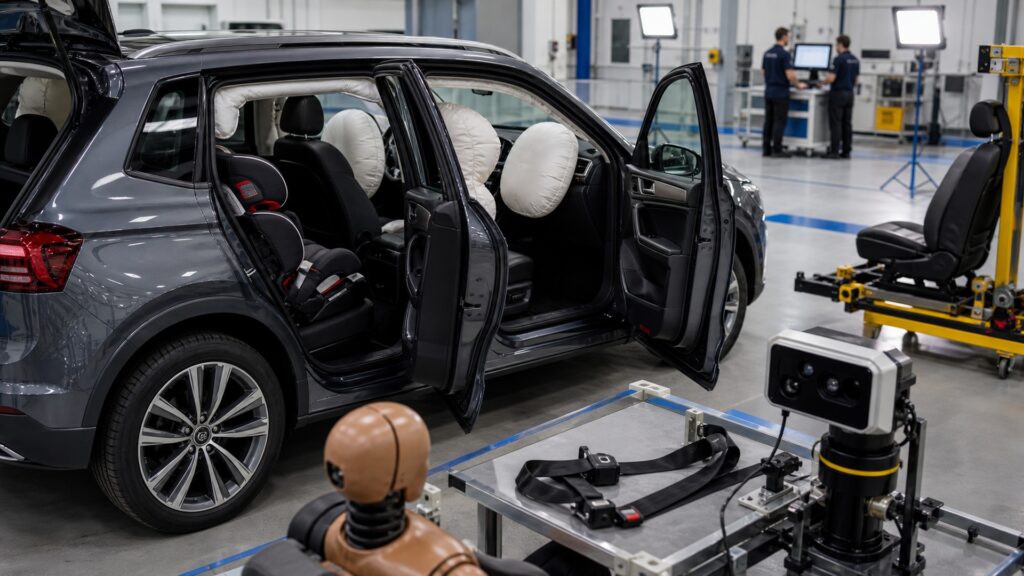
vehicle safety ratings explainer hero image for Review Streets
What You'll Learn

Read the Test before Reading the Symbol

Safety ratings help only when the vehicle, test procedure, result scale, and buyer's real exposure line up.

  • Match model year body style and trim
  • Keep NHTSA and IIHS scales separate
  • Identify tested seating positions and crash modes
  • Check required safety equipment
  • Consider mass and crash compatibility
  • Add recalls tires and condition to the decision

Tip: Do not average stars, letter grades, and award labels. Each program defines its own test severity and thresholds, and an award may require several component results plus equipment availability in that year.

Definitions

Key Concepts That Define Vehicle Safety Ratings

These terms describe the evidence behind familiar stars, grades, and awards.

New Car Assessment Program

A government consumer-testing program that rates selected crash protection, rollover, and safety-technology performance beyond basic regulatory compliance.

  • NHTSA uses five-star communication
  • Procedures change over time
  • Results require exact vehicle matching

Frontal Crash Test

A controlled impact intended to measure occupant protection during a specified forward collision geometry and speed.

  • Full-width and overlap tests load structures differently
  • Dummy measures represent selected occupants
  • Crash partners vary by protocol

Side Crash Test

A barrier or pole impact used to examine protection when less structure separates occupants from intrusion.

  • Door pillars and airbags share the work
  • Near- and far-side risks differ
  • Vehicle height affects interaction

Crash Compatibility

How the mass, height, stiffness, and energy-absorbing structures of colliding vehicles interact.

  • Self-protection can affect other road users
  • Mass differences change acceleration
  • Test barriers approximate selected partners

Crash-Avoidance Rating

An evaluation of whether sensing, warning, braking, lighting, or other systems help prevent or reduce a defined conflict.

  • Equipment and software version matter
  • Test scenarios cover limited conditions
  • Driver responsibility remains

Test Applicability

The exact models, body styles, weights, build dates, trims, and equipment to which a published result applies.

  • Similar names may not share results
  • Structural changes can break carryover
  • VIN-level equipment confirms relevance

Tip: Definitions matter because a strong result in one crash direction or equipment test cannot be silently extended to another.

Crash Tests Expose Load Paths

The Structure Must Redirect Energy before the Occupant Space Collapses

Crumple zones deform to manage energy while the safety cage preserves survival space. Belts, pretensioners, load limiters, airbags, seats, head restraints, and interior padding manage occupant motion after the structure begins slowing.

  • Study injury measures beside cabin intrusion
  • Check results for each seating position
  • Confirm airbags and belts are intact
  • Never infer repair quality from an exterior glance

A star or grade compresses a sequence of structural and restraint events.

Different Overlaps Reveal Different Weaknesses

Impact Geometry Decides Which Rails, Pillars, and Restraints Engage

A full-width barrier loads much of the front structure and restraints; moderate- and small-overlap tests engage narrower portions and can challenge wheel, suspension, footwell, and pillar paths. One geometry cannot stand in for all three.

  • Compare like procedures and test generations
  • Note driver versus passenger-side coverage
  • Watch for structural updates by build date
  • Avoid cross-class conclusions unsupported by the program

A vehicle can excel in one frontal test and expose a different weakness in another.

Avoidance Ratings Measure an Earlier Opportunity

Detection, Warning, Braking, and Headlights Act before Impact

Automatic emergency braking, pedestrian response, lane interventions, and headlights are evaluated in defined speeds, lighting, targets, and approach paths. Sensor blockage, tires, weather, road shape, and software can change real performance.

  • Confirm the rated equipment is installed
  • Keep cameras radar and lamps unobstructed
  • Use correct replacement glass and calibration
  • Treat assistance as backup rather than autonomy

Passing a scenario shows capability there, not universal object recognition.

Rollover Evidence Needs Two Questions

Propensity to Tip and Protection during a Rollover Are Not the Same

Geometry and handling affect the likelihood of an on-road loss-of-control rollover, while roof strength, curtains, belts, glazing, and ejection mitigation affect occupant protection if one occurs. NHTSA and IIHS present different pieces.

  • Keep tires and loading within limits
  • Secure cargo and use every belt
  • Understand roof-rack load effects
  • Do not confuse AWD with rollover prevention

A lower calculated propensity does not guarantee strong roof or restraint performance.

Ratings Belong inside a Broader Safety File

Condition, Compatibility, Recall Status, and Use Still Matter

A well-rated vehicle with worn tires, disabled airbags, poor collision repairs, open recalls, mismatched glass, overloaded cargo, or untrained child-restraint installation has lost parts of its tested safety system.

  • Run the VIN through recall tools
  • Inspect prior structural and restraint repairs
  • Fit occupants and child seats before buying
  • Choose tires for conditions and maintain them

The test result describes a prepared vehicle, not every used example carrying its badge.

Quick Reality Check

Ratings Reduce Uncertainty; They Do Not Predict a Crash

Laboratory and track tests reveal selected strengths and weaknesses under repeatable conditions, while collision geometry, speed, occupants, partners, equipment, maintenance, and chance determine an individual outcome.

A Strong Safety Comparison

Uses the same program, procedure generation, vehicle class where required, model year, body style, trim, weight, seating position, and installed equipment, then reads component results instead of only an award badge.

Adds crash avoidance, headlights, rollover, recall status, real occupant fit, visibility, tires, braking, vehicle condition, and compatibility with likely road users and routes.

Claims the Ratings Cannot Support

No score proves a vehicle is safe in every crash, makes unlike programs numerically interchangeable, guarantees assistance will detect an object, or erases the effects of speed, mass difference, nonuse of restraints, overload, or poor repair.

Missing exact applicability, major structural changes, absent optional equipment, disabled warnings, prior airbag deployment, questionable collision work, or open safety campaigns requires more investigation before trusting the published result.

Common Myths

Misconceptions About Vehicle Safety Ratings

Safety-rating myths mistake relative evidence from defined tests for a universal property attached permanently to every badge.

Five stars means nobody will be seriously injured

Stars compare performance in specified NHTSA tests; they cannot promise an outcome in every speed, angle, partner, occupant, rollover, or secondary impact. Belts, seating, vehicle condition, and crash circumstances still dominate individual risk.

NHTSA stars and IIHS grades measure the same thing

The organizations use different barriers, speeds, dummies, injury measures, geometry, equipment evaluations, thresholds, and communication scales. Their findings can complement one another but should not be averaged or translated as equivalents.

A Top Safety Pick applies to every version

Award applicability can depend on model year, build date, body style, weight, headlights, and optional crash-prevention equipment. Check the detailed rating page and verify the candidate vehicle carries the qualifying configuration.

A larger vehicle is always safer

Greater mass can reduce its occupants' acceleration in some two-vehicle crashes, but size also affects handling, rollover, stopping, visibility, and risk imposed on others. Structure, restraints, compatibility, and the actual crash matter.

Tip: Keep the tested configuration and hazard visible whenever a star, grade, or award enters the decision.

FAQ

Frequently Asked Questions About Vehicle Safety Ratings

These answers explain how to compare programs and configurations without discarding the useful evidence each rating contains.

Should I use NHTSA or IIHS ratings?

Use both when exact results are available. NHTSA and IIHS examine overlapping and distinct crash, rollover, headlight, and avoidance questions. Disagreement is information: read the underlying component tests rather than choosing the friendlier badge.

Can ratings from different model years be compared?

Only cautiously. Procedures, thresholds, equipment, structure, airbags, and software may change. Compare within the same test generation where possible, and confirm whether an organization formally carries a result to the candidate model year.

Why is my trim not listed separately?

A test may apply across related configurations when the program determines structure, weight, restraints, or equipment are sufficiently comparable. Read applicability notes and verify safety options, body style, drivetrain, build date, and VIN equipment.

Do driver-assistance ratings mean the vehicle drives itself?

No. Evaluations cover defined detection and intervention scenarios. Drivers remain responsible for supervision, speed, steering, braking, and the roadway. Weather, faded markings, glare, obstruction, unusual objects, or sensor faults can reduce assistance.

What else should I check on a used vehicle?

Confirm recalls, warning-lamp self-tests, tires, brakes, glass and sensor calibration, seat belts, airbags, child-seat fit, structural and flood history, repair quality, lights, visibility, and all installed assistance during an independent inspection.

Bottom Line

Vehicle safety ratings matter because repeatable tests reveal protection and avoidance differences that ordinary shoppers cannot measure. Their value comes from disciplined comparison of the same program, procedure generation, vehicle configuration, seating position, and equipment.

Use stars, grades, and awards as separate evidence streams, then add compatibility, rollover, headlights, recalls, tires, occupant fit, condition, and repair integrity. The safest decision is broader than the most attractive symbol.

Next Steps

Turn Rating Badges Back into Evidence

Related explainers connect test results to the systems being measured, ownership condition, and vehicle-format tradeoffs that affect mass, geometry, visibility, and rollover exposure.

How Vehicles Works

Understand the structures, restraints, brakes, tires, sensors, controllers, and electrical systems that produce the measured result.

Why Vehicle Reliability Matters

Separate safety campaigns and condition from general reliability, then inspect the individual vehicle for both kinds of risk.