
Laminated Glazing
Two glass plies bonded to a plastic interlayer so the panel remains together after many impact fractures.
- Interlayer retains fragments
- Optical quality remains critical
- Edge damage can spread
A windshield is more than a transparent panel. Laminated glazing places a plastic interlayer between glass plies so fractured pieces remain held together. A prepared perimeter and adhesive bond locate and retain the glazing in the body opening while moldings, cowl pieces, clips, and seals manage edges, airflow, and water.
Visibility hardware works across that fixed optical surface. A motor and linkage sweep spring-loaded arms and flexible blades through a designed pattern; a pump sends compatible fluid through hoses and nozzles to loosen contamination. Defrosting removes interior fog or ice, rain sensors may automate wiping, and forward cameras look through a controlled glass zone. Each function depends on geometry, cleanliness, power, and correct installation.
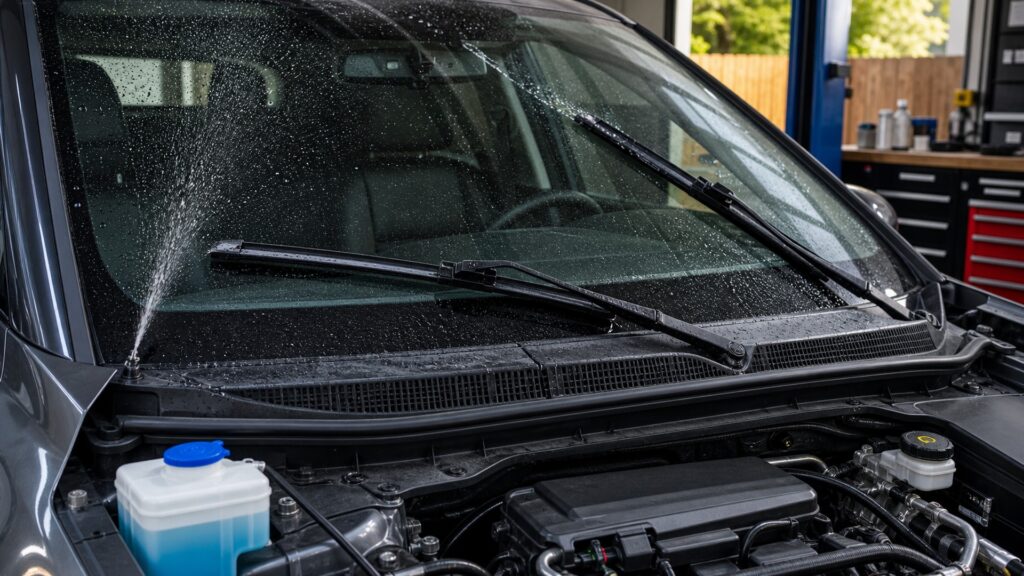
The complete mechanism joins optical transmission, fracture retention, body bonding, wiping geometry, washer delivery, condensation control, and sensor sightlines.
Tip: Never place a hand beneath a raised wiper arm without protecting the glass; the spring-loaded arm can snap back and crack the windshield.
These terms locate the optical, structural, mechanical, and fluid interfaces that create a usable windshield assembly.
Two glass plies bonded to a plastic interlayer so the panel remains together after many impact fractures.
The dark ceramic area near the glass perimeter that manages light exposure, appearance, and selected bonding interfaces.
The cured adhesive joint connecting windshield glazing to the prepared body opening while sealing water and carrying designed loads.
Arms, pivots, joints, and transmission pieces converting motor rotation into coordinated blade travel across the glazing.
Distributed force holding the flexible wiping edge against curved glass throughout its travel.
The location and distribution of washer fluid delivered onto the windshield so wiping can loosen and carry contamination away.
Tip: When one function fails, test its path before replacing the glass; a smear, leak, blocked nozzle, weak arm spring, or camera message has a different mechanism.
Light passes through outer glass, interlayer, and inner glass. Thickness, wedge, tint, curvature, coatings, contamination, chips, and stress can change transmission, distortion, reflection, or image quality.
Transparency is an engineered optical path, not merely the absence of paint.
The adhesive bead wets compatible glass and body surfaces, cures into an elastic joint, seals rain, and keeps the panel located under vibration and designed crash loads. Gaps or contamination break that continuous path.
Molding can hide the edge, but it cannot replace a failed structural bond.
Electrical power turns the wiper motor; gearing and pivots coordinate the arms; springs press rubber edges onto the curved glass. Blade flexibility follows local curvature while parking logic returns the assembly below the sightline.
A moving blade can still fail if pressure, angle, or wipe geometry is wrong.
The reservoir feeds a pump, hoses, check valves, and nozzles. Fluid wets dirt and lubricates the blade edge so debris moves toward the perimeter instead of grinding across dry glass.
Wipers spread contamination when washer delivery is absent or unsuitable.
Warm, dry airflow changes the interior surface temperature and moisture balance. Rain sensors infer surface wetness, heaters clear selected areas, and cameras require correct brackets, optical properties, and calibration.
A clear-looking windshield can still distort or misalign an electronic field of view.
Glazing transmits light, the bond retains and seals it, wipers and washers remove exterior contamination, airflow controls interior moisture, and sensors observe through defined zones.
Glass markings and optical condition, edge and bond continuity, leak evidence, molding and cowl fit, wiper power and linkage, arm indexing, blade pressure, washer delivery, defogging, sensors, heaters, and cameras.
The checks reproduce rain, contamination, fog, temperature, sweep speed, parking, spray, and electronic availability without damaging dry glass or bypassing calibration requirements.
Correct glazing, adhesives, primers, cure conditions, trim parts, electronics, and calibration depend on the exact vehicle and installation procedure. Similar curvature or dimensions do not establish compatibility.
Structural bonding, broken laminated glass, electrical heaters, camera brackets, and driver-assistance calibration require qualified methods. Do not drive before the specified adhesive cure or when visibility and retention are uncertain.
Windshield problems are often reduced to glass cracks or worn blades even though optics, retention, water management, motion, fluid delivery, heat, and sensing interact.
Many modern windshields are retained by a bonded adhesive joint; exterior moldings mainly finish and manage the edge. Treating trim as the structural attachment ignores surface preparation, bead geometry, cure, and continuous adhesion.
A blade can move yet leave unwiped bands because of poor contact pressure, wrong length or curvature, misindexed arms, linkage play, damaged rubber, contamination, or an incorrect sweep. Test the complete wet pattern.
Fluid wets and suspends contamination, lubricates the blade edge, supports cold-weather visibility when correctly formulated, and reduces dry abrasion. Wrong fluid, blocked spray, or an empty reservoir can impair both cleaning and components.
Glass optical properties, bracket geometry, installation position, camera seating, and manufacturer procedures can affect the sightline. Some vehicles require inspection and calibration after replacement; successful completion must be documented before release.
Tip: Trace the failed medium—light, water, force, electrical power, or data—to the component that should control it.
These answers address lamination, bonding, wiper mechanics, washer delivery, defogging, sensor zones, and post-replacement calibration.
The plastic interlayer bonds the glass plies and retains many fragments after fracture. Damage can still spread, reduce visibility, compromise edges, or require replacement, so retained pieces do not mean the windshield remains serviceable.
Blade angle, rubber condition, arm pressure, glass contamination, coatings, dry operation, temperature, linkage motion, or wrong fitment can make the edge alternately stick and release. Diagnose the contact mechanics before replacing the motor.
Many systems monitor changes in light reflected within a defined windshield area, then control wiping through vehicle logic. Dirt, bubbles, wrong optical coupling, glass differences, or sensor misalignment can disrupt the inferred wetness.
Possible paths include discontinuous adhesive, damaged body preparation, glass position, seam sealer, roof drains, cowl joints, moldings, or nearby body openings. Controlled leak tracing is safer than adding sealant around every visible edge.
Forward cameras view the road through glass and a mounted bracket. Replacement can alter optical or geometric relationships. Manufacturer procedures may require inspection, static targets, dynamic driving, or both before driver-assistance functions are released.
Windshield components work by preserving several linked paths: light through laminated glazing, body loads through a cured adhesive bond, wiper torque through linkages and arms, fluid through washer hardware, and sensor sightlines through controlled glass zones.
Diagnose the failed path instead of treating the assembly as one part. Verify optical clarity, retention, sealing, wet sweep, spray, defogging, attached electronics, and required calibration before returning the vehicle to service.
Related explainers extend the mechanism into exact fitment, operating quality, and the safety controls needed during bonded-glass and wiper service.
Match glass geometry, markings, coatings, brackets, sensors, moldings, adhesive interfaces, and calibration requirements.
Examine optical transmission, bond continuity, wipe contact, spray distribution, defogging, and electronic sightline performance.
Control broken-glass, spring-arm, adhesive-cure, visibility, electrical, and calibration hazards during service.
Choose a retailer
Prices checked regularly. We may earn a commission at no cost to you.