
Visible Light Transmission
The fraction of incident visible light passing through the glazing and any tint, coating, film, moisture, or residue.
- Lower transmission darkens the view
- Scatter reduces contrast
- Regulations and locations matter
A windshield operates as an optical surface under changing light, moisture, temperature, vibration, and load. It must transmit an undistorted forward image, limit glare and scattering, remain retained after ordinary stress and many fractures, seal the opening, and provide a known surface for wipers, washers, heaters, rain sensors, and forward cameras.
Performance is therefore distributed. A sound pane can become unusable when a blade loses contact, spray misses the field, interior humidity condenses, a bond leaks, or a camera looks through distorted glass. Conversely, a clean sweep cannot certify retention or sensor geometry. Evaluating operating function means testing each output under representative rain, fog, light, temperature, vehicle state, and electronic conditions.
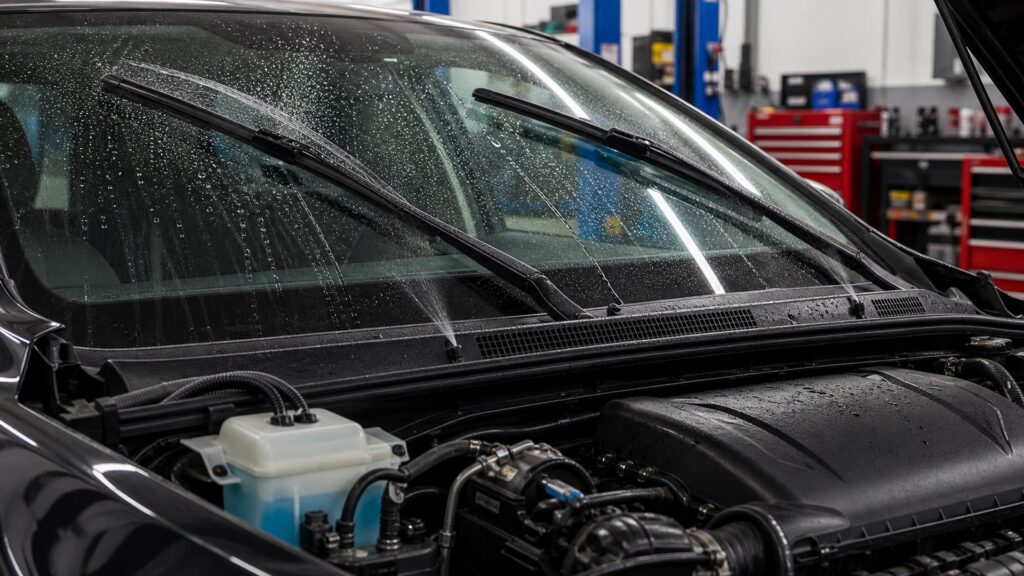
Operating quality emerges from optical, structural, mechanical, fluid, thermal, and electronic functions that must remain aligned across the same glass.
Tip: Do not use abrasive compounds or coatings in camera and sensor zones unless the vehicle and product instructions explicitly approve them; a visually smooth surface can alter optical behavior.
These terms separate the performance dimensions hidden inside a simple description such as the windshield looks clear.
The fraction of incident visible light passing through the glazing and any tint, coating, film, moisture, or residue.
A change in apparent shape, position, or duplication of objects caused by glazing curvature, thickness, wedge, stress, or defects.
Uninterrupted adhesive contact around the specified perimeter so the glass remains located and the body opening remains sealed.
The contact force spread along the wiping edge as the arm spring and blade structure follow curved glass.
Liquid water forming on the cabin-side glass when its surface falls below the dew point of nearby humid air.
The calibrated direction through which a forward camera projects its field of view relative to the vehicle and road.
Tip: Test from the driver's eye position and under the complaint condition; bench appearance cannot reproduce glare, double images, blade reversal, or camera projection.
A windshield can pass plenty of light yet scatter oncoming lamps, create localized waviness, double a HUD image, or distort lane edges. Surface films, abrasion, interlayer condition, and curvature all influence perception.
Clarity is contrast and geometry, not simply brightness.
Impact initiates cracks in one or both plies; the interlayer holds many fragments, but edge proximity, temperature change, body flex, moisture, and existing stress can extend damage and impair the view.
A retained cracked panel may still fail optical or service limits.
The blade must conform across changing curvature, flip its wiping edge at reversal, maintain lubrication, and move contamination without lift or chatter. Arm index and linkage geometry define where that contact travels.
Motor speed alone cannot prove a clean wiped field.
Washer spray distributes cleaning liquid ahead of the blade. Inside, airflow reduces nearby humidity and warms the glass above dew point; embedded heat may assist selected zones.
Exterior spray and interior fog use opposite sides of the same pane.
Rain sensors infer wetness through reflected light; cameras interpret lane, object, and road features. Bubbles, wrong frit windows, bracket errors, contamination, glass mismatch, or calibration faults can degrade availability.
No warning lamp does not independently prove accurate electronic vision.
Transmission, distortion, fracture retention, bond continuity, wet wiping, washer distribution, condensation control, and sensor geometry must each work under the conditions that challenge them.
Driver-position optical inspection in varied light, crack and edge mapping, leak testing, glass position and bond evidence, full wet sweep, blade reversal, washer distribution, defog timing, heater operation, sensor coupling, and calibration results.
The vehicle is tested at representative temperature, humidity, rain or contamination, wiper speed, road vibration, lighting, feature state, and camera requirements without exceeding safe visibility.
A clear daytime view cannot certify nighttime glare, crack stability, bond retention, wet sweep, leak control, cold-weather spray, defogging, rain sensing, HUD quality, or forward-camera geometry.
Do not infer adhesive strength from trim appearance or camera accuracy from a cleared warning. Structural and electronic functions require installation records and vehicle-specific verification.
Windshield condition is often summarized as cracked or not cracked, overlooking performance that fails only in rain, glare, frost, humidity, or electronic operation.
Transmission and distortion are different. A pane can look bright yet bend straight lines, double a head-up display, scatter lights, or shift a camera image because of curvature, wedge, stress, coatings, or defects.
Speed cannot compensate for poor blade contact, hardened rubber, wrong curvature, arm misindexing, linkage play, dry friction, contaminated glass, weak spray, or aerodynamic lift. Inspect the pattern through a complete wet cycle.
Surface temperature matters, but airflow location, air dryness, blower output, mode doors, cabin humidity, recirculation, moisture leaks, and glass films also control condensation. More heat alone may not reach or dry the critical area.
Calibration evaluates supported sensor geometry and perception; it does not measure adhesive continuity, substrate preparation, water sealing, cure, glass retention, or safe drive-away time. Structural and electronic release records remain separate.
Tip: Evaluate each output under the condition that consumes its margin, then keep results separate enough to identify the actual weak link.
These answers address optical quality, crack behavior, wiper contact, washer pattern, condensation, rain sensors, HUDs, and camera verification.
Point light sources reveal scattering from residue, pits, scratches, haze, films, delamination, moisture, or blade smear. Clean approved surfaces first, then inspect permanent damage and driver-position reflections before selecting repair or replacement.
Wrong blade curvature, weak pressure distribution, a bent arm, incorrect attachment, glass contour mismatch, ice damage, or linkage geometry can lift the edge locally. Wet-pattern observation identifies where contact is lost.
Wiping removes droplets but leaves humid air and often a cooler surface. Restore correct defog airflow, heat, and dehumidification, reduce cabin moisture sources, and clean films that encourage condensation or scatter.
Location, remaining optical distortion, resin quality, crack geometry, and manufacturer rules matter. Damage or repair inside a camera's field can alter image quality, so follow vehicle and glazing criteria rather than appearance alone.
Document glass markings, damage map, driver-position optics, lighting, wet sweep, spray, washer fluid, leak test, defog time, heater and sensor status, camera faults, calibration method and completion, weather, temperature, and final road verification.
Windshield-component operating function matters because useful visibility and retention depend on optical transmission, distortion, lamination, edge stress, bond continuity, moving blade contact, fluid distribution, condensation control, and electronic sightline geometry.
Test those outputs under representative light, rain, temperature, humidity, and feature states. A single clear-looking pane or moving wiper cannot certify the complete assembly.
Related explainers connect the complete windshield mechanism, exact fitment, and maintenance observations needed to preserve performance across changing optical and environmental conditions.
Trace light, adhesive loads, wiper torque, washer fluid, airflow, and sensor views through the assembly.
Match curvature, features, brackets, bonding interfaces, trim, and wiper geometry to the exact vehicle.
Maintain glass surfaces, blade edges, washer delivery, drains, defogging, and sensor zones before margin disappears.
Choose a retailer
Prices checked regularly. We may earn a commission at no cost to you.