What Makes All-Terrain Tires Different from Mud-Terrain Tires

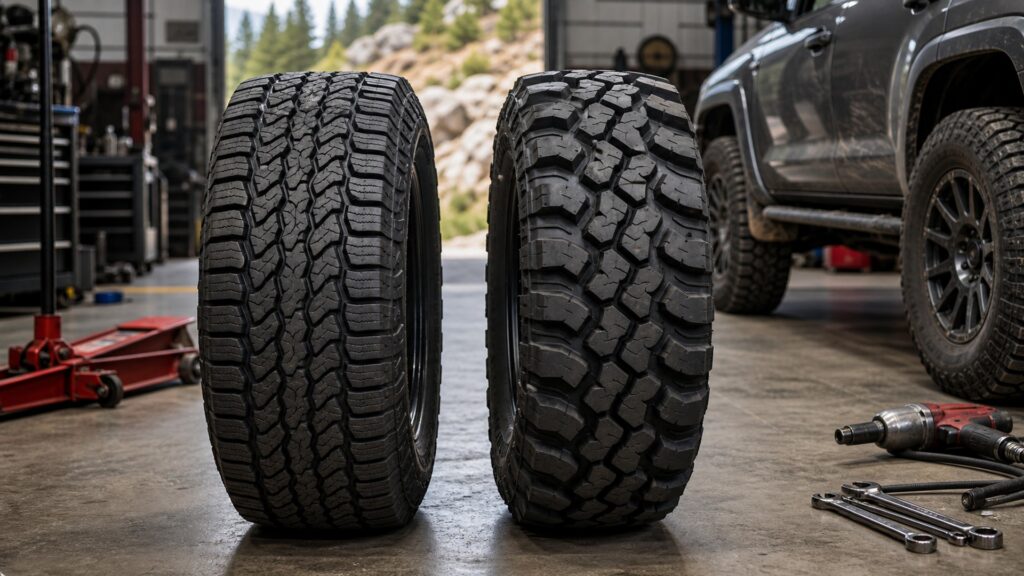
All-terrain and mud-terrain tires are not separated by a single legal tread threshold. They occupy different points on a design spectrum. An all-terrain pattern keeps more supported rubber on pavement while opening enough edges and channels for gravel, dirt, and moderate trail work; a mud-terrain pattern spends more of the footprint on deep voids and independent lugs that can dig and empty.

That exchange reaches beyond traction. Open lugs can clear cohesive soil and resist puncture through heavier construction, yet they may add mass, noise, heat, wandering, and braking distance on ordinary roads. The better choice follows the vehicle's weekly duty cycle, not the hardest-looking obstacle in a marketing photograph.

By: Review Streets Research Lab
Updated: August 31, 2026
Explainer · 8-12 min read
all-terrain tires different from mud-terrain tires explainer hero image for Review Streets
What You'll Learn

Choose for the Miles between the Trailheads

The meaningful comparison is how often the tire must clear deformable material versus how often it must brake, steer, run quietly, and control heat on pavement.

  • How open voids release packed mud
  • Why supported blocks behave better on road
  • Where sidewall construction changes the trade
  • What gravel and rock demand instead
  • Why snow and ice need separate evidence
  • How mass and gearing affect the vehicle

Tip: Write down the percentage of annual miles on pavement, graded roads, rock, sand, and deep mud. The rarest dramatic condition should not silently define every commute, braking event, and fuel stop.

Definitions

Key Concepts That Define All-Terrain and Mud-Terrain Tires

These definitions distinguish the surface mechanisms that the broad category names often conceal.

All-Terrain Tire

A mixed-surface tire balancing continuous pavement contact with moderate voids, edges, and casing protection for unpaved travel.

  • Supported blocks favor road stability
  • Grooves still accept gravel and loose soil
  • Exact street-trail balance varies widely

Mud-Terrain Tire

An off-road-biased tire using large separated lugs and open channels to penetrate and release cohesive material.

  • Deep voids promote self-cleaning
  • Independent lugs deform around obstacles
  • Pavement manners become a larger compromise

Self-Cleaning

The ability of a rotating tread to deform and eject mud or debris before its voids remain packed.

  • Tapered channels help material release
  • Wheel speed and soil consistency matter
  • A packed tread behaves nearly smooth

Block Support

Geometric restraint that limits how far a tread lug bends while transmitting braking or cornering force.

  • Tie bars sharpen response
  • Independent lugs find irregular terrain
  • Tall soft blocks generate heat

Chip Resistance

Compound and construction resistance to pieces tearing from tread under sharp rocks and repeated high stress.

  • Hardness alone does not define it
  • Heat and wheelspin accelerate damage
  • Road compound priorities may differ

Duty Cycle

The actual distribution of pavement speed, load, climate, and off-road surfaces over the tire's working life.

  • Routine miles dominate wear and noise
  • Worst cases set capability needs
  • One percentage does not describe severity

Tip: Treat all-terrain and mud-terrain as families; the exact tire model still needs its own load, wet, winter, durability, and fitment evidence.

In Mud, Empty Space Is the Tool

The Tire Must Dig, Carry, and Then Throw Material

A mud-terrain's high void ratio lets lugs penetrate rather than float on a packed tread face. As the footprint exits, lug deformation and centrifugal force help release soil. All-terrain channels are smaller, preserving pavement rubber but saturating sooner in sticky clay.

  • Judge local soil, not the word off-road
  • Maintain momentum without destructive wheelspin
  • Leave room for packed material to escape
  • Expect deep mud to expose recovery limits

When voids stop emptying, the visual difference between patterns stops producing useful traction.

On Pavement, Rubber Continuity Wins Back Control

Braking and Steering Load Supported Blocks Repeatedly

Closer blocks and ribs give an all-terrain tire more stable pavement contact. A mud-terrain's taller, separated lugs move before force reaches the road, creating squirm, noise, irregular wear, and less consistent wet braking—though exact models vary.

  • Compare wet braking for the exact tire
  • Rotate before heel-and-toe wear grows
  • Keep pressure and alignment disciplined
  • Do not equate heavy steering with grip

The pavement penalty is a mechanical consequence of the same openness that helps in mud.

Rocks Ask Different Questions than Mud

Placement, Casing, and Low-Speed Compliance Take Over

On rock, the driver needs controlled deformation, durable tread edges, sidewall protection, and precise line choice. Either category can be built well or poorly for those needs; lowering pressure requires application-specific knowledge and creates bead, heat, and damage risks.

  • Inspect sidewalls after every hard contact
  • Use a pressure appropriate to load and speed
  • Protect valve stems and bead areas
  • Avoid spinning against sharp ledges

A wide mud channel does not prove rock durability, and an all-terrain label does not prove a weak casing.

The Vehicle Feels the Tire's Extra Hardware

Mass, Diameter, and Rolling Loss Change More than Ride

Aggressive tires often weigh more and may be fitted in larger sizes. Added rotating and unsprung mass affects acceleration, braking, damper control, bearing load, gearing, fuel use, and spare-tire support even before tread friction enters the comparison.

  • Compare actual tire and wheel weights
  • Recheck load and speed capability
  • Confirm full-travel clearance
  • Plan for the matching full-size spare

Changing category and size together can hide which modification produced the new behavior.

Snowflake, Sidewall, and Sales Name

Category Names Do Not Certify Winter or Street Performance

Mud evacuation and snow traction are not interchangeable. Packed snow can reward fine edges and snow retention; ice emphasizes low-temperature compound. Look for relevant markings and tests, then evaluate wet braking, noise, wear, load, and temperature for the exact product.

  • Check severe-snow markings separately
  • Distinguish deep snow from polished ice
  • Read size-specific service descriptions
  • Choose evidence over tread aggression

An all-terrain can carry a winter credential; a mud-terrain can lack one despite its dramatic lugs.

Quick Reality Check

The Real Divide Is Surface Time

Mud-terrain geometry prioritizes repeated entry into and release from deformable soil; all-terrain geometry preserves more everyday pavement behavior.

Choose Mud-Terrain When

Deep cohesive mud is frequent, route completion depends on self-cleaning voids and large lugs, and the driver accepts higher noise, mass, wear, and pavement compromise.

The complete tire also supplies the required load, speed, casing, wheel, clearance, pressure, and spare-tire compatibility for the vehicle's actual off-road work.

Choose All-Terrain When

Most mileage is paved or graded, while off-road demands center on gravel, moderate trails, variable weather, and occasional loose surfaces rather than recurring deep mud.

An all-terrain is not automatically quiet, efficient, winter-rated, puncture-proof, or adequate for every trail; exact-model evidence and recovery planning remain necessary.

Common Myths

Misconceptions About All-Terrain and Mud-Terrain Tires

Category myths turn a continuum of exact tire designs into a contest over visual aggression.

Mud-terrain tires are always best off road

Deep mud strongly rewards open self-cleaning lugs, but sand, rock, gravel, snow, and mixed trails impose different needs. Pressure control, casing behavior, driver technique, vehicle weight, and exact compound can outweigh the broad category name.

All-terrain tires are basically highway tires

Many all-terrain designs add robust casings, cut-resistant compounds, open shoulders, and useful edges while retaining block support. Their off-road ceiling varies, so judge the exact model against the route rather than dismissing the entire family.

More sidewall lugs prevent every puncture

Sidewall features can add localized protection and traction when aired down, but impacts can still bruise cords, cut rubber, damage beads, or pinch the casing. Construction, pressure, load, speed, and line choice remain decisive.

Three-peak mountain snowflake means excellent ice grip

The severe-snow marking reflects a defined snow-traction test, not universal ice braking. Low-temperature compound, siping, studs where permitted, road treatment, vehicle control systems, and driver speed still shape winter performance.

Tip: Compare the mechanisms the route repeatedly needs, then include the road miles, vehicle hardware, and recovery consequences that advertising leaves outside the frame.

FAQ

Frequently Asked Questions About All-Terrain and Mud-Terrain Tires

These answers focus on daily use, rain, towing, pressure, longevity, and deciding when the mud-terrain compromise is genuinely earned.

Are mud-terrain tires safe in rain?

A compliant mud-terrain can be road legal, but large voids and moving lugs may provide less consistent wet pavement behavior than a road-biased alternative. Compare exact wet-braking evidence, maintain depth and pressure, and reduce speed for conditions.

Which type lasts longer on pavement?

All-terrain designs often favor more supported blocks and even road contact, but longevity depends on compound, alignment, rotation, pressure, load, power, road texture, and driving style. Warranty mileage alone does not predict one vehicle's result.

Do mud-terrain tires need lower pressure off road?

Some off-road conditions benefit from a larger, more compliant footprint, but safe pressure depends on load, speed, casing, wheel, bead retention, heat, and manufacturer guidance. Reinflation is required before returning to sustained road speed.

Which category is better for towing?

Choose by load capacity, pressure guidance, heat control, wet stability, braking, and the surfaces reached while towing. A heavier, flexible mud-terrain may add sway or heat; an all-terrain label alone does not guarantee suitability.

When is a mud-terrain worth the compromise?

It becomes rational when deep, cohesive, tread-packing terrain is frequent enough that self-cleaning traction materially changes access or recovery risk. Occasional muddy campsites usually do not outweigh thousands of pavement miles and emergency stops.

Bottom Line

All-terrain tires preserve more supported pavement contact while providing moderate loose-surface capability; mud-terrain tires sacrifice more rubber continuity for lugs and voids that can penetrate and clear deep material.

Choose by the real duty cycle, then validate exact-model wet, winter, load, casing, mass, clearance, wear, and noise behavior instead of treating either category as a universal upgrade.

Next Steps

Match the Tire to the Surface That Repeats

The supporting explainers separate tread geometry, seasonal compound, load, and the complete tire-wheel force path so one aggressive category label does not carry the whole decision.

Why Tire Tread Design Matters

Examine how void ratio, grooves, sipes, shoulders, and wear change the working footprint on water and loose surfaces.

Why Tire Load Ratings Matter

Confirm that any heavier or alternate-size off-road tire still satisfies pressure-based capacity, axle distribution, and vehicle limits.

Why Suspension Tuning Matters

Understand how added unsprung mass and tire stiffness alter spring, damper, steering, and contact-patch behavior.