
Contact Patch
The changing area of tread pressed against the road while the tire rolls under load.
- Its shape shifts with pressure and load
- Longitudinal and lateral forces share it
- Water must escape before rubber can engage
A tire touches the road through patches roughly the size of a hand, yet those patches must transmit acceleration, braking, and cornering while coping with rain, snow, loose surfaces, heat, and wear. Tread design allocates that limited rubber between solid blocks that carry force and empty channels that give water or debris somewhere to go.
Every cut changes another behavior. More void can improve water or mud evacuation but leaves less rubber to support load; more sipes create edges but let blocks flex; large shoulders can sharpen response while raising noise. The useful question is therefore not which pattern looks aggressive, but which compromise matches the surface, speed, climate, and maintenance life the vehicle will actually encounter.
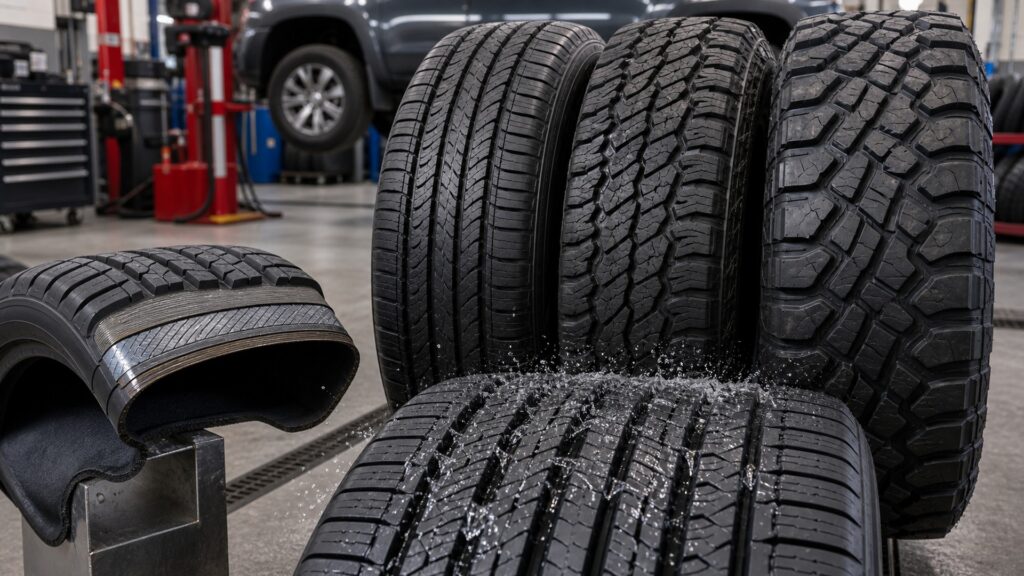
The pattern matters because water, rubber, and road texture interact differently at the leading edge, center, shoulder, and trailing edge of the contact patch.
Tip: Compare a new tire with the same model near its wear bars: the design name is unchanged, but available void volume, edge depth, and wet-weather margin are not.
These six terms describe the geometry that turns a molded pattern into usable road behavior.
The changing area of tread pressed against the road while the tire rolls under load.
The proportion of tread surface occupied by open grooves rather than load-bearing rubber blocks.
A channel running around the tire that carries water along and away from the footprint.
A narrow slit that opens within a deforming tread block to create additional biting edges.
Elastic movement of a tread block as force builds and releases through the contact patch.
A molded bridge that becomes flush at the tire's specified minimum tread-depth indicator level.
Tip: A tread feature earns its place only through the force or material it manages inside the footprint.
At the contact patch's leading edge, the tire must displace a wedge of water. Circumferential grooves provide longitudinal capacity; lateral channels give the fluid an exit toward the shoulders. Speed, water depth, pressure, load, and remaining tread depth decide whether drainage keeps pace.
A wet pattern is a flow network whose capacity shrinks as the tire wears.
Snow rewards many edges that press into and retain snow; loose soil and mud need larger voids that can accept and release material. Stone ejectors and tapered channels resist packing, but open patterns also reduce continuous rubber on pavement.
The surface must be named before an edge or void can be judged useful.
A tread block bends before it delivers lateral force. Broad ribs, tie bars, interlocking sipes, and supported shoulders limit that motion; tall independent lugs allow more block squirm. The same flexibility that finds texture can delay response and raise heat or wear on pavement.
Tread response is elastic, so sharper geometry is never free of ride, noise, or surface tradeoffs.
Wear removes more than rubber thickness. It shortens sipes, reduces groove volume, rounds leading edges, changes block support, and can reveal different compound layers. Hydroplaning resistance and snow bite may decline well before a wear bar says replacement is legally required.
Remaining depth is a performance input, not merely an inspection checkbox.
Pattern pictures cannot disclose compound, casing, construction, test results, or behavior as worn. Select the service category and size first, then compare credible wet, dry, winter, noise, wear, and load evidence for the exact model.
Two similar-looking treads can behave differently, and two different-looking designs can solve the same condition.
Solid tread carries force; voids, grooves, and sipes manage water or loose material. Useful design balances both for a named environment.
It preserves stable load-bearing ribs while creating enough connected evacuation volume and useful edge orientation for the target surface.
Its block supports, pitch sequence, compound, and casing keep the resulting wet or loose-surface capability tolerable in noise, wear, heat, and steering response.
A photograph cannot establish compound grip, casing strength, worn-state performance, load capability, manufacturing quality, or results on the exact vehicle.
No groove layout defeats excessive water depth, unsafe speed, low pressure, severe wear, incompatible mixing, or an operating condition outside the tire's intended service.
Tread myths often judge a tire by the most visible feature while ignoring how that feature behaves under load and wear.
Grooves create water volume but remove load-bearing rubber and can weaken blocks. Wet grip also depends on compound, pressure, depth, road texture, temperature, speed, and whether the channels remain connected through the loaded footprint.
Large voids can clear mud or loose snow, yet polished ice rewards compound flexibility, fine edge density, and sometimes studs where legal. Visual ruggedness alone says little about the tire's low-temperature friction.
Wear bars indicate a specified tread-depth threshold, not identical safety margin for every climate. Heavy rain or snow may demand earlier replacement because evacuation volume and biting-edge depth decline progressively before the bars become flush.
Directional patterns rely on a prescribed rotation direction to organize water flow and block loading. Mounting one backward can defeat that intended behavior, while an asymmetric tire additionally requires its marked inside and outside orientation.
Tip: Ask what the claimed feature moves, supports, or releases inside the contact patch—and what it gives up to do so.
These questions connect tread geometry to rotation, measurement, mixing, noise, and the limits of visual comparison.
Use a calibrated depth gauge in several main grooves across the width and around the circumference. Record the lowest meaningful reading, compare shoulders, and investigate uneven wear rather than averaging away a local alignment or inflation problem.
Large blocks and open voids strike and release the pavement with stronger pressure pulses. Designers vary block pitch and support to spread frequencies, but surface texture, wear, inflation, vehicle insulation, and rotation history also shape cabin noise.
Only if the resulting mounting preserves the sidewall rotation arrow; some moves require dismounting and remounting. Staggered sizes, asymmetric markings, wheel directionality, and vehicle instructions can further restrict the available rotation pattern.
Mixing can create unequal wet evacuation, response, diameter, and breakaway behavior across an axle or between axles. Follow vehicle and tire-maker guidance, maintain required size and type matching, and avoid casual single-tire substitutions.
Width alone does not guarantee drainage and may increase the water volume that must be displaced. Vehicle load, pressure, pattern, depth, speed, road ruts, and water depth collectively determine whether the footprint can maintain contact.
Tire tread design matters because it divides a small footprint between force-carrying rubber and pathways or edges that manage water, snow, mud, heat, noise, and wear.
Choose the complete tire for defined conditions, preserve its pressure and rotation requirements, and reassess capability as depth and block geometry change—not when the pattern merely looks worn.
Tread is only one layer of tire behavior; the next useful questions concern casing load, seasonal compound, and the pressure that shapes the working footprint.
See how polymers, fillers, oils, and temperature change the friction and hysteresis that tread geometry can deliver.
Learn how inflation pressure changes footprint shape, flex, heat, and the way tread features meet the road.
Understand when cold-weather compound and snow-focused features justify a seasonal change rather than a visual tread comparison.
Choose a retailer
Prices checked regularly. We may earn a commission at no cost to you.