
Service Brake
The primary system commanded by the driver or controls to decelerate the moving vehicle at all required wheels.
- It converts motion into heat
- Hydraulic or electric paths create force
- Tires complete the stop
Brake components and engine filters belong to different operating systems. Brakes convert a command into wheel torque and heat so the tires can decelerate the vehicle. Engine filters remove selected particles from air, lubricating oil, or fuel while allowing enough flow for combustion, lubrication, and injection.
That difference changes diagnosis and urgency. Brake wear, leakage, overheating, imbalance, or warning changes can directly reduce stopping control and may require immediate removal from service. A loaded filter usually alters flow, restriction, contamination protection, or pressure behavior according to its type. Neither category should be replaced because the other produced an unrelated symptom.
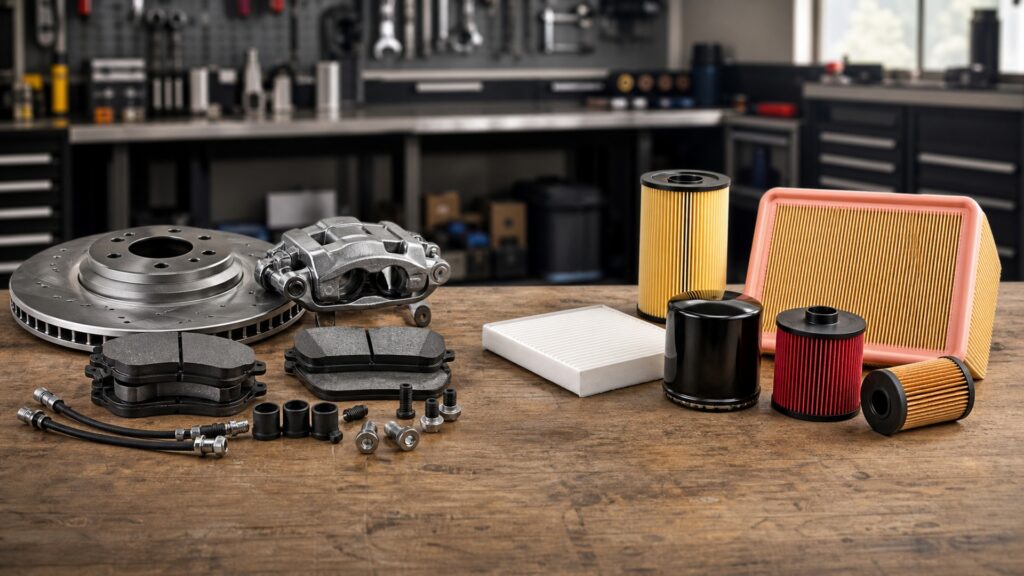
The comparison is useful only when each part is tied to the medium it handles, the failure it prevents, the evidence that condemns it, and the consequence of choosing or installing it incorrectly.
Tip: A generic maintenance package can hide different evidence requirements. Brake friction thickness, hydraulic integrity, filter restriction, bypass operation, fluid condition, and fuel delivery are not interchangeable inspection findings.
These terms distinguish braking energy conversion from filtration flow management.
The primary system commanded by the driver or controls to decelerate the moving vehicle at all required wheels.
Rotational resistance created when brake pads or shoes press against a rotor or drum at an effective radius.
Media that removes airborne particles before intake air reaches sensitive engine and metering components.
Media and valves that remove selected contaminants from circulating engine lubricant while preserving required flow.
A barrier that separates specified particles or water from fuel before sensitive pumps, injectors, or metering devices.
The reduction in fluid or air pressure across a filter, influenced by media, flow rate, viscosity, and contaminant loading.
Tip: Use the exact engine and brake service information because filter media, bypass calibration, rotor limits, fluid, hardware, and warning logic are application-specific.
Pedal command, assist, hydraulics, calipers, pads, rotors, ABS, and tires work in sequence. Component condition affects force, release, balance, temperature, and the driver's ability to control speed.
Brake parts are active force-transmission and energy-conversion components.
A filter succeeds by separating particles or water within an allowed restriction. Seal leakage can send material around the media; excessive loading can reduce flow or open a bypass depending on design.
A filter's job is selective separation without starving the engine process it protects.
Long pedal travel, pull, grinding, drag, heat, leakage, or brake warnings point toward braking diagnosis. Restriction data, oil pressure behavior, fuel delivery tests, contamination, or interval evidence relate to filters.
The named system decides which evidence has causal meaning.
Pads and rotors use measured wear, damage, and performance criteria; hydraulic parts use integrity and service rules. Filters use prescribed intervals, restriction, contamination, time, or fuel-quality context.
One universal maintenance interval cannot govern both systems honestly.
Incorrect brake geometry can impair clearance, balance, heat capacity, or pressure behavior. An incorrect filter can leak, collapse, bypass, restrict, mis-seal, or expose the engine to contaminants.
Both demand fitment, but the protected failure path is different.
Brakes manage vehicle energy and control; filters manage contamination and flow. Their inspection evidence, service boundaries, and immediate risks should remain separate.
Diagnosis finds friction wear, hydraulic leakage, restricted release, damaged rotors or drums, assist failure, ABS-related faults, parking problems, imbalance, overheating, or other defects in the stopping system.
The exact repair restores pressure integrity, movement, friction, heat capacity, warnings, wheel control, and parking function and is followed by appropriate safety verification.
The specified air, oil, or fuel element has reached its interval, restriction, contamination, damage, seal, water-separation, or pressure boundary and the replacement matches the exact engine system.
Replacing a filter cannot restore brake function, and installing brake parts cannot cure restricted intake, lubricant filtration, or fuel delivery. Shared timing or mileage is not causal evidence.
Comparison myths treat all service parts as interchangeable maintenance tokens or assign dramatic performance gains without system evidence.
Engine filters use media and seals to separate particles or water from a flowing medium. Brake pads deliberately create friction against rotating surfaces; calling that filtration erases their force and thermal functions.
The systems do not share that causal path. A severely restricted air filter can affect engine operation, but stopping performance depends on brake command, pressure, friction, heat, controls, tires, load, and road surface.
Pad thickness, cracks, contamination, rotor condition, release, and hydraulic integrity require measurement. Filters can hide restriction or seal problems, while dark media alone may not establish remaining capacity. Follow system-specific criteria.
Brake friction must suit the complete system and duty; filter media must balance efficiency, capacity, flow, valves, and sealing. Price or branding alone cannot establish better stopping, engine protection, economy, or durability.
Tip: Name the medium and physical job first: wheel-force control for brakes, contaminant separation and allowed flow for filters.
These answers clarify service urgency, maintenance intervals, diagnostic overlap, fitment, and why both categories still require application-specific installation.
Ordinary engine air, oil, or fuel filter loading does not directly command the brake warning system. Some dashboard messages share display space, so retrieve exact codes and descriptions instead of linking unrelated icons.
Any evidence of reduced braking control, leakage, grinding, severe overheating, warning activation, or abnormal pedal can require immediate safe stopping and professional diagnosis. Filter urgency depends on the specific medium, restriction, pressure, contamination, and instructions.
Some filters use mileage or time schedules, while brake fluid may have an interval and friction parts are often inspected and measured. Conditions and manufacturer information govern; pads should not be replaced solely by filter timing.
Brake geometry preserves force, clearance, heat capacity, sensing, and parking function. Filter dimensions, seals, threads, valves, media, and flow specifications preserve a clean controlled path. A near-match can undermine either system differently.
Yes, if each is independently due and authorized from its own inspection or schedule. Combining labor logistics does not connect their mechanisms. Record separate findings, part numbers, procedures, and verification for brakes and filters.
Brake components differ from engine filters by physical job: brakes transmit force and convert motion into heat for controlled deceleration, while filters remove contaminants from air, oil, or fuel without unacceptable flow restriction.
Keep diagnosis, urgency, fitment, intervals, and verification attached to the correct system. Service both during one visit when evidence supports it, but never let a generic maintenance bundle substitute one category for the other's failed function.
Related explainers deepen the brake mechanism, the exact application workflow shared by replacement parts, and the engine-side functions that filters protect without confusing their diagnoses.
Follow the complete brake command, hydraulic, friction, thermal, ABS, tire, and parking chain.
Use diagnosis, application data, installation procedure, and verification for every replacement category.
Explore the combustion, lubrication, cooling, sealing, and control functions that engine filters support.
Choose a retailer
Prices checked regularly. We may earn a commission at no cost to you.