
Kinetic Energy
Energy a moving vehicle carries because of its mass and speed before braking removes motion.
- Speed increases energy sharply
- Brakes convert most into heat
- Tires transmit road force
Brake components and vehicle batteries solve different energy problems. Service brakes slow a moving vehicle by turning kinetic energy into heat through hydraulic, mechanical, and friction interfaces. A battery stores chemical energy and releases electrical current for starting, accessories, control modules, or propulsion, depending on its voltage and architecture.
That distinction changes diagnosis, tools, hazards, and proof. Brake work requires dimension, leakage, torque, friction, temperature, and road-behavior checks. Battery work requires voltage, current, charge, connection, capacity, insulation, or battery-management evidence. Regenerative braking links the systems in electrified vehicles, yet friction brakes still provide stopping capacity and batteries still require their own electrical safety controls.
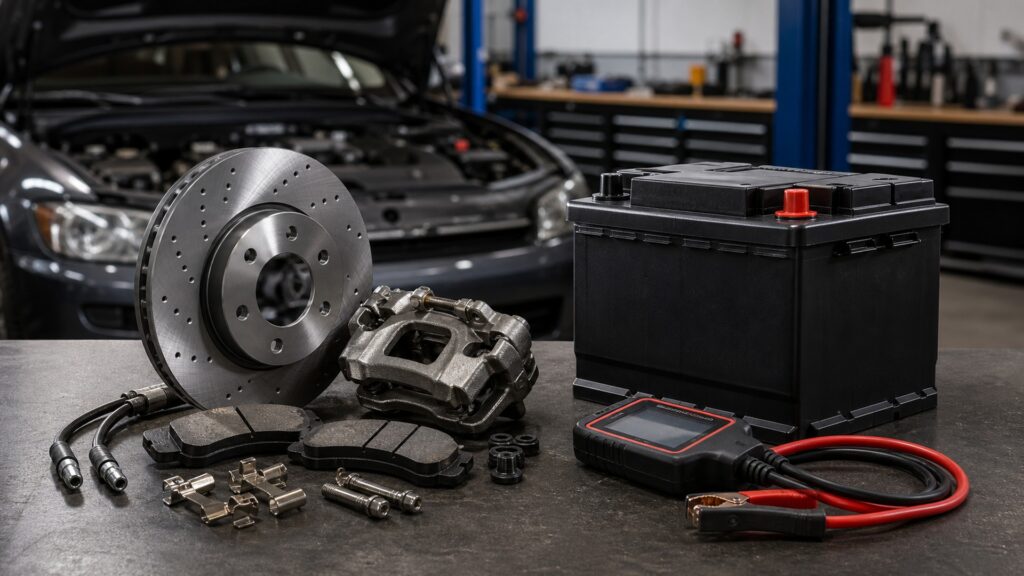
Both systems handle energy, but their direction, medium, failure signatures, service measurements, and isolation procedures are fundamentally different.
Tip: Before testing, identify whether the vehicle has a 12-volt battery, a high-voltage traction battery, or both; the required isolation and personal protection can differ radically.
The vocabulary below keeps mechanical deceleration separate from electrochemical supply while showing the one area where electrified vehicles connect them.
Energy a moving vehicle carries because of its mass and speed before braking removes motion.
The pad-and-rotor or shoe-and-drum surfaces that generate braking torque while sliding under load.
An estimate of the usable electrical energy currently held within a rechargeable battery.
A low-voltage battery measure describing how long it can support a defined load under test conditions.
Separation that prevents unintended current flow between energized conductors, chassis, people, or service tools.
Motor-generator deceleration that routes some vehicle energy back into a traction battery under controlled conditions.
Tip: Do not transfer a measurement across systems: brake-fluid condition says nothing about battery capacity, and battery voltage says nothing about friction reserve.
The brake path begins with a driver or automated command. Hydraulic pressure acts at calipers or wheel cylinders, friction creates torque, and the road reacts through the tires until speed falls.
Brake energy normally leaves as heat, with regeneration handling only a controlled portion on equipped vehicles.
A starting battery supports cranking and low-voltage loads; a traction battery supplies propulsion motors through power electronics. Internal resistance, temperature, state of charge, cell condition, and connections constrain output.
A surface voltage reading is only one clue about the battery's ability to perform work.
Pulling, grinding, long pedal travel, fade, leakage, or vibration direct attention toward brakes. Slow cranking, voltage collapse, charging faults, isolation warnings, or cell imbalance require electrical diagnosis instead.
Shared warning lamps or no-start complaints do not make the two repair categories interchangeable.
Brakes repeatedly create heat during deceleration. Batteries generate internal heat during charge and discharge and may need cooling or heating to protect performance and life. Both suffer when temperature exceeds design limits.
The common word heat hides different sources, controls, and safe responses.
Electrified vehicles may recover energy until battery acceptance, speed, traction, temperature, or power limits intervene. Hydraulic friction brakes then supply the commanded remainder and provide redundant conventional stopping functions.
A traction battery can influence regenerative braking without becoming a brake component.
Brake service proves controllable deceleration; battery service proves safe electrical storage and delivery. Each needs system-specific measurements before normal use.
Use pedal reserve, leakage inspection, component dimensions, fastener torque, friction condition, diagnostic status, bedding, and controlled stops to assess the brake repair.
Choose brake parts when the failed function is pressure generation, mechanical force transfer, friction torque, parking restraint, or wheel-end brake control.
Use architecture identification, voltage, current, conductance or capacity tests, charging-system data, cell information, insulation checks, and manufacturer isolation steps for batteries.
Do not approach orange high-voltage cabling or a damaged traction pack with low-voltage habits; qualified procedures, protective equipment, and verified de-energization are essential.
Calling both systems replacement parts can conceal incompatible tools, measurements, and hazards.
Most service braking is created hydraulically or electromechanically at the wheels. Electrical power supports controls and boosters on many vehicles, while traction batteries may accept regenerated energy, but friction torque remains a distinct mechanism.
Regeneration can reduce friction use, especially in routine slowing, but low speed, hard stops, full batteries, cold conditions, faults, and stability events still call on friction brakes. Corrosion and age also remain.
They differ in voltage, chemistry, packaging, controls, cooling, isolation, and service access. A low-voltage tester cannot validate traction-pack cells or insulation, while high-voltage work requires vehicle-specific training, protective equipment, and verified procedures.
Warning lamps indicate a monitored condition, not a parts order. Read codes and live data, test the relevant circuit or mechanism, inspect connectors and grounds, and confirm the root cause before replacement.
Tip: Start from the energy function that failed, then follow the matching diagnostic tree instead of choosing the more familiar component category.
These answers address diagnostic overlap, regeneration, maintenance, and why work on either system begins by identifying the energy architecture.
Yes. Low system voltage can disturb control-module startup and generate multiple warnings, but it does not prove brake hardware is sound. Test the battery and charging circuit, then recheck brake modules and mechanical condition.
Friction brakes are designed to provide conventional stopping, while the vehicle may reduce or disable energy recovery because of charge, temperature, traction, or faults. Any warning or altered pedal behavior still requires prompt diagnosis.
Both can cause severe harm through different hazards: moving vehicles, pressure, dust and hot friction parts for brakes; current, arcing, electrolyte, gas, mass, and high voltage for batteries. Training must match the task.
Regenerative contribution varies with battery acceptance and control limits. Brake-by-wire blending adjusts friction pressure to meet deceleration demand, so transitions may feel different even though the driver still commands one combined response.
Name the failed output: inadequate deceleration or restraint points toward the brake path; inadequate starting, energy storage, charging, or electrical support points toward batteries. Validate the diagnosis before selecting any part.
Brake components dissipate motion through controlled friction; vehicle batteries store and deliver electrical energy. Their measurements, hazards, and release criteria therefore cannot be swapped.
Regenerative braking coordinates them on electrified vehicles without erasing the boundary. Diagnose the failed energy path, use architecture-specific safety procedures, and prove the repaired function with its own evidence.
Related explainers map the complete brake path, brake operating limits, and broader engine-component context so a shared warning or maintenance visit does not trigger the wrong repair.
Trace the mechanical and hydraulic sequence that produces wheel braking after a pedal or automated command.
Examine how clamp force, friction coefficient, effective radius, tires, and temperature bound actual braking output.
Place batteries, charging, ignition, lubrication, airflow, and mechanical assemblies within the larger engine-system context.
Choose a retailer
Prices checked regularly. We may earn a commission at no cost to you.