
Hydraulic Output
The pressure and flow a wash machine delivers through its hose, gun, lance, nozzle, or automated arch.
- Ratings need operating conditions
- Nozzles shape surface force
- Supply limits final output
Car wash equipment supplies repeatable physical capacity. Pumps, hoses, guns, nozzles, foam devices, brushes, vacuums, extractors, blowers, arches, and reclaim systems move water, air, chemistry, or contact media across a vehicle. Their performance is described by flow, pressure, reach, duty, recovery, and coverage.
Detailing kits organize smaller products and hand or machine interfaces for a defined sequence. Shampoo, clay, iron remover, compound, polish, protectant, applicators, brushes, and towels address particular soils or finish defects through chemistry, abrasion, adsorption, and controlled wiping. A kit may connect to equipment, but the box does not generate hydraulic power or airflow. Equipment provides delivery capability; the kit defines selected treatments and consumables.
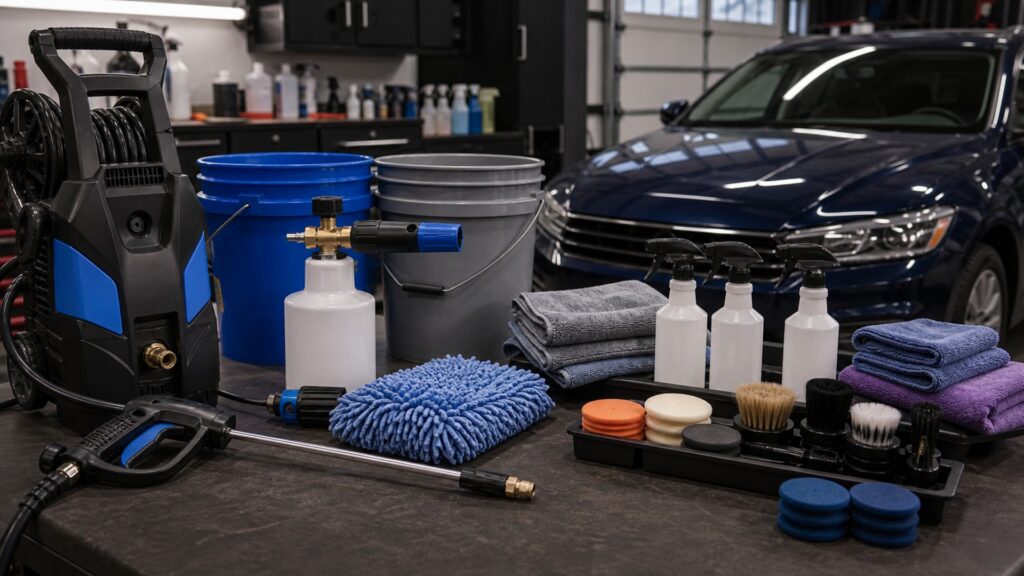
Equipment creates controlled motion and capacity; a detailing kit groups chemistry and contact tools for a specific inspection-to-finish workflow.
Tip: Do not assume a kit is safe simply because its components were sold together; check every chemical, pad, brush, towel, and step against the actual paint, trim, glass, wheels, and interior.
These terms distinguish durable delivery capability from a curated set of surface-treatment products and consumables.
The pressure and flow a wash machine delivers through its hose, gun, lance, nozzle, or automated arch.
The allowed relationship between operating time, rest, temperature, and load before a machine exceeds its design limits.
The specified time a product remains active and wet on a compatible surface before agitation, rinsing, or removal.
The relative cutting behavior of a compound, polish, pad, or medium under defined paint, pressure, speed, and lubrication.
The height, density, split, and structure of fibers that influence pickup, softness, drag, and product removal.
The ordered progression from inspection and soil removal through decontamination, correction, finishing, protection, and final verification.
Tip: List what the package cannot do. Missing water control, power, lighting, test instruments, replacement media, or material-specific cleaner can change the result more than the branded container.
A pressure washer can rinse broad areas, a vacuum moves debris-laden air, an extractor sprays and recovers solution, and a blower displaces water. Each requires power, rated connections, maintenance, and operating limits.
Equipment answers how much physical work can be delivered.
A kit may combine wash, decontamination, correction, protection, or interior steps. The items work only when product chemistry, pad or towel behavior, dilution, dwell, and removal suit the substrate.
A kit answers which prepared steps and consumables are included.
Equipment faults include cavitation, leaks, pressure cycling, worn nozzles, overheated motors, clogged filters, or weak suction. Kit failures include dried product, wrong chemistry, contaminated clay, saturated towels, mixed applicators, or missing sequence steps.
More pressure cannot restore expired chemistry, and more product cannot repair a failing pump.
Machines improve throughput and repeatability across many vehicles when supported by water, power, drainage, and maintenance. Kits simplify a bounded job but their consumables and hand labor scale directly with each surface.
The more specialized the finish defect, the less raw throughput alone decides value.
Foam cannons use wash solution; polishers use pads and abrasive liquids; extractors use compatible cleaners. The combined setup must respect paint thickness, material sensitivity, heat, moisture, residue, and safe disposal.
Compatibility is established at the surface, not by owning both categories.
Car wash equipment generates movement, pressure, suction, or airflow, while detailing kits group chemicals and contact media for selected surface objectives.
Water or air flow, pressure, spray or suction pattern, duty cycle, temperature, reach, hose and power requirements, recovery, chemical draw, attachment fitment, throughput, and maintenance burden.
The work needs repeatable rinsing, foaming, vacuuming, extracting, blowing, agitation, automated coverage, reclaim, or other powered delivery across one or many vehicles.
The exact soil or defect, substrate, chemical compatibility, dilution, dwell, abrasive behavior, applicator, brush, towel, lubrication, residue removal, protection goal, consumable condition, and process order.
Neither category guarantees skill or finish quality. Equipment can amplify a bad method, while a curated kit can omit lighting, water, power, disposal, replacement media, or products needed for the actual vehicle.
Retail bundles often combine a compact machine with several products, which blurs whether the buyer is acquiring durable capacity, consumable treatment steps, or both.
Some waterless or hand processes need little equipment, but heavy loose soil, large vehicles, extraction, underbody rinsing, or repeated throughput may require controlled water, vacuum, or airflow capacity beyond the bundled consumables.
A machine can concentrate spray, heat, agitation, or product delivery and increase damage when chemistry is wrong. Read both equipment and chemical limits, test a small area, and monitor the surface.
Piece count can be inflated by redundant towels, sample sizes, or products unrelated to the task. Completeness means the correct sequence, compatible materials, enough clean media, and no critical missing control.
Ownership adds setup, water, power, storage, maintenance, winterization, repair, drainage, and training. For occasional targeted work, a suitable kit or service may cost less; frequent throughput can reverse the calculation.
Tip: Separate the machine specification from the product recipe, then test how their interfaces behave on the actual surface.
These answers address overlap between machines and bundles, cost, skill, consumables, waterless methods, and choosing for repeated or targeted work.
Yes. A bundle can include equipment accessories and chemistry, but the cannon still depends on compatible pressure, flow, connector, orifice, dilution, and maintenance. Classify each item by the function it actually supplies.
It is detailing equipment rather than wash-water delivery. It supplies controlled pad motion for correction or finishing, while pressure washers, arches, and rinse systems manage washing. Category labels can overlap, so define the task.
A small task-specific kit can clarify sequence, while modest equipment can reduce lifting and rinsing effort. The safer choice has understandable controls, compatible products, adequate clean media, and room for test spots—not maximum power.
Include machine, accessories, products, replacement media, water, electricity, storage, maintenance, repair, drainage, time, and expected vehicle volume. A cheap bundle becomes costly when it lacks compatible connectors or sufficient consumables.
Equipment delivers stable, appropriate force or flow; kit chemistry and media behave as labeled; soil or defects improve in the test area; surfaces stay cool and undamaged; residues are removed; and tools remain uncontaminated.
Car wash equipment supplies durable physical delivery—pressure, flow, suction, agitation, or air—while detailing kits organize chemicals, applicators, abrasives, brushes, and towels into a selected surface-treatment sequence.
Choose and evaluate them separately, then validate their interface. The machine must deliver suitable energy, and the kit must provide compatible chemistry and clean media for the actual substrate, soil, defect, and finish goal.
Related explainers deepen equipment operation, kit sequencing, and the decision boundary between repeatable wash capacity and targeted detailing treatment.
Trace how pumps, nozzles, detergent, contact, rinse, drying, and drainage create wash capacity.
Follow a detailing kit through inspection, washing, decontamination, correction, protection, and media separation.
Choose between powered coverage and a targeted bundle using soil load, frequency, space, utilities, finish goals, and consumable capacity.
Choose a retailer
Prices checked regularly. We may earn a commission at no cost to you.