
Throughput Demand
The number, size, and soil load of vehicles that must be processed within a defined time and quality target.
- Vehicle count changes equipment economics
- Large panels increase rinse demand
- Setup time belongs in throughput
Choose car wash equipment when the constraint is physical capacity: broad loose soil, large vehicles, frequent washes, repeated rinsing, vacuuming, extraction, blowing, or consistent throughput. A suitable machine can move more water or air and reduce repeated manual effort, but it also needs compatible utilities, drainage, storage, maintenance, and safe operating space.
Choose a detailing kit when the constraint is treatment specificity. A bounded bundle can supply the chemistry, clay, abrasives, applicators, brushes, or microfiber needed for decontamination, correction, protection, or a small low-water task. The kit does not create utilities or skill, and its included quantities must cover the actual vehicle.
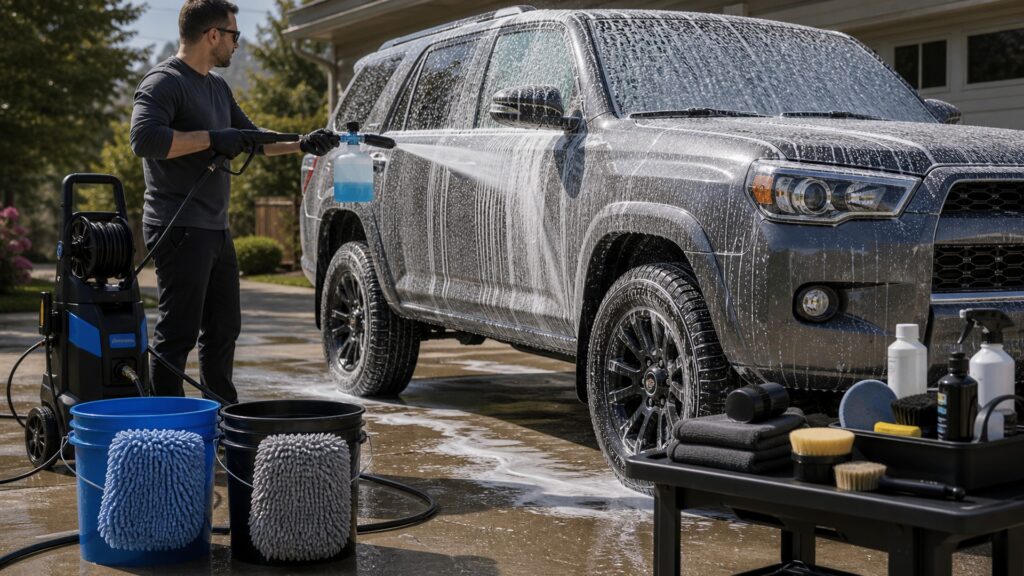
This decision weighs coverage and repetition against treatment specificity, then checks whether the site, vehicle, finish goal, consumables, and operator can support the chosen path.
Tip: For a first attempt, buy neither category until a test area identifies the soil or defect; an incorrect process scales faster with powerful equipment and becomes expensive faster with specialty products.
These terms convert a product-category choice into workload, site, finish, and lifecycle evidence. The selection weighs soil coverage, vehicle throughput, repeated wash cycle, water and power access, drainage capacity, setup overhead, targeted decontamination, abrasive correction, consumable capacity, and total task cost.
The number, size, and soil load of vehicles that must be processed within a defined time and quality target.
The water flow, pressure, electrical capacity, ventilation, drainage, lighting, space, and noise conditions available at the work site.
How narrowly chemistry, media, abrasive action, or protection is matched to a particular soil, material, defect, or finish objective.
Time and effort required to move, connect, test, protect, prime, clean, drain, dry, and store equipment before and after useful work.
The usable amount and cleanliness of detergent, clay, compound, pads, towels, brushes, applicators, filters, and other expendable items.
The combined cost of acquisition, water, power, products, maintenance, storage, replacement media, labor, disposal, rework, and vehicle risk.
Tip: Compare the smallest complete workflows, not a machine price against a brightly packaged kit with unrelated piece count.
Pressure washers, arches, vacuums, extractors, and blowers provide repeated physical delivery. Their advantage grows with vehicle area, heavy loose soil, fleet frequency, or a need for consistent water or airflow across many cycles.
Capacity earns its cost only when enough suitable work uses it.
Bonded fallout, overspray, isolated staining, light correction, protection application, and material-specific interior work depend more on compatible chemistry, media, technique, and test spots than on maximum water or air movement.
A kit is valuable when its recipe matches the evidence, not because it contains many pieces.
A washer without adequate supply, a high-draw extractor on an unsuitable circuit, or a rinse process without lawful drainage is not a complete solution. Noise, freezing, ventilation, hose paths, and storage also affect feasibility.
An incompatible site turns equipment capability into setup risk.
Equipment spreads purchase and maintenance over repeated cycles but adds setup. Kits lower entry cost for bounded jobs, yet specialty consumables and hand labor rise with area, severity, and repeated vehicles.
The cheaper box is not necessarily the cheaper completed result.
A safe pre-rinse can remove abrasive soil before clay or polishing; a vacuum can remove debris before interior chemistry; a blower can clear crevices before protection. The categories can cooperate without becoming substitutes.
Choose the lead category by the main constraint, then add only the complementary steps the evidence requires.
Soil load, surface area, frequency, utilities, finish objective, and operator capability reveal whether capacity or treatment specificity should lead.
Heavy loose contamination, broad exterior area, frequent vehicle volume, substantial rinsing or recovery, and suitable water, power, drainage, space, maintenance, and storage make repeated delivery capacity valuable.
The operator can control pressure, flow, spray distance, chemical metering, contact media, electrical exposure, runoff, and equipment service without creating damage or unacceptable setup delay.
The task is small, occasional, material-specific, low-water, or centered on decontamination, correction, finishing, or protection rather than moving large amounts of loose soil and liquid.
The exact products and media fit the substrate and defect, quantities are sufficient, test spots are possible, and missing utilities or machines are not concealed by the bundle's marketing.
Selection myths reduce a workload decision to power, piece count, professional appearance, or one purchase price.
Professional value comes from fit, repeatability, serviceability, safe controls, and throughput—not maximum rating. Oversized equipment can add circuit, supply, heat, storage, noise, handling, and surface-damage problems without removing the actual bottleneck.
Many kits omit water, power, lighting, inspection tools, dilution containers, replacement towels, PPE, drainage, machines, or material-specific products. Inventory the complete process and treat every missing control as a separate requirement.
A waterless or rinseless process still needs enough lubrication and clean media to capture contamination without dragging abrasive grit. Heavy mud, sand, salt, or unknown deposits may require controlled pre-rinsing at an authorized location.
Machines amplify pressure, motion, suction, heat, or airflow, so fitment and technique become more consequential. Diagnosis, material knowledge, test spots, clean media, inspection, residue removal, and finish verification remain operator responsibilities.
Tip: Define the completed process and its dominant constraint before deciding which category should lead.
These answers address first purchases, mobile work, heavy soil, paint correction, fleet volume, and when a hybrid workflow is more complete than either category alone.
Start with the specific recurring task and the site's utilities. For routine exterior washing, modest compatible equipment plus safe chemistry and media may lead; for a bounded defect or protection goal, a focused kit and test spot may lead.
Choose around carried water, electrical access, drainage rules, noise, vehicle volume, storage, weather, and service mix. Compact equipment can add capacity, while concentrated products and modular kits reduce load; neither removes containment obligations.
Do not proceed when runoff cannot be controlled, surfaces are damaged or unknown, temperature creates freezing or chemical drying, supply is inadequate, bystanders cannot be excluded, or the site prohibits washing. Relocate or use an authorized service.
Correction requires compatible abrasives, pads, a controlled machine or hand method, lighting, thickness and condition judgment, residue removal, clean media, and test spots. A branded kit may bundle some pieces but does not establish paint safety.
Use both when bulk soil or liquid must be moved before a targeted surface treatment. Pre-rinse and wash, inspect, then decontaminate, correct, or protect only as needed, maintaining clean media and verification between stages.
Use car wash equipment when broad coverage, heavy soil transport, frequent cycles, or powered rinsing, recovery, and drying are the dominant constraints and the site supports them.
Use a detailing kit when a bounded soil, material, defect, or finish goal needs specific chemistry and media. Many complete jobs use equipment first, then only the targeted kit stages the inspected surface requires.
Related explainers distinguish the category functions, trace equipment operation, and show how a detailing kit turns selected products and media into an ordered treatment.
Compare powered delivery capacity with chemistry, applicators, abrasives, brushes, and microfiber organized as a treatment set.
Trace how water supply, pump, nozzle, chemistry, contact, rinse, drying, and runoff create wash capacity.
Follow a detailing kit through inspection, decontamination, correction, protection, and media separation.
Choose a retailer
Prices checked regularly. We may earn a commission at no cost to you.