
Cured Coating
A thin applied film whose reactive ingredients develop a more connected network after leveling.
- Needs direct surface contact
- Properties build during cure
- Removal may require abrasion
Ceramic coatings and automotive waxes can both improve gloss, water behavior, and resistance to ordinary contamination, but they reach those outcomes through different film systems. A coating is applied to a carefully prepared surface and develops a more persistent network as it cures; wax leaves a comparatively temporary sacrificial layer that is easier to refresh.
That distinction changes labor, error recovery, maintenance, and cost. Coatings demand better defect decisions and stricter application control because high spots or trapped flaws can remain visible. Wax accepts faster renewal and simpler correction of mistakes, but usually requires more frequent reapplication. Neither choice prevents stone chips, deep scratches, neglected water spots, or failed paint.
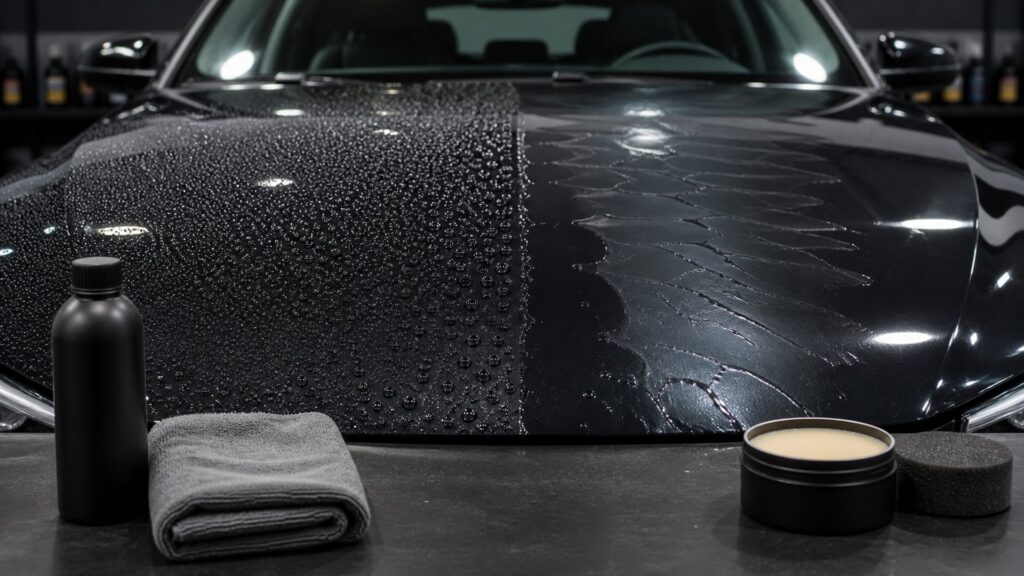
The meaningful contrast is not ceramic versus natural; it is a long-lived, preparation-sensitive cured film versus an easily renewed sacrificial layer.
Tip: Choose the renewal burden you will actually support: a durable installation still needs careful washing, while easy wax renewal only helps when it is performed.
These terms identify the chemistry, timing, and service behavior that make the systems operationally different.
A thin applied film whose reactive ingredients develop a more connected network after leveling.
A sacrificial protective layer deposited from natural, synthetic, or blended ingredients and a carrier.
The interval in which a coating begins changing appearance and remains practical to level.
Time required for a coating to develop resistance after its initial wipe and set.
Material intended to take weathering, detergent, and contamination before the paint beneath it.
A compatible maintenance product placed over protection to alter slickness, gloss, or repellency.
Tip: Compare product instructions within each category; neither 'ceramic' nor 'wax' defines one fixed formula or lifespan.
Coating precursors spread, level, and react into a persistent film on a compatible surface. Wax products deposit a softer sacrificial blend as carriers evaporate or are wiped away, making later renewal comparatively simple.
Shared beading does not mean the layers were created by the same mechanism.
A transparent coating tends to preserve the condition beneath it for longer, so contamination, polish oils, and visible defects deserve resolution beforehand. Wax can also benefit from preparation, but its shorter renewal cycle makes correction later less disruptive.
The longer the intended service interval, the more expensive a poor starting decision becomes.
Coatings use small sections, flash cues, leveling towels, and controlled temperature or humidity. Waxes generally offer a wider wipe-off window and easier reapplication, though overuse, trim staining, or incomplete removal can still create problems.
Coating errors become durable because the layer is harder to disturb after cure.
Road film, minerals, detergent residue, abrasion, and toppers alter the exposed surface of either system. Cleaning may restore repellency when contamination masks it, while consumed wax is simply renewed and damaged coating needs diagnosis.
Observed hydrophobicity describes today's surface, not the entire protection history underneath it.
A coating suits owners willing to fund preparation, protect the cure window, and maintain the finish over a longer interval. Wax suits owners who value low commitment, tactile application, frequent refresh, or easy product switching.
The better system is the one whose maintenance and error-recovery demands fit the owner, paint, and exposure.
Both can add gloss and repellency, while preparation, persistence, and renewal separate their real-world use.
A properly installed coating can retain useful surface behavior through more wash and exposure cycles while reducing frequent reapplication.
Wax offers accessible application, quick renewal, easy product changes, and a forgiving way to add temporary gloss and water behavior.
Neither thin film prevents rock chips, dents, deep scratches, clear-coat failure, or mineral etching under every condition.
Category names do not guarantee durability; formula, preparation, film uniformity, environment, washing, and maintenance determine actual service.
Comparison myths often use durability, hardness, or natural ingredients as a universal quality score.
Wax remains useful when easy application, frequent renewal, low commitment, or a particular appearance matters. A coating offers a different maintenance interval, not a universal replacement for every sacrificial protection strategy.
A compatible product may be applied over some coatings, but it can change slickness and water behavior while masking the coating's exposed surface. Follow the coating maker's maintenance guidance before adding layers.
A thin cured coating can resist some chemical and light abrasion exposure, but stone impact involves energy and film thickness on another scale. Paint protection film addresses that threat through a different mechanism.
Appearance depends on paint color, surface texture, correction quality, product residue, lighting, and observer preference. Protection cannot create optical clarity that poor preparation or damaged clear coat has already removed.
Tip: Evaluate film formation and service behavior rather than assuming one label wins every vehicle and ownership pattern.
These answers address lifespan, preparation, layering, removal, and choosing between a coating installation and repeat wax application.
Usually, when a true coating is properly prepared, applied, cured, and maintained, but no universal interval applies. Exposure, mileage, washing chemistry, abrasion, storage, and the exact formulas can reverse simplistic calendar comparisons.
No. Polishing removes material and is justified by defects, not by the protection label. Both systems require cleaning and compatible preparation; correction is optional when the inspected finish already meets the owner's target.
Usually not unless the coating system explicitly permits it, because an oily or sacrificial layer can prevent direct bonding to paint. Follow the coating instructions rather than building an intuitive but chemically incompatible stack.
Mechanical polishing is commonly needed for a fully cured film, although chemistry and condition vary. Use inspection and a test area because aggressive removal can also consume the clear coat beneath the protection.
Either can work. Choose coating when longer intervals justify preparation and controlled maintenance; choose wax when quick renewal, low cost, and easy experimentation outweigh the inconvenience of applying protection more often.
Ceramic coatings differ from wax because their cured, preparation-sensitive films create a longer and less reversible service commitment than a readily renewed wax layer.
Compare the actual formula, preparation, application window, maintenance plan, removal method, and exposure instead of choosing by beading videos or category prestige.
Review coating formation, paint correction, and impact-oriented protection before deciding which layer belongs on the vehicle.
Examine coating bonding, leveling, cure, contamination, and maintenance without the comparison shorthand.
Decide whether existing defects justify finite abrasive refinement before either transparent protection is installed.
Compare thin chemical protection with film-based defenses against impact and other damage modes.
Choose a retailer
Prices checked regularly. We may earn a commission at no cost to you.