What Makes Cold Air Intakes Different from Short Ram Intakes

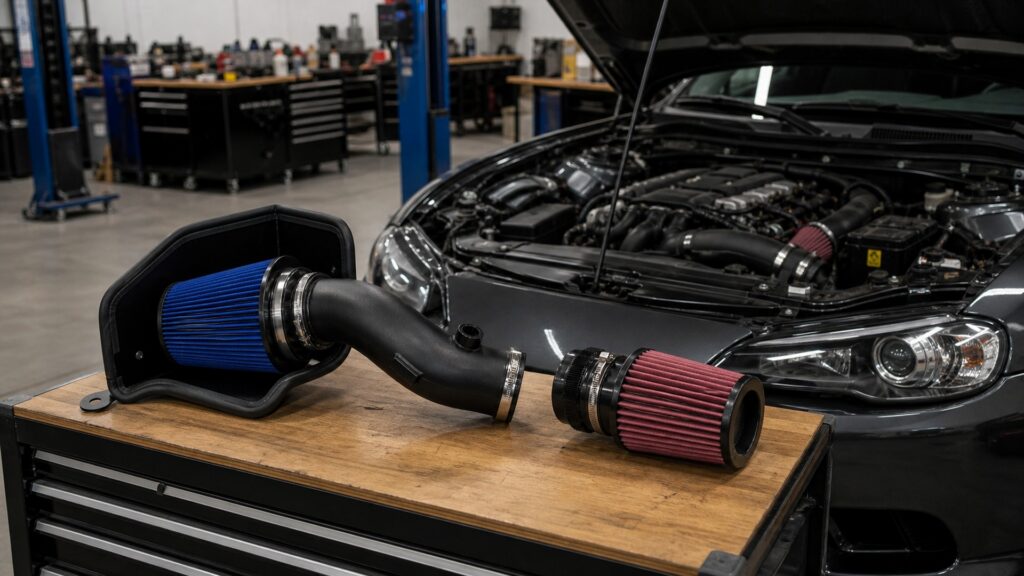
A cold air intake places its inlet or filter where it can draw air isolated from engine-bay heat, often behind a bumper, fender liner, or sealed duct. A short ram intake keeps a shorter tract near the engine. The first prioritizes cooler-source potential; the second prioritizes packaging, access, and reduced length.

Neither label guarantees power. Vehicle speed, radiator discharge, shielding, filter restriction, tube area, bends, resonance, throttle demand, and sensor housing shape determine pressure and temperature at the engine. Remote placement can increase water and debris exposure, while an open short ram can suffer heat soak. Logged inlet temperature, trims, pressure loss, and repeatable torque settle the comparison.

By: Review Streets Research Lab
Updated: August 31, 2026
Explainer · 8-12 min read
cold air intakes different from short ram intakes explainer hero image for Review Streets
What You'll Learn

Trace the Operating Chain behind Cold Air Intakes and Short Ram Intakes

For Cold Air Intakes and Short Ram Intakes, follow physical inputs, control decisions, limiting conditions, and verification evidence to determine whether the claimed result is useful.

  • How Filter Location Changes Temperature Potential
  • Why a Shorter Tube Is Not Automatically Freer Flowing
  • How Intake Geometry Shapes the Torque Curve
  • Why MAF Housing Details Can Change Fuel Control
  • Where Remote Placement Adds a Different Risk
  • Where cold air intakes and short ram intakes measurement separates improvement from impression

Tip: Record the cold air intakes and short ram intakes configuration and a repeatable baseline before changing it; uncontrolled comparisons cannot identify which mechanism caused the result.

Definitions

Key Concepts That Define Cold Air Intakes and Short Ram Intakes

These six terms locate the controlling variables inside cold air intakes and short ram intakes.

Cold Air Intake

Inlet system drawing from a location substantially isolated from hot engine-bay air.

  • Cold Air Intake has a configuration-specific meaning within cold air intakes and short ram intakes
  • Actual source temperature needs testing
  • Verify cold air intake directly on the vehicle before deciding

Short Ram Intake

Relatively short inlet path with filter usually positioned inside the engine compartment.

  • Short Ram Intake has a configuration-specific meaning within cold air intakes and short ram intakes
  • Shielding changes heat exposure
  • Verify short ram intake directly on the vehicle before deciding

Heat Soak

Temperature rise after components absorb heat during low airflow or shutdown.

  • Heat Soak has a configuration-specific meaning within cold air intakes and short ram intakes
  • Recovery matters after motion resumes
  • Verify heat soak directly on the vehicle before deciding

Intake Resonance

Pressure-wave behavior created by tube length, area, and boundary reflections.

  • Intake Resonance has a configuration-specific meaning within cold air intakes and short ram intakes
  • Its benefit occurs in particular speed bands
  • Verify intake resonance directly on the vehicle before deciding

Water Ingestion

Liquid water entering the intake tract and potentially reaching the engine.

  • Water Ingestion has a configuration-specific meaning within cold air intakes and short ram intakes
  • Remote low mounting increases exposure
  • Verify water ingestion directly on the vehicle before deciding

MAF Scaling

Relationship between sensor signal and mass flow through its housing.

  • MAF Scaling has a configuration-specific meaning within cold air intakes and short ram intakes
  • Housing geometry and turbulence affect accuracy
  • Verify maf scaling directly on the vehicle before deciding

Tip: Apply cold air intakes and short ram intakes concepts with exact service data, calibrated instruments, and a recorded complete configuration.

Air Source

How Filter Location Changes Temperature Potential

A remote inlet can avoid radiator and exhaust heat, while a short ram samples local engine-bay conditions unless a sealed box and duct provide isolation. Road speed and fan operation make static hood-open readings misleading.

  • Log temperature after idling
  • Compare moving recovery
  • Inspect box sealing
  • Measure at the sensor location

Cold-source potential matters only if that air reaches the engine with acceptable loss.

Length and Restriction

Why a Shorter Tube Is Not Automatically Freer Flowing

Total pressure loss depends on filter media, area changes, bends, surface, diameter, and flow rate. A longer smooth tract can outperform a short system with a small filter or abrupt sensor housing.

  • Measure pressure at full load
  • Inspect bend radius
  • Keep diameter transitions gradual
  • Test with a serviced filter

Tube length is one contributor, not a complete restriction measurement.

Wave Behavior

How Intake Geometry Shapes the Torque Curve

Opening and closing valves create pressure waves that reflect through runners and inlet plumbing. Changing tube length or volume can shift sound and cylinder filling across engine speed without increasing peak flow capacity.

  • Compare the complete torque curve
  • Separate resonance from restriction
  • Retain stable idle flow
  • Avoid unsupported universal lengths

A louder induction pulse is not proof of more trapped charge.

Sensors and Calibration

Why MAF Housing Details Can Change Fuel Control

Sensor position, cross-sectional area, bends, turbulence, vibration, and leaks alter the signal used to estimate air mass. A visually similar tube can require different transfer data and diagnostics.

  • Check short- and long-term trims
  • Inspect sensor orientation
  • Smoke-test downstream joints
  • Validate mixture under load

A sensor error can imitate performance while undermining combustion control.

Exposure and Service

Where Remote Placement Adds a Different Risk

A low filter may encounter splash, standing water, road debris, and harder inspection. An engine-bay filter sees heat and contamination from service activity; both need secure mounting, drainage, filtration, and scheduled checks.

  • Map likely water paths
  • Retain splash protection
  • Inspect clamps and abrasion
  • Service media as specified

The suitable layout fits the actual weather, roads, maintenance, and packaging—not merely a category name.

Quick Reality Check

What Cold Air Intakes and Short Ram Intakes Can Change—and What It Cannot Prove

For Cold Air Intakes and Short Ram Intakes, isolate the operative mechanism from conclusions still requiring complete-vehicle testing.

Evidence of a Coherent Result

Cold air intakes prioritize isolation from engine-bay heat, while short ram intakes prioritize short routing and packaging; measured pressure, temperature, sensing, and exposure decide the outcome.

A credible cold air intakes and short ram intakes result repeats after temperature stabilization while its connected safeguards remain functional.

Claims Requiring More Evidence

Neither layout guarantees horsepower, safe fueling, water protection, filtration quality, legal approval, or a superior torque curve from its name alone.

Within cold air intakes and short ram intakes, sound, sensation, a peak number, or a product label cannot establish durability, legality, or improvement throughout the operating range.

Common Myths

Misconceptions About Cold Air Intakes and Short Ram Intakes

Common cold air intakes and short ram intakes myths confuse a visible feature with complete-vehicle behavior.

Cold air intakes always make more power

A colder source can increase density, but restriction, sensor scaling, calibration, throttle demand, resonance, weather, and existing factory ducting determine whether more oxygen reaches the cylinders. The label alone supplies no fixed horsepower gain.

Short ram intakes always lose power from heat

An exposed filter may heat soak at low speed, yet shielding, ducting, moving airflow, shorter restriction, and engine demand can produce different results. Temperature must be logged through the relevant driving cycle.

An intake cannot affect engine calibration

Changing MAF housing area, turbulence, sensor position, leaks, pressure, or temperature can alter load estimation and fuel control. Even vehicles using manifold pressure may respond through modeled airflow, trims, diagnostics, or torque calculations.

Hydrolock happens whenever a filter gets wet

Moisture on filter media is not automatically a cylinder full of incompressible water. Risk rises when a low inlet becomes submerged or ingests substantial liquid; placement, shields, drainage, speed, and driver response matter.

Tip: Test each cold air intakes and short ram intakes claim under controlled conditions; then inspect the heat, force, flow, and control demands created specifically by cold air intakes and short ram intakes.

FAQ

Frequently Asked Questions About Cold Air Intakes and Short Ram Intakes

The following answers resolve practical decisions specific to cold air intakes and short ram intakes.

Which intake is better for daily driving?

Choose using measured temperature and restriction plus rain exposure, road debris, service access, noise, emissions documentation, and calibration support. A sealed factory-style cold-air path may outperform either poorly executed aftermarket category.

How should intake-air temperature be tested?

Log the sensor after a heat-soaked idle, during acceleration, at steady road speed, and through recovery using matched ambient conditions. Sensor location and ECU reporting delay must remain consistent for a meaningful comparison.

Can a short ram improve throttle response?

Lower tract volume or restriction may alter transient pressure and sound, but electronic throttle strategy, manifold volume, gearing, calibration, and driver expectation influence perception. Timed or logged tests are needed to establish a real response change.

Does tube length change horsepower?

Length can shift resonance and therefore cylinder filling in selected speed bands. Diameter, boundary conditions, plenum and runner geometry, cam timing, restriction, and calibration interact, so no single length provides a universal power result.

How can a low-mounted filter be protected from water?

Retain liners and splash shields, avoid standing water, inspect drainage, secure joints, and follow the manufacturer's precautions. A bypass device or cover has limits and cannot make deliberate submersion safe for the engine.

Bottom Line

Cold air intakes prioritize isolation from engine-bay heat, while short ram intakes prioritize short routing and packaging; measured pressure, temperature, sensing, and exposure decide the outcome.

Neither layout guarantees horsepower, safe fueling, water protection, filtration quality, legal approval, or a superior torque curve from its name alone.

Next Steps

Continue from Cold Air Intakes and Short Ram Intakes to Its Dependent Systems

Use these adjacent mechanisms to plan, validate, and troubleshoot the complete cold air intakes and short ram intakes decision.