
Impact Mechanism
A hammer-and-anvil assembly that stores rotational energy and releases it as repeated torque pulses.
- Pulse shape differs by mechanism design
- Socket mass changes energy transfer
- Repeated blows can damage hardware
Cordless and pneumatic impact wrenches both use a rotating hammer mechanism to deliver short torque pulses, but their energy systems differ. A cordless tool draws from battery cells through electronics and a motor; a pneumatic tool converts airflow and pressure through an air motor supplied by a compressor, regulator, fittings, and hose.
That difference moves the weak point. Cordless performance changes with pack charge, temperature, and cell capability, while pneumatic output depends on dynamic pressure and flow at the inlet—not the compressor's tank label. Cordless wins mobility and repeatable modes; air tools can offer continuous shop service with a prepared air system. Neither should perform final torque blindly, because output varies with joint condition and trigger time.
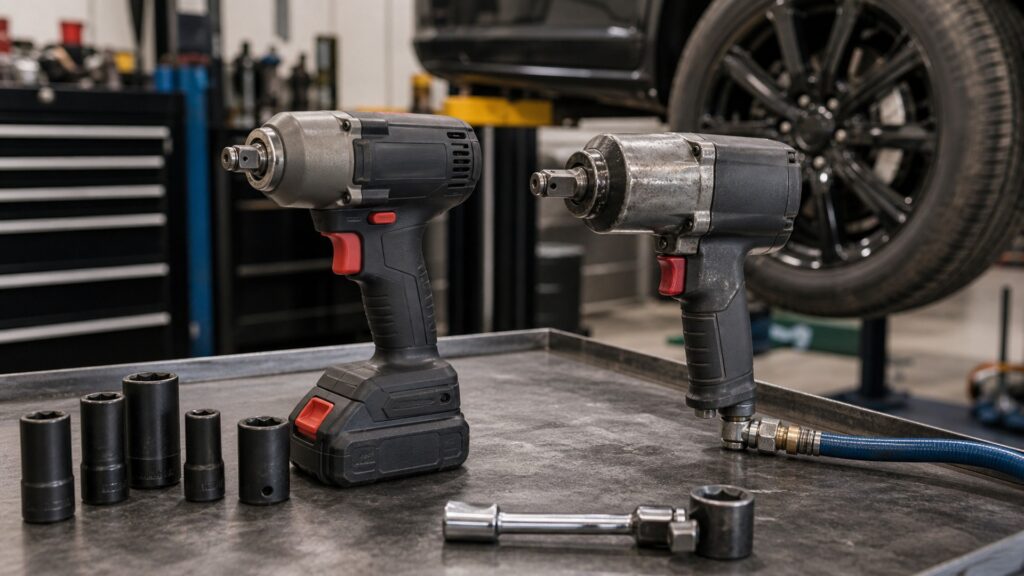
The correct choice follows where energy is stored, how it reaches the hammer, what limits repeated impacts, and how the operator prevents fastener damage.
Tip: For pneumatic diagnosis, install a pressure gauge near the tool and observe it during a sustained pull. Static pressure can look correct while restrictive fittings and hose starve the motor under flow.
These terms distinguish advertised numbers from the energy and joint behavior seen during real service.
A hammer-and-anvil assembly that stores rotational energy and releases it as repeated torque pulses.
A claimed or measured peak associated with loosening a previously tightened or test fastener.
The removable cell, protection, temperature, and communication assembly supplying a cordless tool.
Air pressure measured near a pneumatic tool while it is consuming air under load.
The flow demanded by a pneumatic tool during stated operation, commonly expressed as volume per time.
The practical tightening or loosening range a maker associates with controlled tool operation rather than a peak claim.
Tip: Impact output must be evaluated with the same socket, fastener condition, time, supply state, and measurement method.
The pack voltage sags under high current, the controller limits current or temperature, the motor accelerates the hammer, and repeated impacts heat every stage. A larger compatible pack may hold voltage better but adds weight and changes access.
Mobility comes from carrying the entire energy and heat system at the wrist.
An air wrench receives useful power only when pressure and mass flow remain adequate during operation. Long narrow hose, restrictive quick couplers, clogged filters, regulator loss, leaks, and undersized compressor delivery can turn a capable wrench into a weak one.
A large receiver tank postpones a supply problem; it does not increase continuous compressor output.
Cordless tools may offer speed modes, auto-stop, bolt-removal control, or connected presets. Pneumatic models use regulator positions, feathering, and supply adjustment. Neither method measures clamp load; time, lubrication, thread pitch, and joint stiffness still alter the result.
A mode label reduces risk only when the procedure defines what happens after it.
Continuous work can consume packs faster than chargers recover and trigger cordless thermal protection. A properly sized shop-air system can support long duty, but compressor heat, moisture management, noise, hose drag, and energy loss remain facility burdens.
The best production tool depends on system recovery between impacts.
Use impact-rated sockets and extensions, keep square engagement, and avoid worn anvils or adapters. Impact pulses can round fasteners, stretch studs, crack sockets, and over-tighten assemblies, especially when the tool's peak capacity dwarfs the joint.
Power-source choice does not change the fastener's allowable stress.
Cordless tools carry energy and controls; pneumatic tools rely on a shop-wide flow system. Real output and duty emerge from the complete chain.
Work moves between vehicles, roadside locations, lifts, or yards; quick setup, electronic modes, and freedom from hoses outweigh pack weight, charging logistics, and thermal recovery.
The approved battery platform can sustain the required fastener count and temperature while the operator still hand-starts and finishes critical joints by the service procedure.
A properly sized, maintained air system already exists and high fastener volume, compact tool body, continuous duty, or lower hand-held motor mass outweigh hose and compressor burdens.
Neither architecture rescues rounded hardware, wrong sockets, weak threads, incorrect units, unsafe reaction position, insufficient PPE, or a joint that requires controlled final clamp rather than repeated impacts.
Impact-wrench myths rank tools by a single torque claim and ignore supply state, test method, duty, socket, and the joint being worked.
A well-supplied air wrench can be formidable, but modern cordless tools may equal or exceed many models. Actual output depends on exact mechanism, supply, socket, time, temperature, and test method—not energy source alone.
Pressure without sufficient flow at the tool is inadequate. Compressor delivery, regulator, hose diameter and length, couplers, leaks, and simultaneous demand determine dynamic inlet conditions while the wrench is actually consuming air.
Modes can limit speed or stop behavior, but they do not measure clamp load and remain sensitive to joint friction, battery state, hardware, and technique. Use the specified torque and angle process for final assembly.
Torsion extensions can limit some impact transfer under defined tool and joint conditions, yet results vary with impact mechanism, time, socket mass, corrosion, and stick condition. Final verification must follow vehicle and tool guidance.
Tip: Compare energy at the anvil under repeatable conditions, then choose the control strategy that protects the actual fasteners.
These answers address claimed torque, compressor sizing, battery choice, sockets, maintenance, and when keeping both tool types is operationally sensible.
Only cautiously. Breakaway, fastening, nut-busting, working, and peak labels may use different fixtures, durations, voltages, pressures, and definitions. Seek standardized or transparent test methods and compare performance in the required fastener range.
Use the tool's required pressure and air-consumption data, then size delivered flow for duty cycle, hose losses, and simultaneous tools. Receiver volume provides a buffer; compressor output determines whether pressure recovers during sustained work.
A higher-capability compatible pack can reduce voltage sag and extend runtime, but tool electronics may cap output, and added mass changes balance. Temperature, charge state, cell condition, and manufacturer compatibility remain important.
Impact sockets use material and geometry intended to absorb repeated pulses. Chrome hand sockets can be brittle and may fracture; any socket can fail when worn, cracked, undersized, misaligned, or used beyond its marked application.
Yes in a busy shop with air infrastructure and mobile work. Pneumatic tools can cover sustained bay duty while cordless tools handle field service and quick access, but duplicated capability is wasteful when volume never justifies maintenance.
Cordless impact wrenches package cells, electronics, motor, and hammer into a mobile tool; pneumatic wrenches depend on sustained compressed-air flow through the entire shop supply chain.
Choose by mobility, dynamic output, duty cycle, access, heat, balance, noise, and maintenance, then protect the joint with correct impact sockets, hand starting, controlled seating, and measured final tightening.
Related explainers deepen the final torque process, the broader tool workflow, and selection by interface and consequence.
Move from rapid removal or rundown to controlled friction, sequence, torque range, angle, and clamp-load verification.
Select drive size, socket, extension, supply, and output range from the fastener interface and failure consequence.
Place either power tool inside rated support, PPE, ventilation, clean assembly, and post-repair verification.
Choose a retailer
Prices checked regularly. We may earn a commission at no cost to you.