Why Proper Tool Selection Matters

Proper tool selection matters because automotive work transfers force through small, specific interfaces. A socket loads fastener flats, a flare-nut wrench supports a tube fitting, a puller contacts a hub or race, a probe touches a terminal, and a torque wrench operates within a range. The wrong geometry concentrates stress where the part cannot tolerate it.

Fit is only the first gate. Material, drive size, reach, force direction, protective rating, resolution, and consequence matter. A tool can turn a fastener yet crack under impact, deform a connector, load a bearing through rolling elements, distort a seal, or produce a meaningless measurement. The right choice preserves the component and evidence while giving the technician a controlled position and safe stopping point.

By: Review Streets Research Lab
Updated: August 31, 2026
Explainer · 8-12 min read
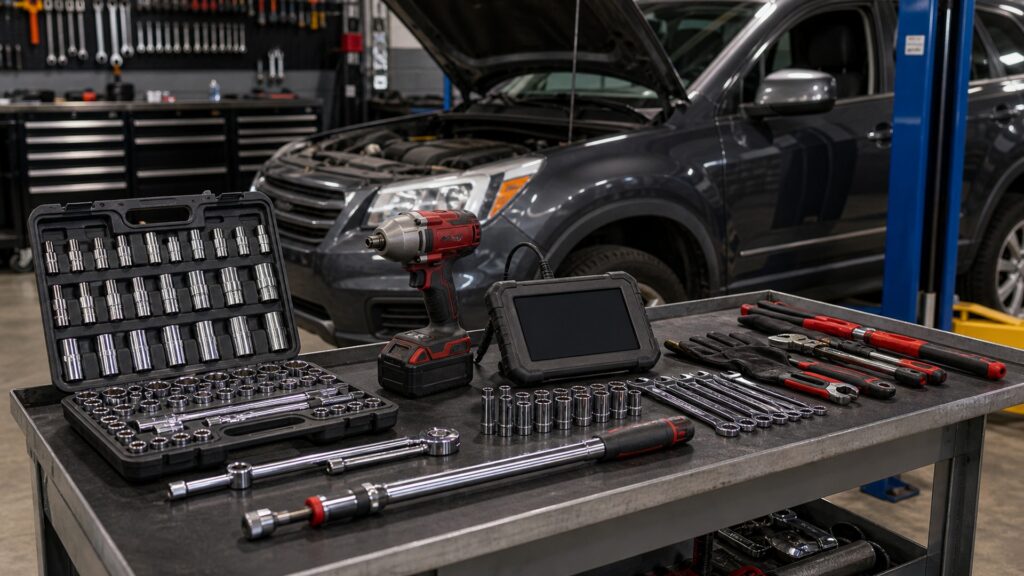
proper tool selection explainer hero image for Review Streets
What You'll Learn

Choose from the Interface Outward

Identify what surface may safely carry force, the direction and magnitude of that force, the available access, and the consequence if the tool slips or reads incorrectly.

  • Name the exact fastener or component interface
  • Keep force on the intended axis
  • Match drive and material to the energy source
  • Select measuring range around the target
  • Protect terminals seals and finished surfaces
  • Stop before tool flex becomes stored danger

Tip: Before applying more leverage, inspect the interface under bright light. Corrosion, rounded corners, wrong fastener standard, shallow engagement, paint, previous tool marks, or a loaded component can change the correct tool and procedure.

Definitions

Key Concepts That Define Proper Automotive Tool Selection

These terms connect tool geometry with force control and the damage that an apparent fit can conceal.

Fastener Interface

The designed flats, recess, spline, seat, or drive surface through which installation or removal torque is transferred.

  • Full engagement spreads contact stress
  • Standards that look similar may differ
  • Wear can eliminate safe tool contact

Drive Size

The square connection dimension joining sockets, extensions, and handles within a rated tool system.

  • Larger drives carry greater torque
  • Adapters can create weak links
  • Access and control may favor smaller systems

Reaction Force

The equal opposing force that a tool applies to the operator, fixture, or adjacent structure during work.

  • High torque can rotate the body
  • Support points must resist safely
  • Pinch zones form around handles

Tool Range

The span over which a measuring or power tool is designed to operate with stated performance.

  • Targets near extremes may be unsuitable
  • Resolution matters at low values
  • Overload can permanently change accuracy

Protective Rating

A documented limit for electrical, impact, pressure, chemical, speed, temperature, or other hazardous service.

  • Appearance cannot establish the rating
  • Accessories need compatible limits
  • Damage can invalidate protection

Failure Consequence

The credible harm caused if the tool slips, fractures, releases energy, misreads, contaminates, or damages the workpiece.

  • Safety systems demand greater control
  • Downtime changes acceptable risk
  • Consequence guides escalation and redundancy

Tip: The smallest safe tool is the one that fully engages the interface, remains within rating, and leaves adequate control—not simply the smallest tool that can be attached.

Fastener Geometry Comes before Leverage

More Force on Poor Contact Accelerates Damage

Six-point sockets load broad flats and suit high torque; twelve-point tools can improve indexing but offer less contact on some hex fasteners; flare-nut wrenches support more of a tube nut; exact Torx, spline, hex, and external profiles need matching sizes.

  • Clean the recess before insertion
  • Use full-depth straight engagement
  • Choose six-point contact for damaged high-load hexes
  • Replace tools with spread or chipped jaws

Leverage should increase only after contact quality is secured.

Energy Source Determines Tool Material

Impact Pulses Need Tough Sockets and Controlled Attachments

Impact-rated sockets and extensions are designed for repeated hammer loading. Chrome hand sockets, universal joints, reducers, and worn adapters may fracture or shed pieces. Drive size should carry the required energy without making the assembly too bulky to seat squarely.

  • Use marked impact-rated components end to end
  • Avoid stacked adapters
  • Guard the line of possible ejection
  • Wear rated eye protection

A socket that fits the anvil is not necessarily built for the anvil's energy.

Pullers and Presses Must Load the Correct Surface

Bearings, Bushings, and Hubs Have Intended Force Paths

Pressing through bearing balls can brinell races; gripping a pulley flange can bend it; a generic jaw can tear a dust shield. Proper adapters contact the specified race, boss, or reinforced face and keep the force axial.

  • Study the removal and installation load path
  • Support close to the pressed feature
  • Keep adapters square and centered
  • Stop if force rises unexpectedly

The special tool often exists to protect an invisible internal surface.

Measuring Tools Need the Right Scale and Intrusion

Range, Resolution, Bandwidth, and Connection Shape the Evidence

A high-capacity torque wrench may be poor at a tiny specification; a slow meter can miss an intermittent; a sharp probe can spread a terminal; an oversized pressure gauge can lack useful resolution. Select accuracy and access for the expected signal.

  • Put the target inside the useful range
  • Choose non-damaging probes and adapters
  • Confirm calibration and zero
  • Record units and test conditions

A displayed number is not evidence when the tool cannot resolve the decision boundary.

Operator Position Is Part of Selection

The Right Tool Creates a Controlled Pull and an Escape Path

Long handles, compact heads, wobble extensions, crowfeet, ratcheting heads, and reaction arms change access and body mechanics. The best setup keeps the tool square, hands out of pinch points, footing stable, and reaction force away from fragile components.

  • Pull rather than push when practical
  • Brace for fastener release
  • Keep knuckles out of the travel path
  • Choose another access route before forcing an angle

A theoretically strong setup is poor when the operator cannot control what happens at release.

Quick Reality Check

The Right Tool Preserves the Interface and the Evidence

Good selection delivers the required force or measurement through the intended surface without creating a new defect or uncontrolled release.

A Defensible Selection

Geometry fully engages the fastener or component; material, rating, drive, range, and adapters suit the energy; access keeps the force axial and the operator outside pinch or ejection paths.

The tool's resolution and condition support the decision, the procedure defines contact and limits, and higher-consequence work includes calibration, redundancy, or professional escalation where appropriate.

Signals to Change the Method

Partial engagement, spreading jaws, bending extensions, rising press force, unstable footing, damaged insulation, off-axis reaction, slipping adapters, missing rating, poor measurement resolution, or uncertain interface require a stop and reassessment.

No universal kit can cover vehicle-specific pullers, high voltage, restraint systems, refrigerant service, calibration fixtures, precision machining, or safety-critical work whose procedure and failure consequence exceed the available equipment.

Common Myths

Misconceptions About Proper Automotive Tool Selection

Tool-selection myths assume size and apparent fit settle the question, even when material, reaction, range, or component force path disagree.

An adjustable wrench replaces a full wrench set

Adjustable jaws can be useful on appropriate low-risk flats, but clearance, jaw play, direction, and contact area can round high-load fasteners. Exact six-point sockets or correctly sized wrenches provide more controlled engagement when consequence rises.

The longest breaker bar is always the safest solution

More leverage reduces hand force but increases stored energy, reaction travel, and the torque available to strip threads or break tools. Confirm direction, interface, support, and fastener procedure before extending leverage or adding heat.

Adapters only change size

Reducers, extensions, swivels, crowfeet, and bit holders add torsion, leverage, angularity, clearance, and potential failure points. They can alter effective torque or impact suitability and must be rated and configured for the complete load.

Professional tools cannot damage fasteners

Premium material and tolerances improve consistency but cannot overcome wrong size, shallow engagement, off-axis force, excessive energy, corrosion, damaged hardware, or an incorrect procedure. Technique and the workpiece condition remain part of tool selection.

Tip: Choose the complete tool stack from the workpiece outward and treat every adapter as a new interface with its own rating and alignment.

FAQ

Frequently Asked Questions About Proper Automotive Tool Selection

These answers address socket profiles, drive size, impact tools, stuck fasteners, electrical tools, and deciding when a special tool is economically justified.

When should a six-point socket be preferred?

Use it for high torque, shallow heads, soft materials, or damaged hex fasteners when access permits, because broad flat contact can reduce corner loading. Twelve-point sockets remain necessary for matching twelve-point hardware and tight indexing.

How is the correct drive size chosen?

Match expected torque, socket size, access, handle control, and tool ratings. A small drive can overload; a very large drive can reduce feel and fit. Avoid reducers that become the weakest link under high energy.

Can hand sockets be used on an impact wrench?

Do not use ordinary chrome hand sockets for impact service. Use marked impact-rated sockets and accessories of the correct drive and condition, keep full engagement, inspect for cracks or wear, and protect against ejected fragments.

What is the first move on a seized fastener?

Clean and inspect the interface, confirm direction and procedure, use penetrating treatment where appropriate, choose exact six-point contact, support the component, and plan the release path. Heat, extraction, drilling, or cutting require added controls.

When is a special tool worth buying or renting?

It is justified when it protects an expensive component, keeps force on the intended surface, reduces injury risk, or makes a specification measurable. Compare tool cost with repeated labor, part damage, downtime, and professional service.

Bottom Line

Proper automotive tool selection matters because force and measurement must pass through an exact interface, range, material, axis, and operator position without damaging the component or corrupting the evidence.

Choose from the workpiece outward, keep every adapter within rating, stop when engagement or control deteriorates, and use special or professional equipment when the failure consequence exceeds the savings from improvisation.

Next Steps

Make Tool Choice a Force-Path Decision

Related explainers apply this method to impact energy, measured fastener clamp, and the complete garage sequence.

Why Torque Wrenches Matter

Move from rapid rundown to controlled torque, friction, sequence, angle, calibration, and joint verification.