
Treatment Architecture
An ordered selection of chemistry, media, and instructions designed for a bounded soil, defect, material, or finish objective.
- Sequence creates value
- Stages can be optional
- Compatibility governs handoffs
A detailing kit packages a treatment architecture: selected chemicals, abrasives, applicators, brushes, clay, pads, or towels intended to change a particular surface condition. Its value lies in specificity and sequence. Products are consumed, media become loaded, and the operator decides which stages a test area actually needs.
Car wash equipment is durable delivery infrastructure. Pumps, vacuums, extractors, polishers, blowers, arches, and water systems provide repeatable pressure, flow, suction, motion, or air. They need utilities, rated interfaces, maintenance, and setup. Equipment can deliver a kit product, but it does not supply the chemical recipe or prove that the selected treatment suits the finish.
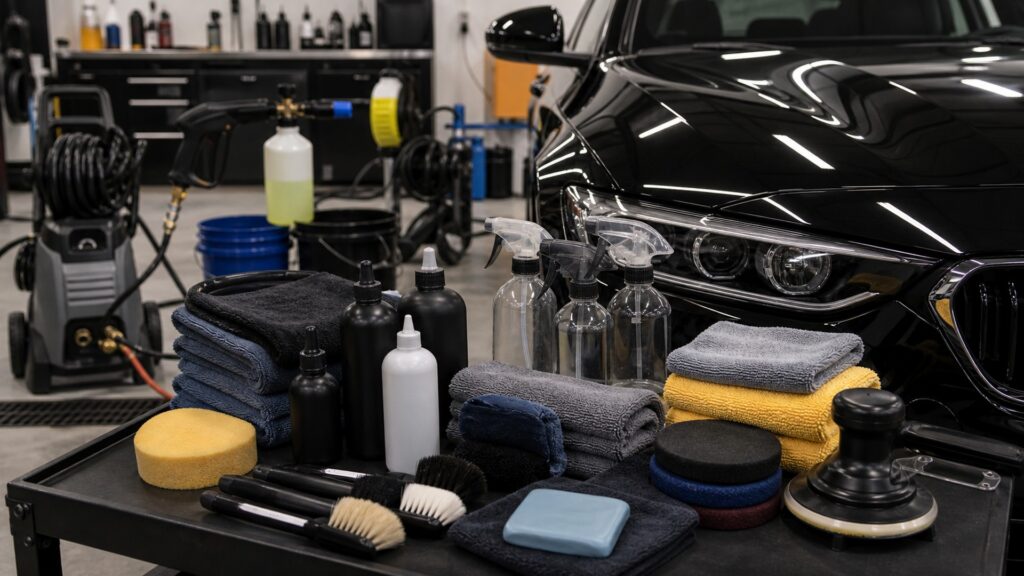
The categories differ in what is purchased, how work scales, where failure appears, and what evidence shows completion, even when a machine and kit operate together.
Tip: Split combination bundles into two ledgers—durable components and consumable treatment steps—so replacement cost, service life, missing utilities, and surface compatibility remain visible.
These terms expose the business and process structure behind two categories that are often sold in one package.
An ordered selection of chemistry, media, and instructions designed for a bounded soil, defect, material, or finish objective.
Cleaner, decontaminant, abrasive liquid, solvent, dressing, protectant, or other formulation depleted through application, removal, evaporation, or disposal.
The available brushes, clay, pads, applicators, mitts, and towels whose cleanliness and condition determine usable treatment capacity.
Durable machinery, hoses, tanks, power systems, nozzles, plates, or attachments that generate and route water, air, suction, heat, or motion.
Distribution of machine purchase, connection, priming, protection, testing, cleanup, maintenance, and storage effort across completed jobs.
Observations or measurements proving the machine operated correctly and the target surface reached the intended clean, corrected, prepared, or protected condition.
Tip: A polisher or extractor may appear in a kit, but classify each item by whether it provides durable delivery, expendable treatment, or a supporting interface.
Kit selection starts with the surface problem and included treatment stages. Equipment selection starts with required pressure, flow, suction, orbit, airflow, duty, reach, and supporting utilities.
The categories solve different shortages: treatment specificity versus delivery capacity.
Chemistry is measured by usable volume and shelf condition; media by clean cycles; machines by output, duty, wear, and repairability. Ownership economics therefore use different replenishment and depreciation assumptions.
A low purchase price can hide either rapid depletion or high setup burden.
Adding vehicles consumes more chemical, media cycles, and hand labor. Equipment can increase throughput when supply, drainage, power, and operator capacity support it, but specialized defects still require individual testing and finishing.
More machinery accelerates repeatable transport, not every judgment-intensive treatment.
Wrong chemistry, dry clay, saturated towels, mismatched abrasives, or expired product damage a kit process. Starved pumps, worn nozzles, clogged filters, leaks, overheated motors, and incompatible power undermine equipment.
Stronger product cannot repair a pump, and higher pressure cannot clean a contaminated pad.
Equipment passes when output is stable, rated interfaces hold, and safety controls function. Treatment passes when soil or defects improve without unacceptable change, residue is removed, and the next stage or final finish meets its criteria.
Ownership of both categories does not merge their evidence.
A foam cannon, polisher, or extractor can deliver a kit product, yet durable output and treatment compatibility remain separate decisions.
The exact chemistry, abrasive, media, quantity, sequence, test area, removal, cure, and finish evidence match a defined vehicle surface and objective.
Consumable capacity and contamination controls are sufficient for the job, with missing lighting, PPE, machines, water, power, or drainage identified rather than assumed.
Pressure, flow, suction, orbit, airflow, duty cycle, fittings, supply, circuit, hose path, maintenance, drainage, and safe operating limits support repeated physical delivery.
Equipment does not diagnose paint, choose chemistry, establish colorfastness, keep media clean, interpret a test spot, or verify that abrasion and protection changed the finish appropriately.
Comparison myths treat package size, professional appearance, or shared accessories as proof that one category subsumes the other.
A bundle may support low-water or hand work, but heavy loose soil, frequent vehicles, extraction, blowing, or broad rinsing can require water, power, drainage, suction, and durable equipment capacity that consumables cannot create.
Professional work is defined by diagnosis, compatibility, controls, repeatability, verification, and accountability. A focused hand kit can be correct for a small defect, while expensive equipment can scale an unsuitable or unsafe process.
The machine remains durable delivery infrastructure; its chemicals, pads, towels, and instructions remain the treatment architecture. Keeping those roles separate clarifies ratings, maintenance, replenishment, contamination, and surface-compatibility responsibilities. in practice
Machines wear, filters and seals are replaced, hoses age, and accessories fail. Kits can include durable bottles, brushes, plates, or tools. Classify each component by function and lifecycle rather than the package category.
Tip: Separate the durable output system from the expendable surface prescription, then verify their interface on the actual task.
These answers address combination bundles, total cost, professional use, low-water work, recurring jobs, and the evidence required when equipment delivers detailing products.
A polisher is detailing equipment because it supplies controlled motion. A kit may bundle the machine with pads and abrasives, but output ratings, pad interface, abrasive choice, surface testing, and consumable replacement remain separate considerations.
It depends on frequency, utilities, setup, maintenance, repair, product yield, clean-media turnover, labor, disposal, and rework. Compare complete workflows per finished vehicle rather than machine price against the kit's initial retail cost.
They can organize rinseless, waterless, spot, decontamination, correction, or protection steps requiring limited bulk flow. Suitability still depends on soil load, lubrication, clean towels, material compatibility, ventilation, and lawful disposal of residues.
Repeated coverage raises the value of durable pressure, suction, airflow, tanks, reels, and duty capacity, while consumables need bulk inventory and quality control. Specialized stains or defects still require individual treatment evidence.
The equipment delivers stable approved output; the product is metered and remains within dwell; media stay clean; the test area improves; residue leaves completely; surfaces remain undamaged; and the finished condition meets the next-stage criteria.
Detailing kits are task-specific treatment architectures built from consumable chemistry, contact media, and sequence. Car wash equipment is durable infrastructure that generates repeatable water, air, suction, heat, or motion.
Choose, cost, maintain, and verify those roles separately. Their interface succeeds only when the machine output supports the product directions and the surface treatment passes its own compatibility and finish checks.
Related explainers trace the kit workflow, explain when targeted treatment should lead, and show the hydraulic and physical chain behind wash equipment.
Follow a detailing set through inspection, decontamination, correction, preparation, protection, and media control.
Choose targeted chemistry and media over powered infrastructure when the surface problem and site favor specificity.
Trace water, pump, nozzle, chemistry, contact, rinse, drying, and wastewater through wash equipment.
Choose a retailer
Prices checked regularly. We may earn a commission at no cost to you.