When to Use Detailing Kits Instead of Car Wash Equipment

Use a detailing kit when the problem is already bounded: bonded contamination on selected panels, a small paint defect, trim restoration, glass treatment, light interior work, or protection application. The value comes from targeted chemistry, appropriate contact media, and a test-driven sequence rather than from moving large amounts of water, air, or debris.

Choose this route only when soil load and site conditions allow it. Heavy grit, repeated fleet volume, broad extraction, underbody rinsing, or high throughput can exceed hand methods and consumable capacity. A kit also demands labor, clean media, lighting, and skill. Limited equipment does not justify dragging abrasive contamination across a surface.

By: Review Streets Research Lab
Updated: September 1, 2026
Explainer · 8-12 min read
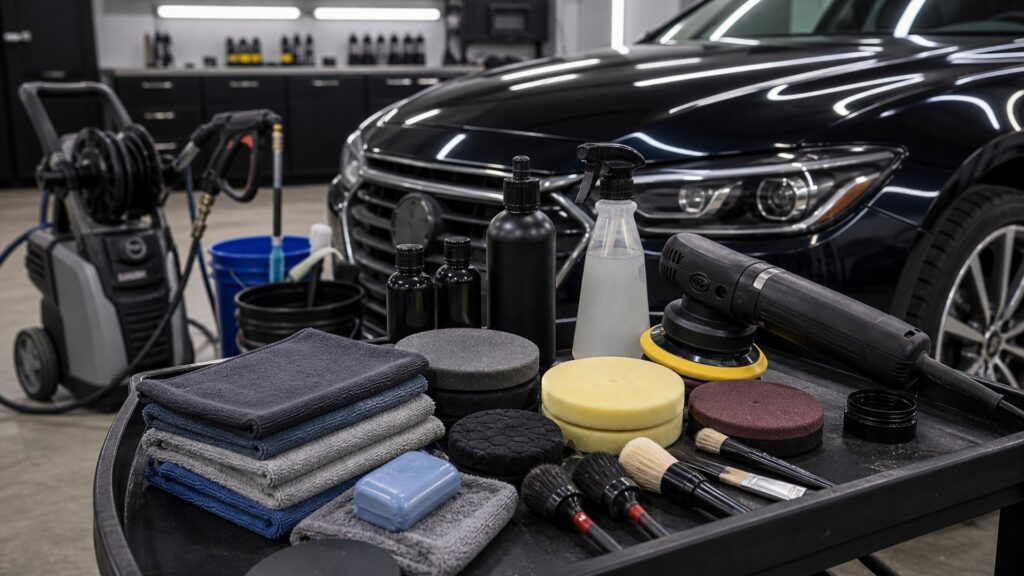
detailing kits instead of car wash equipment explainer hero image for Review Streets
What You'll Learn

Let the Diagnosed Surface Problem Lead

The kit should be chosen because a specific treatment mechanism fits a bounded condition, not simply because it is cheaper, portable, or easier to store than equipment.

  • Define the material soil and finish goal
  • Estimate the exact treatment area
  • Check water power drainage and space
  • Calculate clean-media and product capacity
  • Test the least aggressive sequence
  • Set a stop or referral threshold

Tip: Price the complete kit workflow—including lighting, PPE, towels, pads, disposal, labor, and rework—before treating the machine purchase as the only alternative cost.

Definitions

Key Concepts That Define Detailing Kits or Car Wash Equipment

These terms frame the kit-first decision around diagnosis, precision, site limits, capacity, and preservation risk. The decision weighs diagnosed surface condition, targeted treatment area, finish precision, single-vehicle frequency, utility constraint, low-water method, test-spot iteration, consumable sufficiency, manual labor demand, equipment setup burden, rework consequence, and stop-or-refer threshold.

Diagnosed Condition

A named soil, defect, material, prior treatment, and finish objective supported by inspection and a representative test rather than a vague appearance complaint.

  • Diagnosis narrows products
  • Prior repairs alter risk
  • Acceptance should be explicit

Treatment Footprint

The physical area and number of surfaces requiring a specific chemical, contact, abrasive, or protection stage.

  • Small areas favor targeted tools
  • Edges increase precision needs
  • Whole vehicles consume more media

Utility Constraint

A limitation in water flow, electricity, drainage, ventilation, noise, space, transport, weather, or storage that affects powered equipment feasibility.

  • Constraints can prohibit work
  • Adapters do not create capacity
  • Relocation may be safest

Test-Spot Iteration

A controlled series of small trials changing one product, pad, pressure, speed, dwell, or pass variable while comparing the verified surface response.

  • One variable supports diagnosis
  • Residue removal precedes judgment
  • Escalation needs a boundary

Manual-Labor Demand

The time, repetition, posture, contact pressure, media changes, and inspection effort required when powered transport or motion is limited.

  • Fatigue changes technique
  • Large panels multiply passes
  • Ergonomics affect consistency

Referral Threshold

A preselected condition requiring different equipment, location, expertise, repair, or service rather than further chemical or mechanical escalation.

  • Damage can exceed detailing
  • Hazard can exceed site controls
  • Unknown finishes warrant restraint

Tip: A low-water or hand method remains conditional on contamination severity; portability cannot turn sand, mud, or salt into a safe wipe-off task.

Bound the Problem

Kits Lead when the Surface Needs a Specific, Limited Treatment

A few bonded deposits, isolated transfer, small correction area, protection application, or material-specific cleaning can be solved with selected chemistry and media without building a high-throughput wash system. The diagnosed surface condition and targeted treatment area establish the bounded case.

  • Photograph the initial condition
  • Identify the smallest treatment footprint
  • Choose function-specific products
  • Define the acceptable result

Precision creates value when the problem is truly bounded.

Check Soil Severity

Hand and Low-Water Methods Need a Safe Contamination Load

Rinseless or waterless products can lubricate suitable light soil when directions and clean-media capacity are followed. Thick mud, sand, road salt, or gritty unknown deposits may require controlled bulk removal elsewhere. A utility constraint can favor a low-water method only within safe soil limits.

  • Inspect lower panels and crevices
  • Do not wipe dry abrasive soil
  • Use enough fresh towel faces
  • Relocate when rinse capacity is required

A constrained site changes where work occurs, not the physics of grit.

Value Finish Precision

Test Spots and Hand Control Can Beat Raw Throughput on Delicate Work

Localized stain removal, edge work, trim, small defects, or coating application often benefit from measured chemistry and careful media placement. Large machines can add setup or reach where the task needs restraint. Finish precision is established through test-spot iteration rather than package claims.

  • Mask vulnerable adjacent materials
  • Change one test variable
  • Use small dedicated applicators
  • Inspect after complete residue removal

Precision is a controlled method, not merely slower work.

Count Hidden Costs

Portability Trades Equipment Setup for Consumables, Labor, and Media Management

A compact kit avoids tanks, reels, pumps, and storage but consumes towels, pads, product, time, and physical effort. Frequent or broad jobs can make this trade inefficient and inconsistent. Manual labor demand must be compared with equipment setup burden over repeated work.

  • Estimate labor by stage
  • Count clean-media turnover
  • Include laundering and disposal
  • Compare repeated-job economics

Low equipment cost can produce high completion cost.

Set the Boundary

Stop when Coverage, Hazard, Damage, or Uncertainty Exceeds the Kit

Refer or relocate work involving uncontrolled runoff, biological hazards, severe odor reservoirs, failing finishes, extensive correction, uncertain coatings, unsafe electrical access, or contamination that cannot be removed without bulk transport. Rework consequence and a stop-or-refer threshold define the professional exit.

  • Write stop conditions before testing
  • Do not conceal structural damage
  • Escalate location before aggression
  • Use qualified repair or remediation when needed

A kit-first decision remains professional only when it includes a credible exit.

Quick Reality Check

Kits Lead through Specificity, Not Universality

They are strongest when diagnosis narrows the material, mechanism, area, and finish goal enough that targeted treatment outweighs powered coverage.

Choose the Kit-First Path When

The contamination or defect is identified, limited in area, supported by product directions, safe for controlled testing, and solvable with available chemistry, media, lighting, PPE, ventilation, and residue handling.

Vehicle frequency and surface area do not justify substantial equipment setup; site utilities are constrained but the soil load remains compatible with a safe low-water or hand process.

Choose Equipment or Another Site When

Heavy loose contamination, large vehicles, repeated volume, deep extraction, underbody residue, extensive rinsing, rapid drying, or consistent throughput require durable water, air, suction, or motion capacity and supporting utilities.

Do not use a kit-first process when abrasion, moisture, fumes, runoff, fatigue, missing clean media, uncertain finish, or hidden contamination cannot be controlled within the location and available expertise.

Common Myths

Misconceptions About Detailing Kits or Car Wash Equipment

Decision myths equate small packages with gentle work, portability with site suitability, and equipment avoidance with lower total cost.

A kit is always the safer beginner choice

Concentrates, solvents, clay, compounds, coatings, and contaminated towels can damage surfaces or expose users when diagnosis and controls are weak. Begin with a narrow task, complete directions, PPE, a test area, and conservative stop conditions.

Waterless products eliminate every need for wash equipment

They can suit compatible light contamination with sufficient lubrication and clean media, but cannot make heavy mud, sand, salt, or gritty deposits safe to wipe. Bulk soil may require an authorized rinse location.

Hand methods cannot damage paint

Dirty towels, dry clay, aggressive abrasives, repeated pressure, edge work, and fatigue can scratch, haze, thin, or contaminate finishes. Mechanical energy still exists when supplied by a person's hand instead of a motor.

Avoiding equipment always lowers total cost

Kits can increase product consumption, towel turnover, laundering, hand labor, setup repetition, and rework. At sufficient frequency or coverage, appropriate equipment lowers per-vehicle cost while improving consistency and ergonomics. overall

Tip: Use soil physics, treatment footprint, finish risk, capacity, and a referral boundary instead of category preference.

FAQ

Frequently Asked Questions About Detailing Kits or Car Wash Equipment

These answers cover beginners, waterless work, spot correction, mobile detailing, recurring vehicles, site restrictions, and when a kit should give way to equipment or referral.

What is a good first kit-first task?

Choose a small, identified, low-risk condition on a known material with complete directions and a clear test area, such as routine compatible interior wiping or isolated light contamination, rather than full correction or unknown chemical staining.

When is a waterless kit appropriate?

Use it only within product directions on compatible light soil, cool surfaces, and a controlled area with abundant clean media. Stop when particles, drag, residue, heat, or towel loading show that bulk removal is needed.

Can a kit handle isolated paint correction?

Yes, when finish condition, defect depth, lighting, pad and abrasive compatibility, and a conservative test spot support it. Protect edges, clean media, remove residue fully, and stop before chasing unsafe or unrepaired defects.

What makes kit-first mobile work feasible?

The site must support parking, permission, shade or temperature control, ventilation, safe chemical handling, waste containment, clean-media transport, lighting, security, and enough time. Portability does not waive runoff or exposure requirements.

When does recurring work justify equipment?

When repeated coverage, rinse, vacuum, extraction, blowing, or polishing demand makes setup amortization favorable and the site supports supply, power, drainage, storage, maintenance, and safe operation. Keep specialized kit stages for diagnosed surface needs.

Bottom Line

Use detailing kits instead of car wash equipment when a diagnosed, bounded surface condition needs targeted chemistry, controlled contact, finish precision, or a low-volume process that the site can safely support.

Switch to equipment, relocation, repair, or referral when loose soil, coverage, frequency, extraction, runoff, hazard, fatigue, or uncertainty exceeds kit capacity. Specificity is the kit's advantage; a credible boundary keeps it safe.

Next Steps

Choose Targeted Treatment Only after Bounding the Job

Related explainers compare kit architecture with durable delivery, show the inverse capacity-led decision, and trace the component functions used in a kit-first test sequence.