
Traction Battery
A high-voltage rechargeable pack storing electrical energy for propulsion.
- Protected state-of-charge limits define usable energy
- Temperature control supports output and life
- Capacity and vehicle efficiency jointly shape range
Electric autos and gas autos face the same task at the road: produce wheel torque while overcoming mass, tire resistance, aerodynamic drag, and grade. They differ in how energy is stored, converted, controlled, replenished, and kept within a safe temperature range.
A battery-electric vehicle meters electricity from a traction battery through power electronics to a motor. A gasoline vehicle releases fuel energy through combustion, routes crankshaft torque through a transmission, treats exhaust, and rejects heat. Those paths change response, braking-energy recovery, trip planning, component sets, and service. Both architectures still rely on tires, brakes, steering, suspension, and electronic stability control after propulsion torque reaches the driveline.
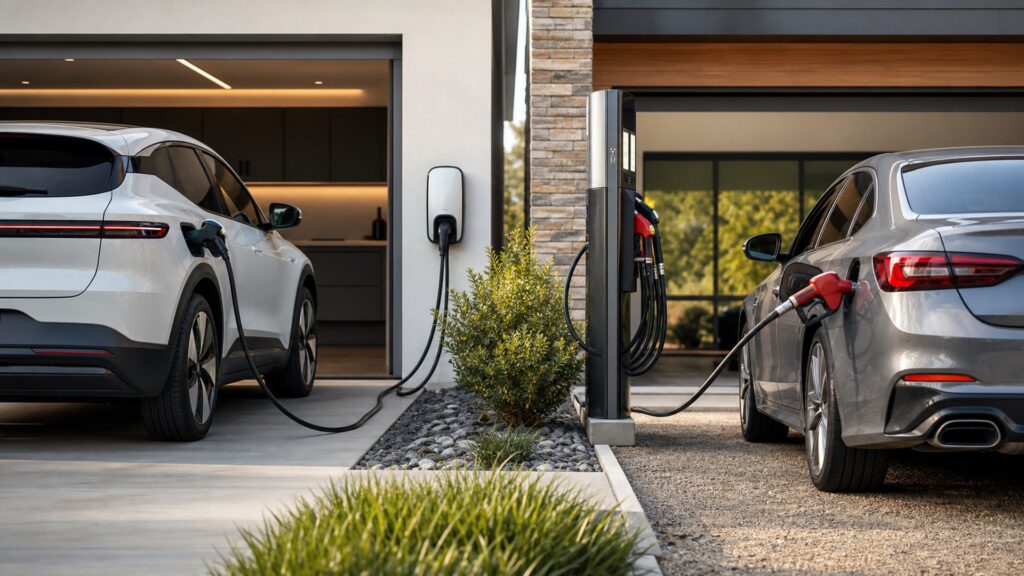
The decisive differences occur before torque reaches the wheels and when the vehicle must recover braking energy, reject heat, or replenish storage.
Tip: Compare the complete trip loop—energy acquisition, conversion, road use, and replenishment—not just acceleration feel or a single range number.
These components mark the different storage, conversion, and replenishment handoffs in battery-electric and gasoline vehicles.
A high-voltage rechargeable pack storing electrical energy for propulsion.
Power electronics converting battery DC into controlled motor current and reversing flow during regeneration.
A machine converting electrical energy into shaft torque or vehicle motion into electricity.
A machine burning an air-fuel mixture to produce crankshaft rotation.
The tank, pump, injection, evaporative, exhaust, catalyst, and sensor path supporting gasoline operation.
The port, external equipment, onboard charger, and battery controls moving grid energy into an EV.
Tip: Translate both battery capacity and tank volume into usable travel after conversion losses; the raw storage numbers are not directly comparable.
An EV sends electrical energy through an inverter to create magnetic force in a motor. A gas vehicle meters air and fuel into cylinders, converts combustion pressure into crankshaft torque, and routes it through a multi-ratio driveline.
The architectures differ most in conversion; road load still sets useful work.
A motor can make controlled torque from zero shaft speed across a broad range. An engine must idle and remain within a narrower useful speed band, so clutches, torque converters, and multiple ratios connect it to changing wheel speed.
Fast response is not proof of superior traction or universal performance.
Gasoline refueling transfers liquid energy quickly at stations. EV charging transfers electrical power over time, often while parked; results depend on location, charger, vehicle acceptance, battery temperature, and starting charge.
Parking, daily distance, route, and schedule decide which pattern fits.
An EV can operate its motor as a generator and return part of kinetic energy to the battery. Gas-only vehicles normally discard braking energy as friction heat, while engines, batteries, inverters, motors, and cabins impose different cooling or heating loads.
Electrification redirects energy flows; it does not eliminate heat or friction braking.
A BEV removes engine oil, spark ignition, fuel, and exhaust parts. It retains tires, suspension, steering, cooling, air conditioning, low-voltage electronics, brakes, and driveline hardware while adding high-voltage isolation and battery diagnostics.
Maintenance shifts to a different component and skill set rather than vanishing.
Each path has genuine strengths, but value depends on parking, distance, climate, load, and energy access.
The EV path explains efficient low-speed conversion, regenerative braking, quiet operation, and the absence of tailpipe exhaust.
The gasoline path explains rapid liquid refueling and a service network built around combustion hardware.
Range, charging, efficiency, performance, maintenance, cost, and durability vary within both groups.
A label cannot replace checking the exact battery, engine, thermal system, tires, capacity, equipment, and route.
Weak comparisons turn an architectural tendency into a universal claim about range, maintenance, acceleration, or trip suitability.
They eliminate several engine and exhaust services, but tires, suspension, brakes, cabin systems, cooling circuits, low-voltage electronics, and inspections remain. High-voltage systems introduce specialized diagnostic and safety procedures. That vehicle-specific boundary still matters.
Conventional gas vehicles mainly use friction braking, but hybrids still burn gasoline and can recover braking energy electrically. The powertrain label must be precise before drawing that conclusion. That vehicle-specific boundary still matters.
Motor response helps, but acceleration also depends on power, gearing, mass, tire grip, thermal state, and control limits. Torque the tires cannot transmit does not become forward motion. That vehicle-specific boundary still matters.
Speed, temperature, wind, elevation, payload, accessories, and tire condition affect range. Charging or fueling access also changes how useful the available distance feels. State of charge and internal combustion engine remain important vehicle-specific boundaries in this case.
Tip: Test broad claims against the exact vehicle, route, temperature, load, and replenishment plan.
These answers clarify charging hardware, battery depletion, regenerative braking, and cross-powertrain efficiency comparisons.
Charging equipment supplies AC safely, and the vehicle's onboard charger converts it to DC for the battery. During DC fast charging, external equipment supplies controlled DC through a different path.
An EV provides warnings and may limit performance near its protected lower boundary. Continuing until propulsion stops can require towing; displayed reserve and behavior are model-specific. Fuel tank remains an important vehicle-specific boundary.
Regeneration cannot cover every stop. Friction brakes provide stronger deceleration, low-speed completion, stability-control action, backup capacity, and braking when battery acceptance or traction limits regeneration. Traction battery remains an important vehicle-specific boundary.
Both express distance per standardized energy quantity, but MPGe uses a gasoline-energy equivalent. Compare consumption, prices, route, and charging losses before turning either figure into operating cost. That vehicle-specific boundary still matters.
Their propulsion path has fewer common engine and exhaust components, but battery modules, power electronics, thermal loops, software, high-voltage safety, and charging interfaces introduce different forms of complexity. That vehicle-specific boundary still matters.
Electric autos store electricity and create torque through batteries, power electronics, and motors; gas autos store liquid fuel and create torque through combustion and emissions-controlled engine operation.
Those paths change response, efficiency, recovery, heat, replenishment, and service, while route, climate, load, infrastructure, and exact design determine which differences matter.
Continue with the architecture that combines both energy paths, then compare their efficiency metrics and shared automobile systems.
See how a hybrid combines an engine, motor-generator, and smaller traction battery instead of choosing one propulsion path.
Compare MPG, consumption, and MPGe after understanding why the architectures lose and replenish energy differently.
Return to gearing, tire force, steering, braking, suspension, and feedback shared by both powertrains.
Choose a retailer
Prices checked regularly. We may earn a commission at no cost to you.