
Hybrid Electric Vehicle
A vehicle using an engine and one or more electric machines for propulsion.
- A conventional HEV is not plugged in
- Gasoline remains the external energy source
- Electricity is recovered or generated onboard
A conventional gas auto asks its engine to cover nearly every propulsion condition and discards most braking energy as heat. A hybrid adds a traction motor, battery, power electronics, and supervisory control so the engine can shut off, receive assistance, or operate in a more favorable region.
That does not make the vehicle continuously electric. Battery state, temperature, speed, braking demand, route, and system design decide when assistance or regeneration is available. The real distinction is coordinated energy reuse and engine-load management, not a badge guaranteeing one result on every trip.
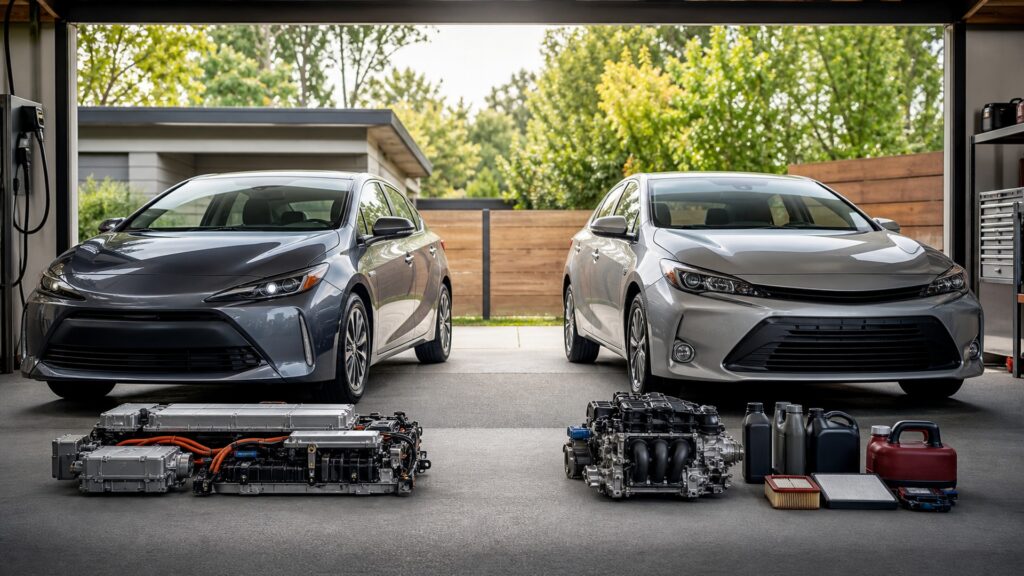
Hybrid hardware changes when the engine runs, where braking energy goes, and how launch and accessory demand are supplied.
Tip: Watch when the engine starts, stops, and changes load; that strategy explains more than an electric-mode indicator.
These concepts distinguish a hybrid's dual-source loop from conventional gasoline propulsion.
A vehicle using an engine and one or more electric machines for propulsion.
An electric machine producing drive torque or converting motion into electricity.
A high-voltage energy buffer for assistance and regeneration.
Software choosing engine, motor, charging, and braking commands.
Deceleration that converts kinetic energy into stored electrical energy.
Hardware combining engine and motor output at the wheels.
Tip: Treat the battery as an energy buffer that shifts and reuses energy within a drive cycle, not as a second fuel tank.
A controller can meet wheel demand with engine torque, motor torque, or both while maintaining emissions, temperature, and battery-charge boundaries.
The advantage comes from coordination across time, not adding peak ratings.
A hybrid can use motor torque for launch, stop the engine at rest, and schedule combustion where fuel conversion is more useful.
The motor changes when the engine works; it does not make it irrelevant.
During suitable deceleration, the motor-generator opposes motion and charges the battery; friction brakes blend in when demand or limits require them.
No hybrid recaptures all energy spent accelerating.
Frequent stops create engine-off and regeneration opportunities; steady highway travel creates fewer. Cold, grades, towing, cabin heat, and charge state alter the balance.
A combined MPG result is not route-independent.
A hybrid retains engine, fuel, exhaust, cooling, and emissions systems while adding a motor-generator, battery, inverter, high-voltage wiring, and control logic.
Additional complexity buys opportunities to avoid inefficient engine operation.
The mechanisms are genuine; battery size, calibration, load, and trip pattern decide how often they help.
Engine-off operation, motor assistance, and regeneration address idling, unfavorable load, and discarded braking energy.
Stop-start routes can activate those mechanisms frequently.
Layouts, battery power, calibration, mass, and aerodynamics vary widely.
Sustained high speed or load can reduce electrical opportunities.
Hybrid misunderstandings exaggerate battery independence or assume every trip activates identical behavior.
A non-plug-in HEV replenishes its operating battery through regenerative braking and engine-driven generation. Plug-in hybrids are a different category with larger externally chargeable batteries. Motor-generator remains an important vehicle-specific boundary.
The battery is a managed buffer with limited usable energy. Sustained demand requires the engine, while control preserves charge and protects operating limits. Regenerative braking and engine-off operation remain important vehicle-specific boundaries in this case.
Friction brakes remain essential for strong stops, low speed, stability control, backup, and limited battery acceptance. Inspection and eventual service remain necessary. Power-split device and state of charge remain important vehicle-specific boundaries in this case.
The difference depends on design and route. Stop-start driving may activate more engine-off time and regeneration; high-speed, cold, hilly, or heavy-load use changes the balance. Inverter remains an important vehicle-specific boundary.
Tip: Separate “can move electrically” from “has enough stored energy for this demand”; control always manages that boundary.
These answers clarify plugging, battery charge, engine operation, braking feel, and faults.
Many can at low load, but availability depends on design, charge, temperature, speed, cabin demand, and power request. It is not a fixed electric range. Idle reduction remains an important vehicle-specific boundary.
The controller may need power, cabin heat, emissions temperature, charging, or thermal management. The gauge represents a managed band, not absolute battery limits. Engine operating point and motor-generator remain important vehicle-specific boundaries in this case.
No. Designs include power-split, stepped, continuously variable, and dual-clutch arrangements. Hybrid describes multiple energy sources, not one mechanical layout. Traction battery and regenerative braking remain important vehicle-specific boundaries in this case.
Regeneration becomes less useful at low speed, and the system transitions toward friction braking. Calibration blends the paths, so response can differ from friction-only braking. Engine-off operation remains an important vehicle-specific boundary.
Do not assume so. The battery may support starting, conversion, or driveline operation. Some faults reduce power or prevent propulsion; follow warnings and service information. State of charge remains an important vehicle-specific boundary.
Hybrid autos differ by using a motor-generator and traction battery to shift engine operation, assist propulsion, stop idling, and recover part of braking energy.
Route, charge state, temperature, demand, layout, and calibration determine when that electrical path changes the result.
Separate hybrid energy buffering from battery-electric propulsion, then interpret the resulting consumption numbers.
Compare a hybrid's managed energy buffer with an externally charged battery-electric propulsion system.
Apply MPG and consumption reasoning to engine-off operation, regeneration, and motor assistance.
Place hybrid blending inside the larger automobile chain of gearing, tires, braking, and feedback.
Choose a retailer
Prices checked regularly. We may earn a commission at no cost to you.