
Electric Brake Magnet
An electromagnet energized through trailer wiring to actuate a drum-brake mechanism against rotation.
- Current controls available magnetic force
- Air gap and wear affect response
- One open circuit can unbalance an axle
Electric trailer brakes receive adjustable current from a tow-vehicle controller. Magnets or electric-over-hydraulic hardware turn that command into braking at the trailer wheels. Surge brakes need no ordinary in-cab command: trailer overrun compresses a sliding coupler, which operates a hydraulic master cylinder.
The control difference changes response, inspection, backing, and failure diagnosis. Electric systems let the driver tune gain and apply trailer brakes manually, but depend on wiring, grounds, controller compatibility, and adjustment. Surge systems can work behind different tow vehicles without an electric controller, yet coupler motion, brake fluid, hydraulic integrity, actuator travel, and reverse behavior become critical. Both need capable wheel brakes, tires, breakaway provisions where required, and enough following distance; neither architecture automatically stops better.
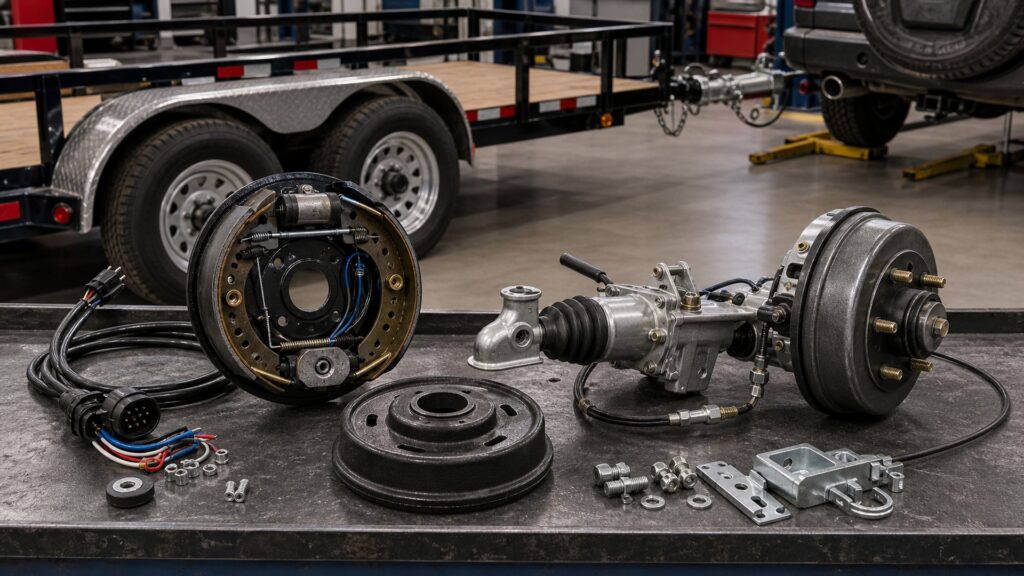
Compare what initiates braking, how force travels, which faults reduce output, and whether the driver can command the trailer independently.
Tip: During a low-speed test, identify whether weak braking begins at the command, transmission path, or wheel end. Raising gain cannot repair voltage drop; more coupler travel cannot repair air or leakage in hydraulics.
These terms separate sensing, actuation, and emergency operation.
An electromagnet energized through trailer wiring to actuate a drum-brake mechanism against rotation.
A sliding coupler assembly that converts trailer compression against the tow vehicle into hydraulic master-cylinder motion.
The controller setting scaling electrical trailer-brake output for load and road conditions.
A device or valve preventing surge-brake application when the tow vehicle pushes the trailer backward.
Independent equipment applying trailer brakes after separation through stored electrical or mechanical energy.
Loss across trailer conductors, connectors, splices, or grounds while electric brakes draw current.
Tip: Brake architecture describes the command path, not the condition of the friction hardware at each wheel.
Pedal input and controller strategy determine output; wiring carries it through the connector to parallel wheel circuits. Magnets actuate drums, or an electric-over-hydraulic pump builds fluid pressure. Gain, boost, dynamic voltage, adjustment, and axle load shape torque.
A controller display proves a request, not useful current or wheel torque.
When the tow vehicle slows, trailer inertia pushes the sliding actuator inward. The master cylinder sends pressure to wheel cylinders or calipers. Actuator friction, air, fluid leaks, hose condition, brake adjustment, and grade can change response.
The trailer creates its own command from compression at the hitch.
A conventional electric controller offers manual override for testing and limited sway intervention. Pure surge brakes respond only when the trailer pushes into the actuator, so the driver cannot ordinarily command them independently from the cab.
Independent command is a control advantage, not proof of stronger wheel brakes.
Backing uphill can compress a surge actuator, requiring a lockout or free-backing design. Long descents can keep either system hot: electric settings, engine braking, hydraulic release, wheel adjustment, and stopping strategy determine heat.
Brake architecture changes the trigger; friction still turns motion into heat.
Electric service emphasizes conductors, grounds, magnets, drums, adjustment, and controller setup. Surge service adds coupler pivots, master cylinder, fluid, lines, hoses, cylinders or calipers, and lockout. Bearings, tires, friction surfaces, and breakaway equipment remain common.
The right diagnosis begins at the system's initiating signal and ends at each tire.
Electric brakes follow an electrical request, while surge brakes derive hydraulic pressure from trailer overrun at the coupler.
Adjustable in-cab response, manual trailer control, multi-axle electrical actuation, and tow-vehicle integration are valuable and compatible wiring, controller, breakaway, and wheel hardware are maintained.
The trailer changes load often enough that gain adjustment and direct diagnostic access justify the electrical system's connector, ground, magnet, and controller dependencies.
A self-contained hydraulic response suits the trailer and tow-vehicle variety, the sliding actuator and reverse strategy are approved, and fluid, lines, coupler travel, and wheel brakes receive disciplined service.
Neither choice excuses overload, worn tires, maladjusted brakes, heat, weak friction material, missing breakaway function, unsafe following distance, or incompatibility with the trailer, tow vehicle, and applicable law.
Brake-system myths confuse the command method with stopping quality and overlook wheel-end condition.
Ordinary braking is hydraulic, but trailers can still require lighting, reverse lockout, breakaway, charging, or other electrical circuits. Equipment and legal requirements vary, so self-actuation does not mean the trailer is electrically independent.
A sound controller and circuit can respond promptly, but sensor logic, settings, voltage drop, magnet condition, adjustment, and mechanical clearance affect delay. A well-maintained surge actuator can also respond smoothly under correct geometry.
Higher command cannot restore an open magnet, resistive ground, worn shoes, contaminated drum, poor adjustment, or undersized conductor. Diagnose current and wheel hardware before using settings to mask missing mechanical output.
Coupler compression can maintain hydraulic application, especially with speed, grade, load, or dragging hardware. Fluid, friction materials, seals, bearings, and tires remain vulnerable to heat just as electric systems are.
Tip: Compare response, diagnosability, driver control, compatibility, and maintenance after confirming both systems can produce balanced friction at the loaded tires.
These answers address towing behind multiple vehicles, reversing, breakaway systems, saltwater exposure, diagnosis, and whether one architecture can be converted to the other.
Surge brakes can avoid installing a compatible controller in every tow vehicle, but each vehicle still needs the correct hitch, wiring, ratings, and legal equipment. Electric systems provide better in-cab adjustment when properly integrated.
Approved actuators use electrical or mechanical lockouts, or wheel brakes designed to release during reverse rotation. Confirm the exact design before backing; never pin the actuator out and forget to restore braking for travel.
Electric brakes commonly use a charged trailer battery and pull switch. Hydraulic surge systems may use a cable or mechanism that pressurizes and holds brakes. Test, reset, and maintain only by the exact instructions.
Hydraulic surge systems are common because they are self-contained, but water and corrosion challenge couplers, lines, calipers, wiring, connectors, bearings, and breakaway hardware. Use marine-suitable components and follow post-immersion service guidance.
Only with engineered, approved components and compliance for actuator, coupler, axle brakes, wiring, breakaway, hydraulics, controller, ratings, and certification. Conversion cost and frame changes often make replacement or specialist service more rational.
Electric trailer brakes convert a tow-vehicle controller command into wheel torque; surge brakes convert trailer overrun at a sliding coupler into hydraulic pressure.
Choose by compatibility, driver control, response, reversing, maintenance, environment, and law, then test the complete path from initiating signal to every wheel; neither architecture compensates for weak friction hardware or unstable loading.
Related explainers deepen controller setup, complete towing-system checks, and the safety equipment that must operate if the primary connection or service brakes fail.
Examine proportional and time-delayed control, gain, boost, wiring, manual override, magnets, and loaded setup for electric brakes.
Place either brake system inside measured loads, hitch ratings, cargo stability, tires, lights, chains, and departure checks.
Verify breakaway, lighting, chains, tires, wheel attachment, jacks, reflectors, and emergency readiness.
Choose a retailer
Prices checked regularly. We may earn a commission at no cost to you.