
Coupler Lock
The latch, pin, jaw, or secondary mechanism retaining the primary hitch interface after coupling.
- Correct size engagement comes first
- A padlock may provide only security
- Wear and contamination can prevent closure
Trailer safety equipment creates independent layers around failures the primary hitch or service brakes cannot prevent. A coupler lock retains the connection, chains catch a separated tongue, a breakaway system applies trailer brakes, and lighting makes the combination visible.
Other layers protect loads and roadside work: restraints stop cargo migration, sound tires and wheel attachment carry heat and impact, chocks stabilize parking, mirrors preserve sightlines, and warning devices protect a disabled rig. Chains can drag, breakaway batteries can die, lamps can corrode, tires can age while parked, and straps can loosen. Equipment must be compatible, inspected, tested, reachable, and used in a departure sequence.
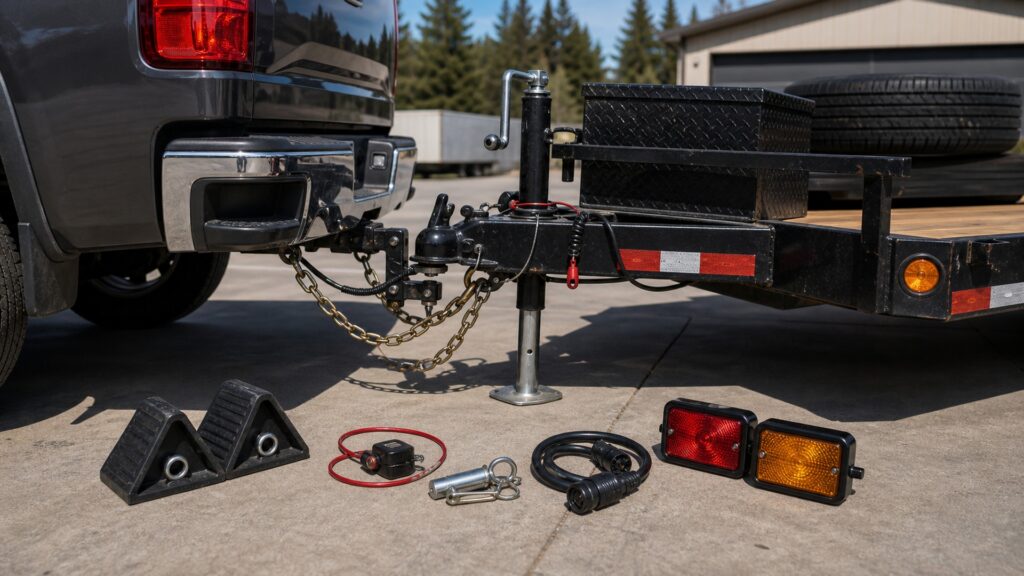
Each safety device should still work when the component it backs up has already failed.
Tip: Attach the breakaway lanyard to a point independent of the hitch component whose separation should trigger it. Looping it around a removable ball mount can remove both primary and emergency functions together.
These terms distinguish backup retention, emergency braking, visibility, and load control.
The latch, pin, jaw, or secondary mechanism retaining the primary hitch interface after coupling.
Rated secondary connections intended to retain a trailer temporarily after primary coupling separation.
A pull-triggered device commanding trailer brakes after separation from the tow vehicle.
Stored trailer energy dedicated or available to apply brakes when tow-vehicle power is lost.
Rated straps, chains, binders, nets, blocks, and anchor points preventing load movement during transport forces.
Lamps, reflectors, markings, and clean lenses that reveal trailer presence, width, direction, and braking to others.
Tip: Legal minimums vary; manufacturer instructions and the actual trailer duty can require more.
The ball or kingpin, mount, receiver, latch, pin, chains, anchors, breakaway cable, and battery form distinct layers. Correct chain length supports articulation while avoiding pavement contact; crossing practice follows equipment and legal guidance.
Redundancy disappears when every layer attaches to the same removable part.
Tail, stop, turn, marker, and license lights depend on connector pins, grounds, wiring protection, and compatible tow-vehicle logic. Reflectors remain passive backup, but dirt, cargo, damage, and poor placement can hide them.
A glowing dash indicator does not prove the trailer lamp operated.
The system must apply the trailer brakes from stored power after separation. Battery, charger, switch, cable, wiring, magnets or hydraulics, and wheel adjustment all matter; the cable should not drag or trigger during normal turns.
Service brakes working through the connector do not prove emergency operation.
Trailer tires may sit for long periods, then run near load limits in heat. Cold pressure, cracking, damage, date and service history, wheel rating, lug condition, bearing service, valve stems, and hub temperature require attention.
A perfect breakaway system cannot stabilize a failed tire or loose wheel.
Shifting loads change tongue weight and can leave the trailer. Rated anchors, edge protection, multiple restraint paths, doors, ramps, chocks, jack pads, tools, lighting, and warning devices keep transport and roadside response controlled.
The equipment list succeeds when it supports the actual departure and stop sequence.
Independent retention, braking, visibility, load, tire, and roadside layers prevent one defect from cascading.
Coupler, pin, chains, anchors, breakaway, battery, wiring, every lamp, tires, wheels, bearings, jacks, doors, ramps, and load restraints pass physical and functional checks.
Equipment remains reachable and compatible through full articulation, cargo does not obscure visibility, and an early stop is planned to inspect heat, settling, looseness, pressure, and restraint tension.
Unknown ratings, damaged couplers, dragging chains, weak anchors, dead breakaway power, faulty lights or grounds, cracked tires, loose wheels, hot bearings, shifting cargo, or unsafe jack support require repair.
No accessory kit compensates for overload, unstable tongue weight, failed brakes, missing legal equipment, poor tow-vehicle mirrors, excessive speed, dangerous weather, or roadside work beside traffic without a safe protected space.
Safety-equipment myths count objects instead of testing whether backup layers are independent and functional.
Chains provide temporary secondary retention after primary coupling failure. Correct rating, independent anchors, suitable length, routing, and intact hooks matter because decorative or dragging chains can fail when the combination most needs them.
Normal brakes may use tow-vehicle power and controller output, while breakaway depends on its own switch, attachment, stored energy, wiring, and brake condition. Test the emergency path separately by the approved procedure.
New-looking tires can be underinflated, overloaded, damaged, aged in inventory, mounted on weak valves, or attached to loose wheels. Check markings, pressure, load, date, condition, lugs, bearings, and temperature trends.
Restraint capacity depends on rated working load, direction, anchor points, edge protection, friction, load shape, and expected forces. Loads settle and straps loosen, so use a planned system and recheck early.
Tip: Judge each item by the failure it interrupts and whether it remains available after that failure occurs.
These answers address chain routing, breakaway testing, lighting faults, tire age, cargo restraints, chocks, and a compact pre-departure sequence.
Crossing can help cradle a conventional trailer tongue, but hitch type, chain geometry, local law, and manufacturer instructions control. Chains need turning length without dragging, twisting damage, weak hooks, or attachment to removable hardware.
Follow the battery, charger, trailer, and switch makers, checking before trips and at specified intervals. Verify state and actual brake application; voltage alone may not prove useful capacity under brake load.
A shared ground, connector pin, tow-vehicle fuse, module, damaged harness, or corroded junction can disable several functions. Test voltage drop and grounds under load rather than replacing every lamp without tracing the circuit.
Use rated anchors and restraints whose combined working load, direction, material, hooks, tensioners, and edge protection suit the cargo and applicable rules. Prevent forward, rearward, lateral, vertical, and rolling movement as the load demands.
Carry compatible wheel and jack tools, chocks, pressure gauge, lighting, warning devices, spare hardware allowed by the maker, communication, and weather protection. The plan must avoid lifting or repairs where traffic exposure is unsafe.
Trailer safety equipment matters because independent coupling, retention, emergency braking, visibility, tire, wheel, cargo, support, and roadside layers keep one failure from cascading into a crash.
Test the devices as systems, attach backups independently, inspect the travel-ready load, and recheck after the first miles; equipment that is dead, hidden, incompatible, or attached to the same failing component is not redundancy.
Related explainers connect trailer safety layers to the full towing workflow, brake-system architectures, and the capacity limits each tire and component must carry.
Use a departure sequence that combines weights, hitching, brakes, lighting, cargo, tires, mirrors, and early reinspection.
Compare electric and surge brake paths, including their different breakaway and reverse requirements.
Keep trailer, hitch, axle, tire, wheel, and tow-vehicle loads within the capacity every safety device assumes.
Choose a retailer
Prices checked regularly. We may earn a commission at no cost to you.