
Continuous Flow
Air, oil, or fuel movement that occurs with engine demand and passes through a filtering circuit.
- Rate changes with operation
- Pressure drives liquid circuits
- Restriction affects available supply
Engine filters and brake components both protect expensive machinery, but they act on different inputs. Filters continuously condition air, oil, or fuel by retaining contaminants as fluid passes through media. Their performance is judged through efficiency, capacity, restriction, pressure, sealing, and downstream cleanliness.
Brakes act when commanded to slow or hold the vehicle. Pedal or automated input creates hydraulic or electromechanical force, friction produces wheel torque, and kinetic energy becomes heat while tires react against the road. Their evidence centers on pressure containment, dimensions, friction condition, torque, temperature, balance, and stopping behavior. Service intervals may place both on one invoice, but their mechanisms, hazards, tests, and release criteria remain separate.
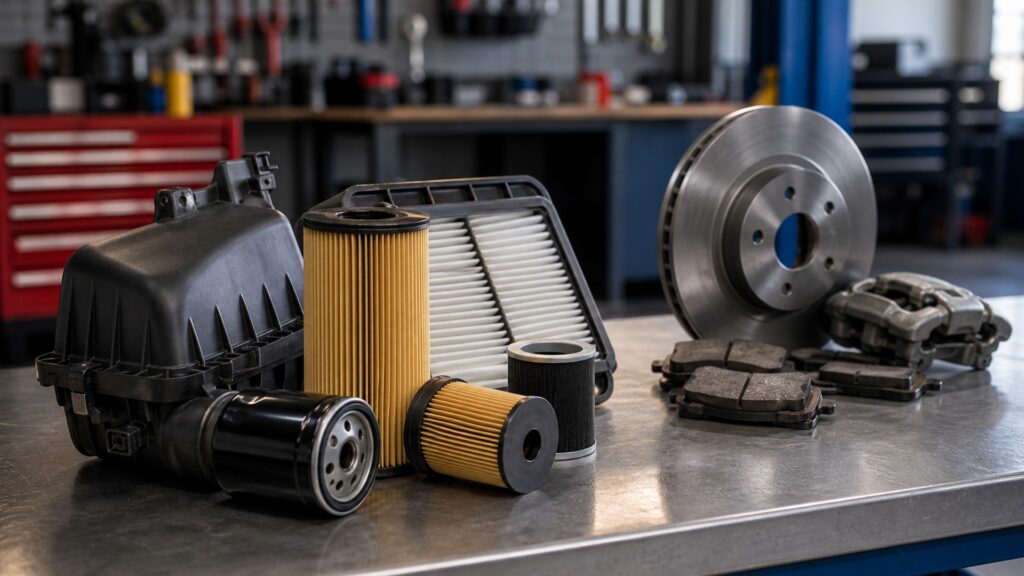
Filters protect an ongoing fluid stream; brakes create a controlled force event. The difference determines what to measure, what can fail silently, and how the repair is proven.
Tip: A filter's dark color and a brake rotor's rusty color are observations, not diagnoses; each needs specifications and functional evidence before replacement.
The terms below separate a flow-conditioning device from a force-and-energy-conversion assembly.
Air, oil, or fuel movement that occurs with engine demand and passes through a filtering circuit.
The pressure difference between a filter's inlet and outlet at a stated flow and condition.
The contaminant mass retained before the filter reaches a defined restriction or test endpoint.
The requested reduction in vehicle speed produced through friction brakes, regeneration, or coordinated control.
The rotational resistance created when pads or shoes act at an effective radius on a rotor or drum.
The ability of brake masses and airflow to absorb and reject stop energy without exceeding operating limits.
Tip: When a symptom crosses systems, return to the failed output instead of borrowing a test from whichever component is easier to reach.
Intake, lubricant, and fuel filters sit in flow paths before cylinders, bearings, pumps, or injectors. Their protective work is mostly invisible until restriction, leakage, or contamination exceeds the circuit's tolerance.
Filtration prevents exposure; it does not directly command engine output.
Brake components remain ready until the driver or an automated system requests deceleration. Hydraulics, calipers, friction pairs, and parking mechanisms then generate torque that opposes wheel motion.
Brake performance is an event response rather than continuous contaminant processing.
Filters are compared through airflow, differential pressure, efficiency, capacity, burst strength, and valve settings. Brakes use dimensions, runout, pressure, torque, temperature, deceleration, and directional behavior.
A valid measurement becomes meaningless when applied to the wrong mechanism.
Filter work may expose hot oil, pressurized fuel, sharp housings, or critical clean passages. Brake work adds supported-vehicle risk, hydraulic fluid, hazardous dust, heavy components, hot rotors, and immediate road-safety consequences.
Shared workshop space does not imply shared precautions.
After filtration work, prove sealing, fluid level, pressure or restriction, and engine behavior. After brake work, prove pedal reserve, leakage control, torque, warning status, bedding, wheel release, and repeatable deceleration.
One successful engine start cannot release a brake repair, and one clean stop cannot release a fuel leak.
Their common replacement-parts label does not merge the physical job, measurement set, service hazard, or proof required after work.
Air, oil, or fuel contamination control; media efficiency and capacity; pressure drop; clean-side sealing; bypass behavior; circuit chemistry; and downstream engine protection.
Symptoms supported by restriction, pressure, leakage, contamination, service history, housing damage, or application-specific filter evidence.
Pedal response, hydraulic pressure, parking restraint, friction wear, rotor or drum condition, wheel-end drag, brake-control faults, thermal fade, and directional stopping behavior.
Any brake uncertainty takes road-safety priority, while any fuel leak, oil-pressure loss, or open clean-side passage also requires immediate control before operation.
Confusing these systems encourages parts swapping based on maintenance proximity rather than causal evidence.
Filters may load with contamination while brake friction material loses thickness, but their rates, failure effects, measurements, and replacement triggers differ. Aging seals, valves, hydraulics, housings, rotors, and controls also matter beyond consumable media.
Warnings reflect monitored conditions and may persist when the cause is wiring, sensors, pressure, leakage, voltage, software, or another component. Diagnose and verify the fault; do not use part installation as a clearing strategy.
Filter color does not quantify restriction, and brake dust or surface rust does not establish remaining dimensions or torque behavior. Use exact limits, condition-specific inspection, and functional measurements before deciding.
A schedule can place several services at the same mileage, but it does not change how each component works. Follow separate procedures, specifications, contamination controls, hazards, and post-service checks for each circuit.
Tip: Give each category one home: filtration owns contamination and flow conditioning; braking owns commanded deceleration and restraint.
These answers address cross-system symptoms, inspection evidence, combined service visits, and which fault takes priority.
Dragging calipers or parking hardware can increase rolling resistance and heat, making the engine work harder. Confirm abnormal wheel temperature and release, then repair the brake cause rather than assuming an engine-filter restriction.
Usually not directly, though low oil pressure, stalling, vacuum-assist faults, voltage problems, or network conditions can influence vehicle behavior and warnings. Read the exact codes and test the implicated systems rather than infer.
Control the highest immediate hazard: compromised stopping, fuel leakage, or lubrication-pressure loss can all prevent safe operation. After triage, plan each repair by access, contamination control, parts availability, and verification needs.
Yes, if equipped with the correct training, service information, tools, lifting practices, fluid handling, diagnostic capability, and verification procedures. Competence in routine filters does not automatically establish competence in hydraulic brakes.
Record separate complaints, inspections, measurements, parts, fluids, torque values, pressure or restriction results, brake verification, engine verification, and unresolved findings. Distinct documentation prevents one completed task from masking another failed gate.
Engine filters condition continuous air, oil, or fuel flow; brake components create commanded deceleration and parking restraint.
Because the mechanisms differ, use restriction, capacity, pressure, and sealing evidence for filters, while using hydraulic, dimensional, thermal, torque, and stopping evidence for brakes. Verify both independently when a service visit includes each.
Related explainers provide the detailed filtration path, the detailed brake path, and a diagnostic decision process for choosing the component family that owns the failed output.
Trace contamination through air, oil, and fuel media while accounting for capacity, restriction, bypass, and seals.
Trace pedal or control input through hydraulics, friction torque, heat, and tire-road force.
Choose the repair path by event timing, safety triage, measurements, codes, and repeatable function.
Choose a retailer
Prices checked regularly. We may earn a commission at no cost to you.