
Deceleration Complaint
A reported failure to slow, stop straight, hold, or provide expected pedal response under defined conditions.
- Speed and load affect severity
- Tire grip remains part of stopping
- Safety triage comes first
Use brake components when the failed function is deceleration, holding the parked vehicle, hydraulic pressure, wheel-end friction, or brake-control response. Pedal travel, fluid leakage, pulling during braking, grinding tied to wheel rotation, repeated-stop fade, brake drag, and brake-system warnings belong on that diagnostic path.
Use engine filters when evidence points to contamination control or flow in the intake, lubrication, or fuel circuit: measured restriction, abnormal pressure across the filter, contaminated media, housing leakage, a service interval, or debris exposure. Do not choose between categories from a dashboard icon or maintenance schedule alone. Define the failed output, test its path, and replace only parts that the evidence implicates.
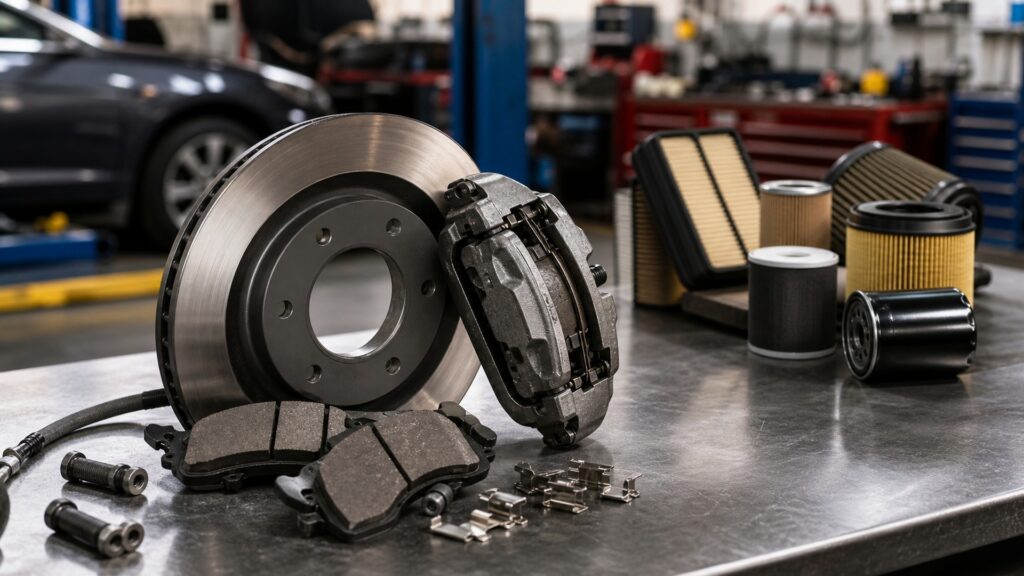
The decision starts by linking the complaint to braking force or filtered engine flow, then confirming that link with system-specific inspection and measurement.
Tip: If pedal feel, stopping direction, or visible brake leakage is abnormal, stop driving and inspect the brake path before pursuing routine engine maintenance.
These terms distinguish the outputs that direct a repair toward brakes or filtration.
A reported failure to slow, stop straight, hold, or provide expected pedal response under defined conditions.
The distance and firmness experienced as the brake command builds hydraulic or electromechanical force.
Temperature produced by normal braking or abnormal drag at a caliper, rotor, drum, bearing, or tire area.
Pressure loss through the engine air-cleaning path as airflow demand rises.
A valve route that preserves oil flow when filter pressure drop becomes excessive under defined conditions.
A measurement or inspection that connects the symptom to the component's failed function before replacement.
Tip: A maintenance reminder identifies scheduled work; it does not prove that the reminded component explains a new symptom.
A complaint appearing while the pedal is applied, the parking brake is used, or the vehicle is slowing points toward brakes, tires, suspension, bearings, or controls. Timing narrows the path before parts are selected.
The event that triggers the symptom is often more useful than the sound's adjective.
Brake-fluid loss, a sinking pedal, metal contact, severe pull, smoke, or an overheated wheel can indicate immediate loss of margin. The vehicle should not continue to normal road testing until those findings are controlled.
Safety triage sets the sequence even when an engine service is also due.
Engine-filter problems more often follow airflow, oil circulation, fuel delivery, contamination exposure, temperature, or service history. They require the correct pressure, restriction, media, housing, or fluid checks for that circuit.
A dirty-looking element is not universal proof that it caused the driveability complaint.
Brake, ABS, stability, oil-pressure, engine, and maintenance indicators come from different modules and thresholds. Low system voltage or shared network faults can create multiple warnings that require orderly diagnosis.
Scanning begins the test plan; it does not end it.
After brake work, verify pedal, leakage, warnings, torque, bedding, and controlled stopping. After filter work, verify sealing, pressure or restriction, leaks, engine response, and absence of introduced contamination.
A cleared reminder is not proof that either system now works correctly.
Brake parts belong to a verified deceleration or restraint fault; engine filters belong to a verified contamination-control or flow need.
Evidence centers on pedal reserve, hydraulic containment, friction wear, wheel-end drag, parking restraint, brake-control faults, or deceleration that changes during a braking event.
Exact brake inspection identifies a below-limit, damaged, seized, leaking, contaminated, or incorrectly fitted component that explains the complaint.
The required work is scheduled air, oil, or fuel filtration service, or measurements show excessive restriction, pressure-drop, bypass, contamination, leakage, or compromised sealing in that circuit.
Both paths can be necessary, and neither category should be used to cover uncertain diagnosis, unsafe road testing, or an unrelated warning triggered by voltage, wiring, sensors, pumps, tires, or other hardware.
The common mistake is treating a service item as a likely cure simply because it is easy to replace.
The lamp reports an emissions-related monitored fault, not a filter verdict. Read codes and data, inspect intake sealing and sensors, measure restriction when relevant, and test fuel, ignition, mechanical, or electrical causes indicated.
Noise can arise from wear indicators, rotor corrosion, hardware, bearings, shields, debris, friction material, or installation. Inspect both wheel ends and measure components before ordering parts, especially if pedal or stopping behavior changed.
Reminders usually track time, mileage, algorithms, or recorded service. They prompt scheduled work but do not establish causation. Diagnose a new performance or safety symptom independently, even when service is simultaneously due.
Diagnostic data may localize a monitored circuit, but mechanical wear, hydraulic leaks, restriction, contamination, and fitment still need physical tests. Codes can also be secondary to voltage, wiring, or communication faults.
Tip: Preserve diagnostic order: define the symptom, control the hazards, test the responsible system, then choose the exact component and verification method.
These answers address overlapping symptoms, service timing, codes, and cases where both categories need work.
Not usually through the brake friction system, though engine-vacuum assist on some vehicles can change with engine or booster faults. Diagnose assist and hydraulic behavior directly rather than replacing an air filter by association.
Yes. A seized caliper or parking mechanism can make acceleration sluggish and create heat or odor. Compare wheel temperatures safely, inspect free rotation and friction wear, and correct the brake cause before extended driving.
Inspect and service each by its own schedule, condition, and specifications. Overdue filters do not reduce the urgency of a brake defect; unsafe braking should be controlled before routine road operation or performance diagnosis.
Brakes use pedal behavior, leak inspection, pad and rotor dimensions, temperatures, hydraulic tests, and chassis data. Filters use restriction, differential pressure, oil or fuel pressure, media condition, sealing, and circuit-specific engine data.
Use qualified help when braking is unpredictable, hydraulic work is required, high heat or leakage exists, the vehicle needs lifting, fuel systems hold pressure, diagnostics conflict, or exact procedures and specifications are unavailable.
Use brake components instead of engine filters when evidence identifies a failure in deceleration, restraint, hydraulics, friction, or wheel-end brake control.
Choose filtration work for documented air, oil, or fuel contamination-control and flow needs. If the symptom is ambiguous, measure both relevant paths rather than substituting a familiar service item for diagnosis.
Related explainers provide the brake mechanism, operating limits, and cross-system comparison needed to separate stopping faults from engine-filtration evidence.
Map pedal demand into hydraulic pressure, friction torque, heat, and tire force before selecting brake parts.
Use clamp force, friction, geometry, temperature, and tire adhesion to interpret weak or inconsistent stopping.
Follow air, oil, and fuel through their filter media, seals, pressure drops, and bypass controls.
Choose a retailer
Prices checked regularly. We may earn a commission at no cost to you.