
Filter Media
Porous fiber or synthetic structure that intercepts contaminants while permitting required air or liquid flow.
- Pleats increase working area
- Loading raises flow resistance
- Supports prevent collapse
Engine filters and vehicle batteries protect operation in different ways. A filter conditions moving air or liquid by capturing particles, separating selected contaminants, preserving acceptable pressure loss, and sealing the cleaned stream from an unfiltered shortcut. Its job occurs while the engine circuit flows.
A battery stores energy electrochemically and supplies voltage and current when the starter, electronics, accessories, or traction motors demand it. Its condition is judged through architecture-specific charge, capacity, resistance, load, temperature, and charging evidence. Both can cause poor performance or warnings, but restriction and contamination do not diagnose a battery, while voltage and cranking tests do not prove a filter's flow or seal.
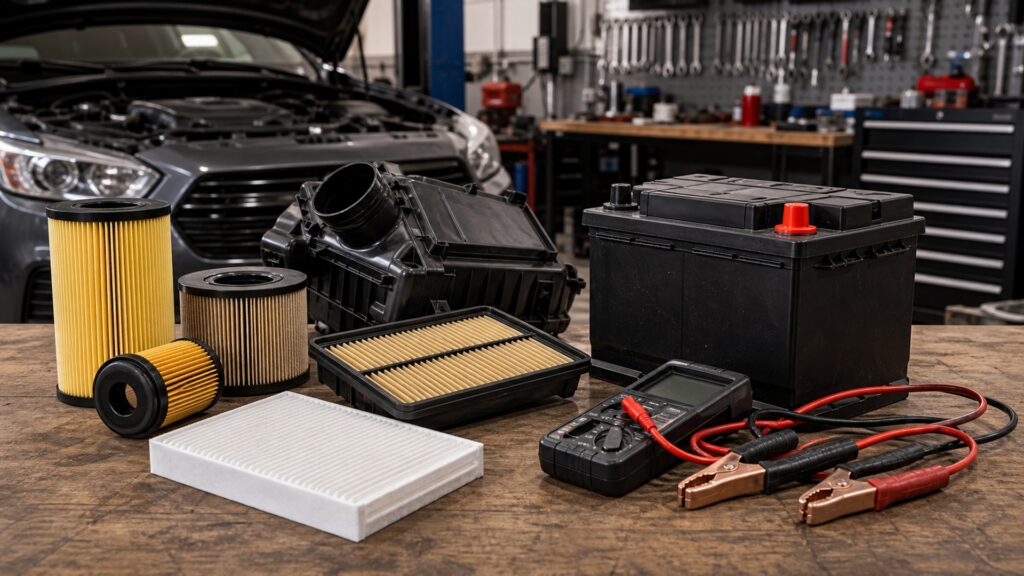
The comparison turns on what moves through the component, what is retained, which limits matter, and how the repaired output is measured.
Tip: Identify whether the vehicle has a conventional low-voltage battery, a high-voltage traction battery, or both before choosing test equipment or approaching exposed conductors.
These terms distinguish filtration performance from electrical storage and delivery.
Porous fiber or synthetic structure that intercepts contaminants while permitting required air or liquid flow.
The loss in pressure across a filter at a stated fluid condition and flow rate.
The interface preventing unfiltered fluid from bypassing media into protected downstream passages.
An electrochemical unit that develops voltage and stores energy through reversible or nonreversible chemical reactions.
An estimate of the usable energy presently retained within a rechargeable battery's protected operating range.
Opposition within a battery that produces voltage drop and heat when current flows under load.
Tip: Do not use one system's maintenance reminder as evidence against the other; begin with the failed output and its own measurement set.
Air, lubricant, or fuel crosses media because suction or pressure drives flow. Particles remain within or upon the element until its capacity or restriction endpoint, while seals keep the clean outlet isolated.
A filter stores debris, not operating energy.
Electrochemical cells support cranking and low-voltage electronics or, in traction packs, propulsion through power electronics. Connections, temperature, state of charge, cell balance, and internal resistance determine usable delivery.
A battery releases current without filtering the circuit it powers.
Filter problems may follow engine demand, cold oil, contaminated fuel, damaged media, or seal leakage. Battery problems may appear as slow cranking, reset modules, low reserve, imbalance, isolation faults, or charge acceptance limits.
Similar sluggishness can originate from entirely different energy paths.
Cold thickens oil and raises filter differential pressure, while battery chemistry may deliver less current. Heat can weaken filter materials and seals, accelerate battery aging, or require active traction-pack cooling.
The same ambient temperature changes each system through a different mechanism.
Filter service ends with correct fluid level, pressure or restriction, sealing, leakage, and engine operation. Battery service ends with safe connection, voltage, current, capacity or conductance, charging, insulation, and architecture-specific checks.
An engine start is useful evidence, but it does not fully release either repair.
Filters retain contamination while passing working fluid; batteries retain chemical energy while delivering electrical power.
Media condition, pressure drop, restriction, capacity, bypass behavior, housing integrity, sealing, fluid compatibility, service interval, and downstream cleanliness.
An exact air, oil, or fuel circuit whose measured flow or contamination-control function is outside its documented limit.
Voltage architecture, state of charge, internal resistance, cranking or traction power, reserve, cell balance, temperature, connections, charging behavior, and electrical isolation.
Neither system should be condemned by a shared warning, an overdue reminder, or a visual impression when related sensors, pumps, wiring, grounds, fluids, controls, and mechanical loads remain untested.
Category labels make filters and batteries sound like comparable consumables even though they manage different matter and energy.
Battery voltage cannot remove intake restriction, restore oil flow through unsuitable media, or clean contaminated fuel. It may improve cranking speed, but the filter circuit still needs its own pressure, restriction, sealing, and fitment evidence.
Air, oil, or fuel filtration rarely explains starter voltage collapse. Test battery delivery, cable voltage drop, starter current, charging performance, and engine mechanical resistance before crediting a scheduled filter with an electrical starting fault.
Time matters, yet filters respond to contaminant exposure, flow, and service conditions, while batteries respond to cycling, temperature, charge history, chemistry, and electrical load. Exact measurements remain more useful than birthdays alone.
Traction batteries contain hazardous voltage, mass, thermal, and chemical energy requiring vehicle-specific isolation, protective equipment, and training. Routine filter experience does not qualify a person to open or probe a high-voltage enclosure.
Tip: Return every claim to the working medium, governing limit, and confirmation test before choosing a replacement.
These answers address overlapping symptoms, service timing, electrical architecture, and why successful starting does not prove both systems healthy.
Low voltage can disrupt sensor readings or module operation, but it cannot prove filter restriction or leakage. Stabilize electrical supply, capture codes and data, then test the relevant air, oil, or fuel circuit.
Not directly in normal operation, though repeated hard starting caused by fuel or airflow faults can consume charge. Diagnose the starting duration, parasitic draw, charging system, battery condition, and engine fault separately.
Control immediate hazards first: oil-pressure loss, fuel leakage, battery overheating, electrical arcing, or isolation warnings can all prevent operation. Then test the function most closely tied to the reported event.
Many hybrids retain engine air, oil, and sometimes fuel filters alongside low-voltage and traction batteries. Each follows separate schedules, cooling needs, safety procedures, diagnostic data, and proof despite sharing one vehicle.
Keep part numbers, dates, mileage, filter pressure or restriction findings, fluid details, battery test values, temperature, charging results, diagnostic codes, installation notes, and final verification. Trends prevent unrelated maintenance from being mistaken for repair.
Engine filters condition moving air, oil, or fuel by trapping contamination and controlling pressure loss; vehicle batteries store chemical energy and supply electrical power.
Choose tests and safety procedures from the failed output. Verify filter flow and sealing separately from battery delivery, charging, capacity, connection, and isolation, even when both parts are serviced during one visit.
Related explainers expand the filtration mechanism, battery-adjacent engine context, and diagnostic discipline needed when poor performance crosses mechanical and electrical systems.
Follow air, oil, and fuel across media, seals, pressure drops, loading, and intentional bypass controls.
Place batteries, starting, combustion, lubrication, airflow, pumps, and controls within the engine system.
Use codes and live data as test directions rather than automatic component verdicts.
Choose a retailer
Prices checked regularly. We may earn a commission at no cost to you.