
Floor Jack
A wheeled low-profile jack using hydraulic force and a lifting arm to raise a remote saddle.
- The chassis reaches under low lift points
- Casters accommodate saddle arc motion
- A smooth firm floor is important
A floor jack carries its hydraulic cylinder in a long, low rolling chassis and raises a saddle through a linkage. A bottle jack stands its cylinder upright and extends a ram directly. The first architecture reaches beneath low vehicles and lets the jack roll as the saddle arcs; the second concentrates high capacity in a small footprint but needs vertical clearance and careful alignment.
Neither design is a support stand. A floor jack suits a level garage where casters can track. A bottle jack works under tall frame vehicles on a fully supported base, but tolerates little side load and may not fit beneath a flat tire. Choose from the lift point, failed-condition height, travel, surface, load, and support plan.
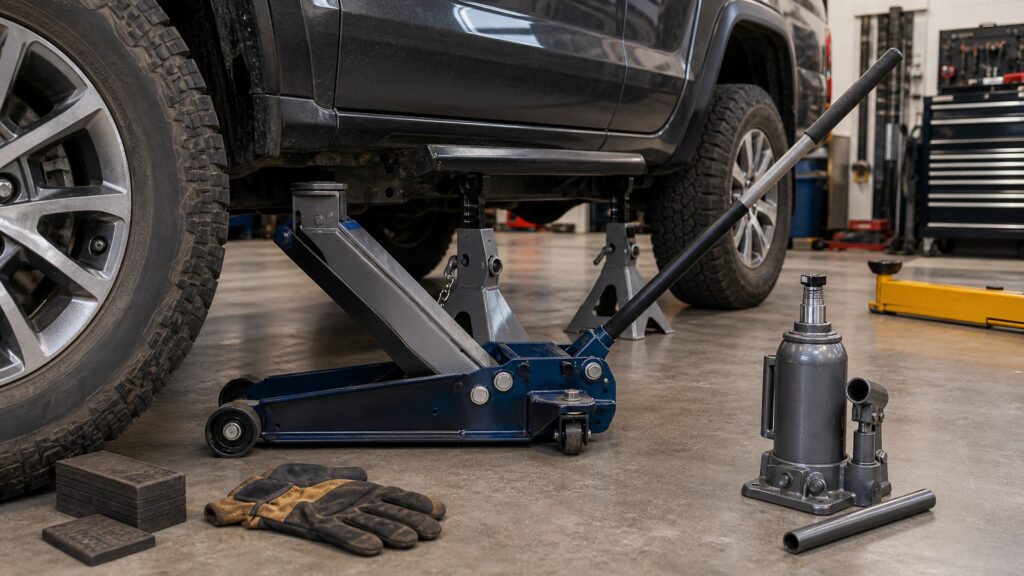
The useful comparison begins with where the saddle must enter, how it moves while rising, and whether the surface can support the jack's intended motion.
Tip: Measure clearance with the tire deflated if roadside service is part of the plan. The jack that fits a healthy vehicle may be impossible to position after the failure it is meant to solve.
These terms expose the geometry hidden behind capacity labels.
A wheeled low-profile jack using hydraulic force and a lifting arm to raise a remote saddle.
An upright hydraulic cylinder whose ram rises near vertically from a compact base.
The lowest working height of the jack contact before lifting begins under load.
The curved path followed by a floor-jack saddle as its arm rotates upward.
The vertical travel available from a bottle jack's hydraulic piston and any threaded screw extension.
Force acting across rather than along the jack's intended lifting axis.
Tip: Compare each jack at the required starting and finishing height, not at its catalog extremes alone.
The floor jack can reach a crossmember or differential inset from the body edge while the operator remains outside. Its low nose fits many cars, and the wide chassis resists tipping, but its wheels and body demand a firm unobstructed floor.
Low profile matters only if the saddle can reach the approved point without the chassis contacting the vehicle.
A bottle jack's straight hydraulic column can lift heavy loads efficiently and packs into a truck or trailer. The narrow base and tall starting height make soft ground, off-center saddles, axle movement, or vehicle roll more consequential.
The same compactness that aids transport leaves less footprint to forgive misalignment.
As a floor-jack arm rises, the saddle moves horizontally relative to the chassis, so the casters normally roll. A bottle jack expects its load path to remain nearly vertical; suspension swing or vehicle movement can impose damaging lateral force.
Ground friction and suspension motion are part of jack selection.
A bottle jack is easier to carry, but gravel, soil, slope, and a collapsed tire can make it unstable or too tall. A floor jack may fit lower yet be too heavy, bulky, or unable to roll on rough terrain.
The better garage jack may be the worse emergency jack, and vice versa.
Once high enough, the vehicle must transfer to approved stands or a locked lift before underbody work. The jack's maximum extension is not a target; greater height can reduce stability and may still leave no correct support-point access.
A comparison of jacks never replaces a support strategy.
Floor jacks excel at low reach on smooth floors; bottle jacks excel at compact vertical lifting when clearance and axial alignment are available.
Use a floor jack for low or recessed points, frequent garage work, and controlled rolling on a firm level slab with room for its chassis and handle.
Use a bottle jack for tall accessible points and portable high-capacity needs where the base is fully supported, the ram remains vertical, and the starting clearance survives a flat tire.
Neither jack supports a person beneath the vehicle, compensates for an unapproved lift point, tolerates improvised stacked extensions, or makes a soft, sloped, damaged, or obstructed surface acceptable.
Capacity alone cannot establish fit: minimum height, reach, lift travel, saddle shape, support placement, vehicle restraint, hydraulic condition, and center-of-gravity change remain separate gates.
Jack myths turn compactness, wheel count, or capacity into universal claims while ignoring the actual lifting path.
The ram moves vertically, but the vehicle and suspension can move laterally. A narrow base, off-center saddle, soft ground, or shifting axle can side-load the column, so axial alignment and restraint remain critical.
Casters allow the chassis to follow the saddle's lifting arc on a suitable floor. Preventing that designed motion can pull the contact sideways; instability instead comes from poor surface, damage, wrong placement, or vehicle movement.
More capacity does not guarantee lower entry, greater reach, suitable saddle geometry, accurate low-load control, enough travel, or safe storage. Choose a rating with margin only after the complete geometry and duty are correct.
Its portability helps, but a deflated tire can eliminate starting clearance and a shoulder may not support the small base. The vehicle's supplied procedure and equipment remain the baseline; unsafe locations require roadside assistance.
Tip: Sketch the point, jack, surface, and motion from fully loaded starting height to stable support before choosing either architecture.
These answers cover low-profile needs, lifting speed, storage, extensions, maintenance, and how to decide whether carrying both designs adds useful capability.
A true low-profile floor jack often provides the required entry and reach, but confirm the loaded saddle height, chassis clearance, approved point, and final support access. Never drive onto improvised objects merely to fit a jack.
Pump geometry, load, handle stroke, air purge, extension screw, and required height determine speed. A bottle jack can take up clearance quickly with its screw; a floor jack's long handle may move more fluid per stroke.
Only if the equipment and vehicle procedures allow an engineered support solution suitable for the load and surface. Random lumber can split, tilt, crush, or stack unstably; never use concrete blocks or improvised height towers.
Follow its manual for fluid, bleeding, lubrication, inspection, storage orientation, and seal service. Remove equipment with leaks, bent parts, damaged casters, cracked welds, poor valve control, or uncertain modification from use.
It can for a workshop handling varied vehicles, because low reach and compact vertical capacity solve different access problems. For one vehicle, redundancy matters only if both fit approved points and the support plan remains complete.
Floor jacks use a low rolling chassis and lifting arm to reach recessed points; bottle jacks use a compact upright ram that needs more starting height and stricter axial support.
Select from the failed-condition clearance, point reach, surface, motion, travel, saddle, restraint, and support strategy—not capacity or portability alone—and never work beneath either jack without approved positive support.
Related explainers connect the architecture choice to the full load path, safe bay, and complete tool workflow.
Build the complete vehicle-to-floor load path and account for support points, wheel restraint, changing center of gravity, and descent.
Control PPE, lighting, floor condition, spills, fire, and exclusion zones around the lifting operation.
Choose saddles, adapters, stands, chocks, and hand tools by the exact interface and force rather than by apparent fit.
Choose a retailer
Prices checked regularly. We may earn a commission at no cost to you.